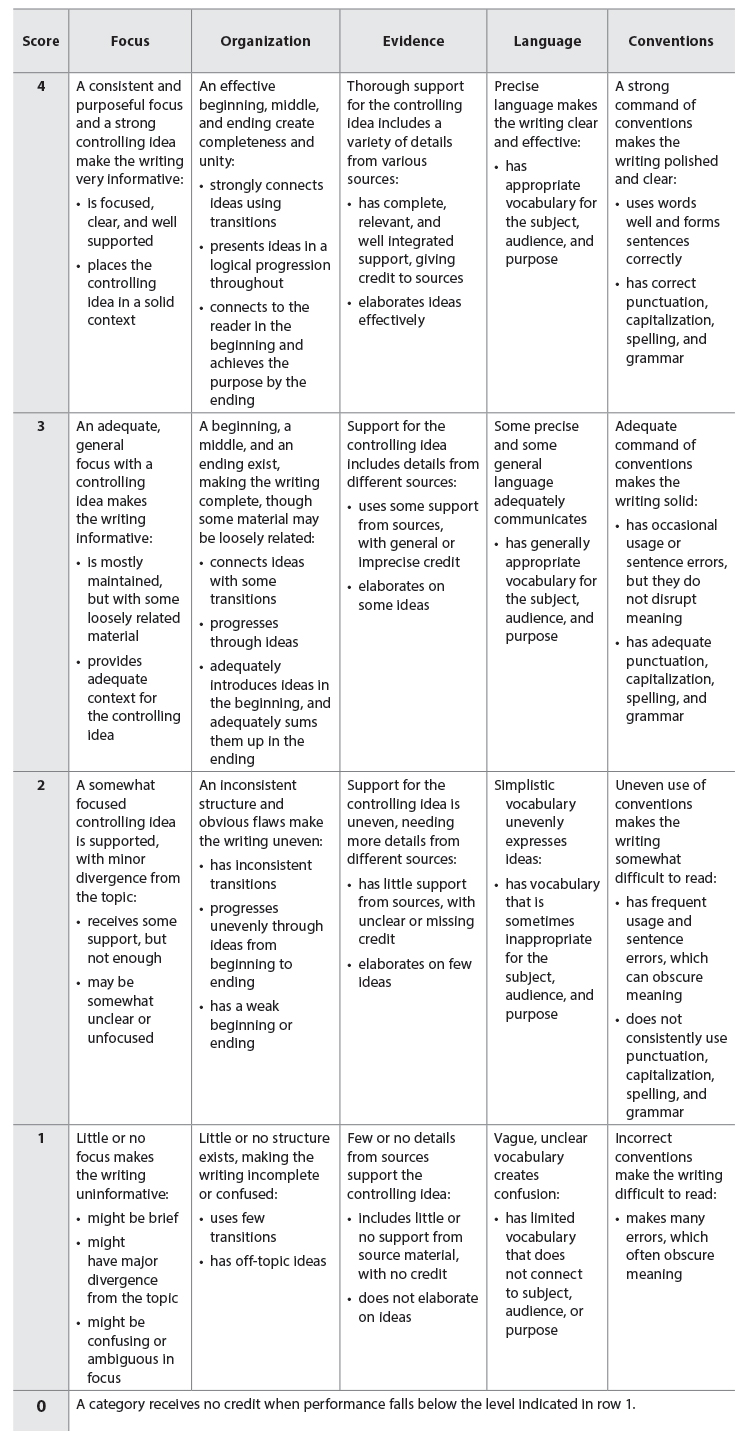
4 | A consistent and purposeful focus and a strong controlling idea make the writing very informative: • is focused, clear, and well supported • places the controlling idea in a solid context | An effective beginning, middle, and ending create completeness and unity: • strongly connects ideas using transitions • presents ideas in a logical progression throughout • connects to the reader in the beginning and achieves the purpose by the ending | Thorough support for the controlling idea includes a variety of details from various sources: • has complete, relevant, and well integrated support, giving credit to sources • elaborates ideas effectively | Precise language makes the writing clear and effective: • has appropriate vocabulary for the subject, audience, and purpose | A strong command of conventions makes the writing polished and clear: • uses words well and forms sentences correctly • has correct punctuation, capitalization, spelling, and grammar |
3 | An adequate, general focus with a controlling idea makes the writing informative: • is mostly maintained, but with some loosely related material • provides adequate context for the controlling idea | A beginning, a middle, and an ending exist, making the writing complete, though some material may be loosely related: • connects ideas with some transitions • progresses through ideas • adequately introduces ideas in the beginning, and adequately sums them up in the ending | Support for the controlling idea includes details from different sources: • uses some support from sources, with general or imprecise credit • elaborates on some ideas | Some precise and some general language adequately communicates • has generally appropriate vocabulary for the subject, audience, and purpose | Adequate command of conventions makes the writing solid: • has occasional usage or sentence errors, but they do not disrupt meaning • has adequate punctuation, capitalization, spelling, and grammar |
2 | A somewhat focused controlling idea is supported, with minor divergence from the topic: • receives some support, but not enough • may be somewhat unclear or unfocused | An inconsistent structure and obvious flaws make the writing uneven: • has inconsistent transitions • progresses unevenly through ideas from beginning to ending • has a weak beginning or ending | Support for the controlling idea is uneven, needing more details from different sources: • has little support from sources, with unclear or missing credit • elaborates on few ideas | Simplistic vocabulary unevenly expresses ideas: • has vocabulary that is sometimes inappropriate for the subject, audience, and purpose | Uneven use of conventions makes the writing somewhat difficult to read: • has frequent usage and sentence errors, which can obscure meaning • does not consistently use punctuation, capitalization, spelling, and grammar |
1 | Little or no focus makes the writing uninformative: • might be brief • might have major divergence from the topic • might be confusing or ambiguous in focus | Little or no structure exists, making the writing incomplete or confused: • uses few transitions • has off-topic ideas | Few or no details from sources support the controlling idea: • includes little or no support from source material, with no credit • does not elaborate on ideas | Vague, unclear vocabulary creates confusion: • has limited vocabulary that does not connect to subject, audience, or purpose | Incorrect conventions make the writing difficult to read: • makes many errors, which often obscure meaning |