Closely Reading Literature and Poetry
Start your close read by carefully working through the text. Then, you can analyze the work by thinking about the parts of it. You've seen how the 5 W's and H relate to the key parts of any story. Now you'll use these parts to analyze a piece of literature.
Reading Literature
You can analyze literature by focusing on these common elements of stories:
- Characters Who are the main people involved? Are they protagonists (struggling for something) or antagonists (struggling against something) or supporting characters?
- Setting Where and when does the literature take place? How do the place and time affect what is happening in the story?
- Conflict What is the problem that the character faces? How does the conflict arise from the person's desires and fears?
- Plot What series of events brings the character into confrontation with the conflict? Does the character succeed? How do the events change the person?
- Theme What does the literature have to say about life in general? What is the deeper meaning of the work?
You'll find these elements not just in works of fiction but also in biography and historical nonfiction. For example, the following reflection by Mark Twain contains all of these elements to one degree or another. Think about them as you read the literature and prepare to answer questions about each part afterward.
Read literature closely.
Closely read the following biographical reflection by novelist and riverboat pilot Mark Twain. Then analyze the literature by answering the questions.
Listen to "Two Ways of Seeing a River"
Hide audio
Two Ways of Seeing a River
by Mark Twain
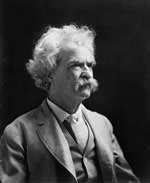
Mark Twain, who served as a riverboat pilot on the Mississippi from 1857 to 1861 (Library of Congress)
Now when I had mastered the language of this water and had come to know every trifling feature that bordered the great river as familiarly as I knew the letters of the alphabet, I had made a valuable acquisition. But I had lost something, too. I had lost something which could never be restored to me while I lived. All the grace, the beauty, the poetry had gone out of the majestic river! I still keep in mind a certain wonderful sunset which I witnessed when steamboating was new to me. A broad expanse of the river was turned to blood; in the middle distance the red hue brightened into gold, through which a solitary log came floating, black and conspicuous; in one place a long, slanting mark lay sparkling upon the water; in another the surface was broken by boiling, tumbling rings, that were as many-tinted as an opal; where the ruddy flush was faintest, was a smooth spot that was covered with graceful circles and radiating lines, ever so delicately traced; the shore on our left was densely wooded, and the sombre shadow that fell from this forest was broken in one place by a long, ruffled trail that shone like silver; and high above the forest wall a clean-stemmed dead tree waved a single leafy bough that glowed like a flame in the unobstructed splendor that was flowing from the sun.
There were graceful curves, reflected images, woody heights, soft distances; and over the whole scene, far and near, the dissolving lights drifted steadily, enriching it, every passing moment, with new marvels of coloring.
I stood like one bewitched. I drank it in, in a speechless rapture. The world was new to me, and I had never seen anything like this at home. But as I have said, a day came when I began to cease from noting the glories and the charms which the moon and the sun and the twilight wrought upon the river's face; another day came when I ceased altogether to note them. Then, if that sunset scene had been repeated, I should have looked upon it without rapture, and should have commented upon it, inwardly, in this fashion: "This sun means that we are going to have wind to-morrow; that floating log means that the river is rising, small thanks to it; that slanting mark on the water refers to a bluff reef which is going to kill somebody's steamboat one of these nights, if it keeps on stretching out like that; those tumbling 'boils' show a dissolving bar and a changing channel there; the lines and circles in the slick water over yonder are a warning that that troublesome place is shoaling up dangerously; that silver streak in the shadow of the forest is the 'break ' from a new snag, and he has located himself in the very best place he could have found to fish for steamboats; that tall dead tree, with a single living branch, is not going to last long, and then how is a body ever going to get through this blind place at night without the friendly old landmark?"
No, the romance and the beauty were all gone from the river. All the value any feature of it had for me now was the amount of usefulness it could furnish toward compassing the safe piloting of a steamboat. Since those days, I have pitied doctors from my heart. What does the lovely flush in a beauty's cheek mean to a doctor but a "break" that ripples above some deadly disease? Are not all her visible charms sown thick with what are to him the signs and symbols of hidden decay? Does he ever see her beauty at all, or doesn't he simply view her professionally, and comment upon her unwholesome condition all to himself? And doesn't he sometimes wonder whether he has gained most or lost most by learning his trade?
- Describe the main character (the "I" in this biographical reflection). How old is the person? What does the person want and fear?
- Where and when is this reflection set? How much time has passed since the original event?
- What conflicts lie within this reflection? How do these conflicts relate to Twain's own desires and fears?
- This reflection does not contain much plot (in the sense of a series of events). However, it implies the progress of the writer's life from youth to age. How is the pilot's life significant to the meaning of the reflection?
- Based upon your observations about character, setting, conflict, and plot, what larger theme about life would you infer from this reading?
Teaching Tip
Remind students that they can use the familiar 5 W's and H to remember the key parts of a story: Who (characters), What (conflict), Where and When (setting), Why (theme), and How (plot)?
Reading Poetry
You can analyze any poem by thinking about the following elements:
- Words What words stand out? What connotations do the words have? What denotations do they have?
- Sounds What vowels are prominent? What consonants? How does the poet use rhythm? Rhyme?
- Images What do you see, hear, smell, taste, and touch? What symbolism exists in the poem?
- Thoughts What reflections, realizations, and predictions does the poet relate?
- Emotions What feelings are expressed (mood and tone)? What does the reader feel?
You'll find these elements not just in traditional poetry (with regular rhythm and rhyme) but also with free-verse works. For example, you will find these elements in the nontraditional poetry below.
Closely read poetry.
Closely read the following two sections from "Song of Myself" by Walt Whitman. Then analyze the poem by reflecting on words, sounds, images, thoughts, and emotions.
Listen to "Excerpt from 'Song of Myself' "
Hide audio
Excerpt from "Song of Myself"
by Walt Whitman
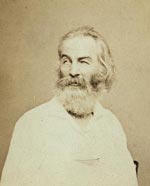
Walt Whitman, poet and contemporary of Mark Twain, who served as a nurse during the Civil War (Library of Congress)
1
I celebrate myself, and sing myself,
And what I assume you shall assume,
For every atom belonging to me as good belongs to you.
I loafe and invite my soul,
I lean and loafe at my ease observing a spear of summer grass.
My tongue, every atom of my blood, form’d from this soil, this air,
Born here of parents born here from parents the same, and their parents the same,
I, now thirty-seven years old in perfect health begin,
Hoping to cease not till death.
Creeds and schools in abeyance,
Retiring back a while sufficed at what they are, but never forgotten,
I harbor for good or bad, I permit to speak at every hazard,
Nature without check with original energy.
2
Houses and rooms are full of perfumes, the shelves are crowded with perfumes,
I breathe the fragrance myself and know it and like it,
The distillation would intoxicate me also, but I shall not let it.
The atmosphere is not a perfume, it has no taste of the distillation, it is odorless,
It is for my mouth forever, I am in love with it,
I will go to the bank by the wood and become undisguised and naked,
I am mad for it to be in contact with me.
The smoke of my own breath,
Echoes, ripples, buzz’d whispers, love-root, silk-thread, crotch and vine,
My respiration and inspiration, the beating of my heart, the passing of blood and air through my lungs,
The sniff of green leaves and dry leaves, and of the shore and dark-color’d sea-rocks, and of hay in the barn,
The sound of the belch’d words of my voice loos’d to the eddies of the wind,
A few light kisses, a few embraces, a reaching around of arms,
The play of shine and shade on the trees as the supple boughs wag,
The delight alone or in the rush of the streets, or along the fields and hill-sides,
The feeling of health, the full-noon trill, the song of me rising from bed and meeting the sun.
Have you reckon’d a thousand acres much? have you reckon’d the earth much?
Have you practis’d so long to learn to read?
Have you felt so proud to get at the meaning of poems?
Stop this day and night with me and you shall possess the origin of all poems,
You shall possess the good of the earth and sun, (there are millions of suns left,)
You shall no longer take things at second or third hand, nor look through the eyes of the dead, nor feed on the spectres in books,
You shall not look through my eyes either, nor take things from me,
You shall listen to all sides and filter them from your self.
- Words What words stand out? What connotations do the words have? What denotations do they have?
- Sounds What vowels are prominent? What consonants? How does the poet use rhythm? Rhyme?
- Images What do you see, hear, smell, taste, and touch? What symbolism exists in the poem?
- Thoughts What reflections, realizations, and predictions does the poet relate?
- Emotions What feelings are expressed (mood and tone)? What does the reader feel?
Teaching Tip
Each of the broad categories above—words, sounds, and so on—encompasses the more formal considerations of denotation, connotation, rhythm, rhyme, alliteration, consonance, assonance, and so on. Most high school students would struggle to keep a glossary of poetic terms and techniques in mind during a high-stakes assessment, but they can remember to analyze a poem's words, sounds, images, thoughts, and emotions.