Revising Personal Narratives
After you've completed a first draft of your personal narrative, take a break before you begin revising. You need to see your work with a fresh perspective because when you revise, you make big improvements to your ideas, organization, and voice.
Revising to Show Instead of Tell
Study the two passages that follow. The “before” passage only explains the action, telling about it. The “after” passage uses action, dialogue, personal feelings, and details to develop the action, showing it. The second passage is much more interesting to read.
BEFORE (only explains the action)
Once when I was little, I got ready to ride on my dad’s motorcycle. Just as I was getting on the seat, I burnt myself on the cycle! It really hurt and I started to cry. My mom checked the burn. I didn’t want to go back on the motorcycle, but my dad took me anyway.
AFTER (develops the action with dialogue and personal feelings)
When I was little, one of my favorite things to do was riding on my dad’s motorcycle. It was always fun for me.
“Come on. Get up,” said my dad cheerfully.
“Okay,” I answered. But just as I was getting onto the seat, I burnt myself on one of the accelerator pipes!
“Ow!” I yelled as I started to cry.
“Are you all right?” asked my mom.
“No,” I answered.
“Come here,” said my mom. “Let’s take a look at that burn. It’s pretty red. I don’t think she should go for a ride on the motorcycle.”
I felt really glad that she had said that.
“Aw, come on. It won’t hurt her any more than she’s already hurtin’,” said my dad. I started to get really angry. I mean, I was only five years old. I hurt! Why should I have to ride a motorcycle?
Revise to show instead of tell.
Take a close look at your own personal narrative. Underline any parts that only tell about events. Then rewrite these parts so that they use action, dialogue, personal feelings, and details to show the event.
Revising for Specific Verbs
Some action verbs are very general. They don’t help readers see, hear, or feel the action. The first sentence below contains general action verbs, which don’t create a very clear picture. The specific action verbs in the second sentence create a clearer picture in the reader’s mind.
- General verbs: As the tornado went through the town, it damaged houses and trees.
- Specific verbs: As the tornado raged through the town, it flattened houses and trees.
Replace general verbs with specific verbs.
In the sentences below, substitute one specific verb for the general verb in parentheses. The first one has been done for you.
-
The fried potatoes sizzled ( cooked ) in the skillet.
-
Suddenly a rock (went) through the picture window. Suddenly a rock crashed through the picture window.
-
Cecily always (moves) her toes to the music. Cecily always taps her toes to the music.
-
A car door (shut loudly) in front of the house. A car door slammed in front of the house.
-
My hungry brothers (ate) their pancakes. My hungry brothers gobbled their pancakes.
-
Out of control, the car (came) around the corner. Out of control, the car careened around the corner.
-
My sister’s music (played) at full volume in her room. My sister’s music blared at full volume in her room.
-
Our strongest batter (hit) another towering home run. Our strongest batter smashed another towering home run.
-
Baby Ray kept (hitting) the plate with his spoon. Baby Ray kept banging the plate with his spoon.
-
The rocket (took off) into space. The rocket blasted into space.
Check your verbs.
Check the verbs in your own writing. Replace any general verbs with more specific ones.
Revising with a Peer Response
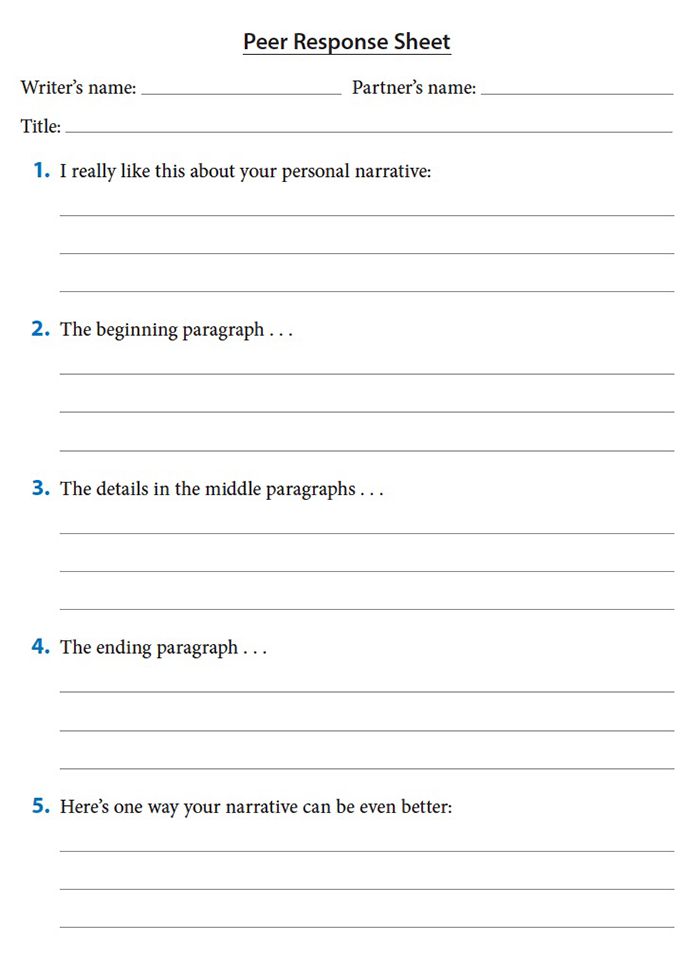
Share your writing.
Have a trusted classmate read your narrative and complete the form.
Revising in Action
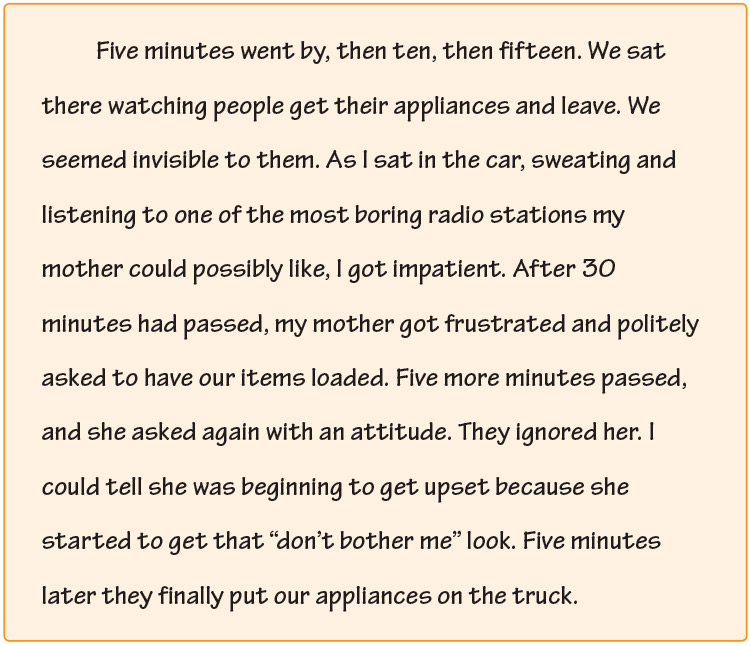
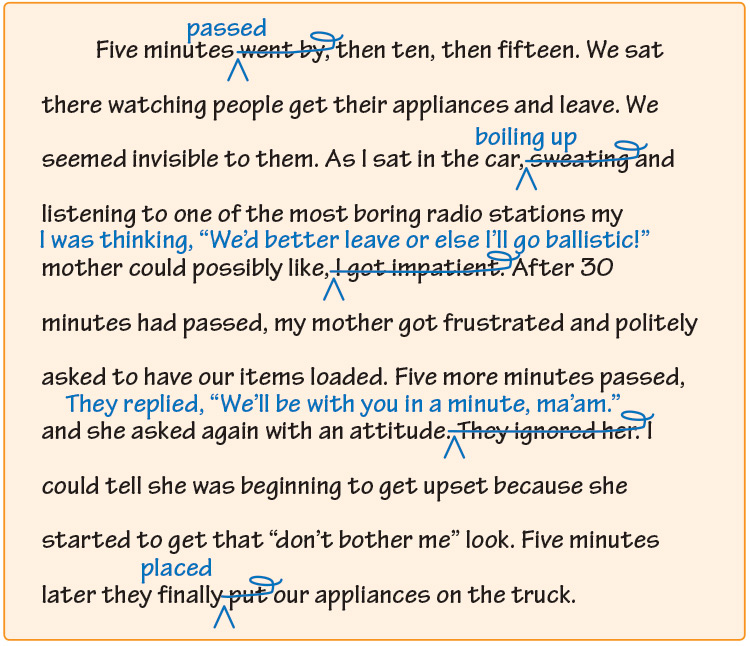
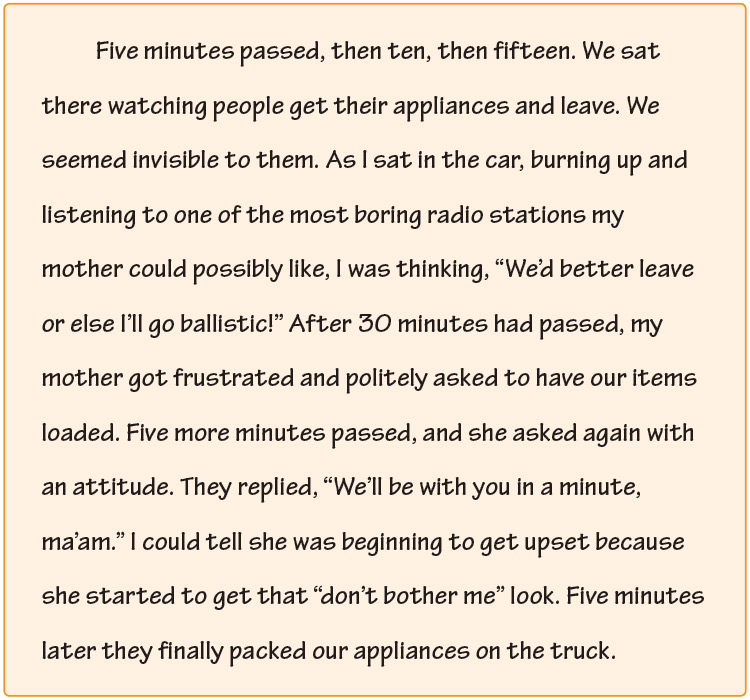
When you revise, you add, delete, rewrite, and rearrange your writing to make it clearer. Here are some revisions to “The Racist Warehouse.”
-
Paragraph Before Revisions
-
General verbs are replaced with more specific ones. Dialogue and thought details are added.
-
Paragraph After Revisions
Revise with a checklist.
Read each line. When you can answer each question with a yes, check it off.
Ideas
- Does the narrative focus on a specific experience or event?
- Does the writing contain specific details and dialogue?
- Do I focus my ideas and include a depth of detail?
Organization
- Does the beginning pull readers into the narrative?
- Are actions presented in chronological (time) order?
- Do time-order transitions connect my ideas?
Voice
- Is my feeling about the topic reflected in the writing?
Word Choice
- Do I use specific nouns and active verbs?
- Have I cut any wordiness?
Sentence Fluency
- Do I have a variety of sentence lengths and beginnings?
- Do my sentences read smoothly?