Warm-Up for Writing Nonfiction Reviews
Have you ever read something so great that you just had to tell someone else about it? Writing a nonfiction review gives you that chance. In this unit, you will write a review of a nonfiction book or article you have recently read.
Listen to "What Is a Nonfiction Review?"
Hide audio
What Is a Nonfiction Review?
A nonfiction review gives just enough information about a book or article to help another reader decide whether or not to read the whole thing. Nonfiction is another word for "true story," so a nonfiction review focuses on a work about real people, places, events, or information. Some examples of nonfiction include biographies, autobiographies, diary entries, historical documents, online news stories, textbook chapters, and newspaper and magazine articles.
A review not only describes what the story is about but also what you think about it and why. The reading and writing activities in this unit will help you create an effective review of a nonfiction text (without spoiling the ending). Afterward, you can share what you've written with your friends and classmates. Who knows, your review might influence what they choose to read next!
Thinking About Nonfiction
Writing a great nonfiction review begins with close reading. To read closely, remember SQ3R—Survey, Question, Read, Recite, Review. This reading strategy will help you identify the key elements of nonfiction: title, author, headings, images, graphics, main idea, beginnings, endings, and supporting details.
Survey, question, and read.
Use these instructions to closely read the following nonfiction article. (Download and print a PDF of the article to make your annotations.)
- Survey the text: Highlight the title, author, and headings.
- Question the topic and purpose: Write comments on the document.
- Read the text: Underline the main idea. (Hint: The main idea is usually located in the first few paragraphs.)
Superman Takes Off
by Stephen Krensky
American comic books became popular in the 1930s. One type of character especially—the superhero—struck a chord with comic book readers. Superheroes are characters who often use special powers or extraordinary abilities to fight injustice and defend the weak. However, as the creator of Superman proves, you don't need super powers or a cape to create the next famous superhero.
A Superhero Is Born
In the early 1930s, young Jerry Siegel was an ordinary high school student. Someday, he thought, he might become a reporter. As he remembered later, he had several crushes on "girls who either didn't know I existed or didn't care I existed."
What could he do about that? He wasn't sure. But at least he could use his imagination. He wondered, “What if I had something special going for me, like jumping over buildings or throwing around cars or something like that?”
Siegel and his friend Joe Shuster attended high school in Cleveland, Ohio. They were both science fiction fans. They also loved reading about the jungle man Tarzan, who was already a comic-strip star.
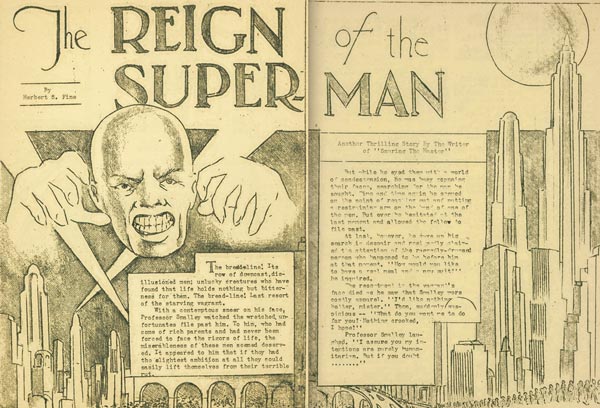
After graduating, the two friends began discussing an idea for a new character. His name was Superman. Siegel even published a story about him called “The Reign of the Superman.” However, this Superman was a villain. He used his mental powers to further his own evil purposes. In a 1983 interview, Siegel recalled what happened next. “A couple of months after I published this story, it occurred to me that Superman as a hero rather than as a villain might make a great comic strip character.”
Like other heroes of the period, Superman came with a secret identity. When not leaping over tall buildings, Superman was a timid newspaper reporter named Clark Kent. Clark’s character was drawn from Siegel’s own experiences. “The concept came to me that Superman could have a dual identity.” He would be a superhero in one identity. But in the other, he would “be meek and mild as I was, and wear glasses, the way I do.”
Superman Makes His Debut
In the mid-1930s, Siegel and Shuster got jobs at DC Comics (then called DC-National). They worked as a team. Siegel wrote adventure and crime-fighting comic book stories, and Shuster illustrated them. They tried several times, with no success, to convince DC to publish Superman stories. But as their reputations grew, DC took their proposal more seriously.
Finally, Superman made his debut in Action Comics #1 in 1938. In that first issue, Superman comes from an unnamed distant planet. He shows extraordinary powers. He can leap great distances, and he has super strength. His eyes give him heat vision, X-ray vision, and telescopic vision.
After a few months, Superman’s popularity erupted. At that time, one issue of a successful comic book might sell one hundred thousand copies. Superman was soon selling more than one million. As the series continued, readers learned that Superman was the last survivor of the doomed planet Krypton. He was an infant when his planet exploded. But he escaped just in time. How? His parents Jor-El and Lara sent him to Earth in a small spaceship. The spaceship crashed in a field in Smallville, Kansas. Farmers Jonathan and Martha Kent found the ship with the healthy baby inside. They adopted him and named him Clark.
Why Did Superman Catch On?
Well, first, his many powers were exciting to fantasize about. Who wouldn’t like to fly and see through walls? Second, Superman used those powers to do good deeds and to battle crime. In the 1930s, gangsters roamed the streets of many big cities, and people wished for a hero to save the day. Third, Superman confronted injustice. In Europe and other parts of the world, dictators loomed as a growing menace. The comics overflowed with these dangers. And when society is turning ugly, the idea of Superman is comforting. He gave people a sense of hope about the future.
Superman was immediately popular, the first hero ever to get his own comic book. Soon, he went on to bigger things. He was the subject of a newspaper comic strip and appeared on radio. It was the radio program that introduced the famous phrases describing Superman as “faster than a speeding bullet” and “more powerful than a locomotive.” It also included the famous lines: “Look! Up in the sky! It’s a bird! It’s a plane! It’s Superman!”
From 1938 to the present, Superman has been one of Earth’s guardians. He remains on the lookout for the next bad guy with evil on his mind.
Superman image from 360b / Shutterstock.com
Reign of the Super-Man Comic Strip by Jerry Siegel, illustrated by Joe Shuster
Teaching Tip
If you wish to use this article as the basis for your students' responses, be aware that the response essay in the lesson plan "Writing a Nonfiction Review" focuses also on this article. You can use the sample to show students what an effective response looks like. However, you should caution your students not to copy from the sample essay.
Respond to the nonfiction article.
Answer the following questions about the article.
- What is the article's title, and who is the author?
- What headings are used in the article?
- What is the article's main idea?
- How does the beginning paragraph introduce the topic—by asking a question, sharing important background information, or quoting a character?
- What supporting details surprised you the most?
- What did you like about the article?
- Would you recommend other people read the article? Why or why not?