Reading a Research Report
Before you begin the process of writing a research report, you'll want to see how others did so. This lesson shows you a sample research report, explaining each of its main parts. As you read the sample, think about how the writer integrated information from different sources to explain the topic in an informative manner.
Reading a Sample Research Report
A research report has some special features, but the actual report has three main parts, just like an essay. The beginning paragraph introduces the topic and leads to a focus statement. The body paragraphs support the focus statement by citing evidence from sources. The ending paragraph revisits the main idea.
Research reports end with a works-cited page, which lists the sources used in the writing. Source material is cited within the report using in-text citations.
Sample Research Paper
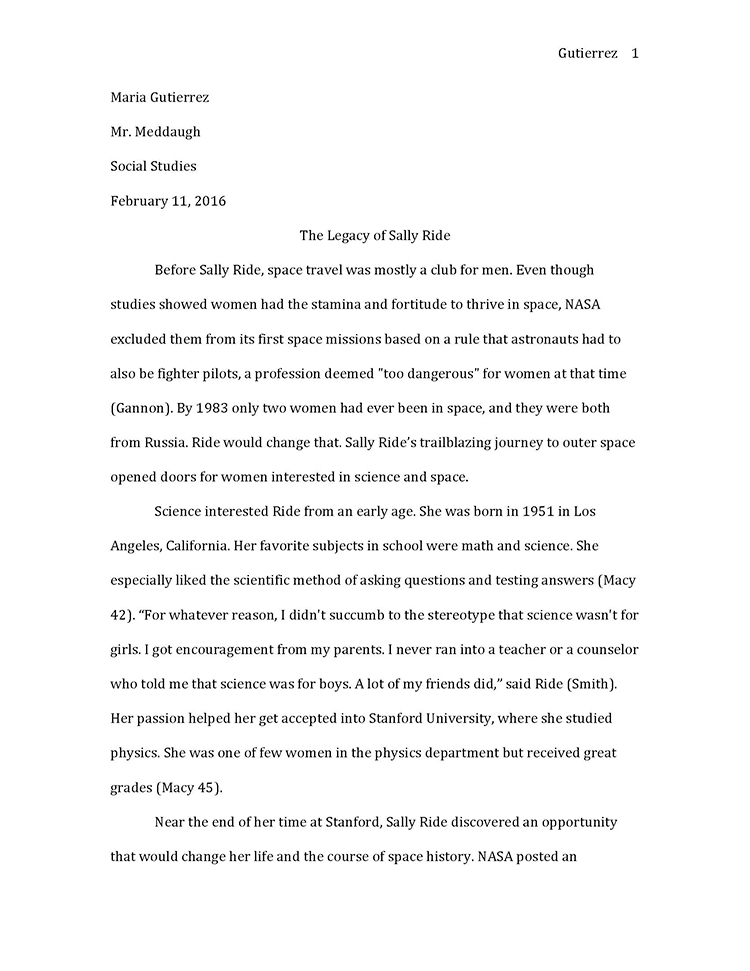
Gutierrez 1
HeaderMaria Gutierrez
Mr. Meddaugh
Social Studies
11 February 2016
The Legacy of Sally Ride
Beginning Paragraph Before Sally Ride, space travel was mostly a club for men. Even though studies showed women had the stamina and fortitude to thrive in space, NASA excluded them from its first space missions based on a rule that astronauts had to also be fighter pilots, a profession deemed "too dangerous" for women at that time (Gannon). By 1983 only two women had ever been in space, and they were both from Russia. Ride would change that. Focus statement Sally Ride’s trailblazing journey to outer space opened doors for women interested in science and space.
Despite growing up in a time when science was considered a mostly male interest, the subject fascinated Ride early on in life. Born in 1951 in Los Angeles, California, her favorite subjects in school were math and science. She especially liked the scientific method of asking questions and testing answers (Macy 42). “For whatever reason, I didn't succumb to the stereotype that science wasn't for girls. I got encouragement from my parents. I never ran into a teacher or a counselor who told me that science was for boys. A lot of my friends did,” said Ride (Smith). Her passion helped her get accepted into Stanford University, where she studied physics. She was one of few women in the physics department but received great grades (Macy 45).
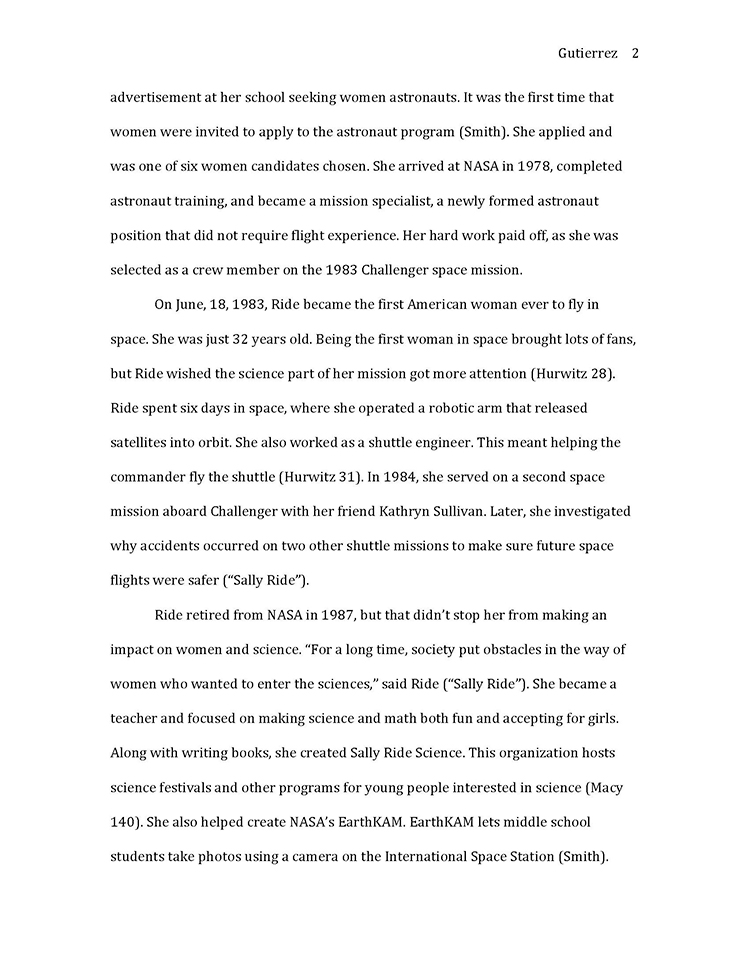
Gutierrez 2
Body paragraphsNear the end of her time at Stanford, Sally Ride discovered an opportunity that would change her life and the course of space history. NASA posted an advertisement at her school seeking women astronauts. It was the first time that women were invited to apply to the astronaut program (Smith). She applied and was one of six women candidates chosen. She arrived at NASA in 1978, completed astronaut training, and became a “mission specialist,” a newly formed astronaut position that did not require flight experience. Her hard work paid off, as she was selected as a crew member on the 1983 Challenger space mission.
In-text citation On June, 18, 1983, Ride became the first American woman ever to fly in space. She was just 32 years old. Being the first woman in space brought lots of fans, but Ride wished the science part of her mission got more attention (Hurwitz 28). Ride spent six days in space aboard Challenger, where she operated a robotic arm that released satellites into orbit. She also worked as a shuttle engineer. This involved helping the commander fly the shuttle (Hurwitz 31). In 1984, she served on a second Challenger space mission with her friend Kathryn Sullivan. Later, Ride investigated why accidents occurred on two other shuttle missions to make sure future space flights were safer (“Sally Ride”).
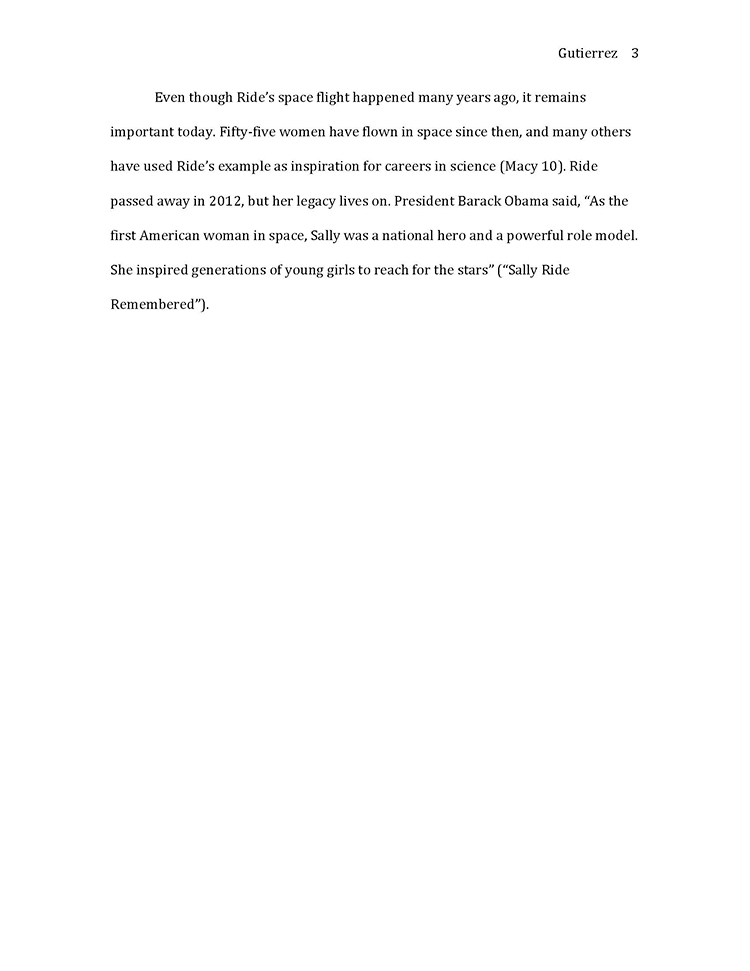
Gutierrez 3
Ride retired from NASA in 1987, but that didn’t stop her from making an impact on women and science. “For a long time, society put obstacles in the way of women who wanted to enter the sciences,” said Ride (“Sally Ride”). She became a teacher and focused on making science and math both fun and accepting for girls. Along with writing books, she created Sally Ride Science. This organization hosts science festivals and other programs for young people interested in science (Macy 140). She also helped create NASA’s EarthKAM. EarthKAM lets middle school students take photos using a camera on the International Space Station (Smith).
Ending Paragraph Even though Ride’s space flight happened many years ago, it remains important today. Fifty-five women have flown in space since then, and many others have used Ride’s example as inspiration for careers in science (Macy 10). Ride passed away in 2012, but her legacy lives on. President Barack Obama summed up Ride’s legacy best when he said, “As the first American woman in space, Sally was a national hero and a powerful role model. She inspired generations of young girls to reach for the stars” (“Sally Ride Remembered”).
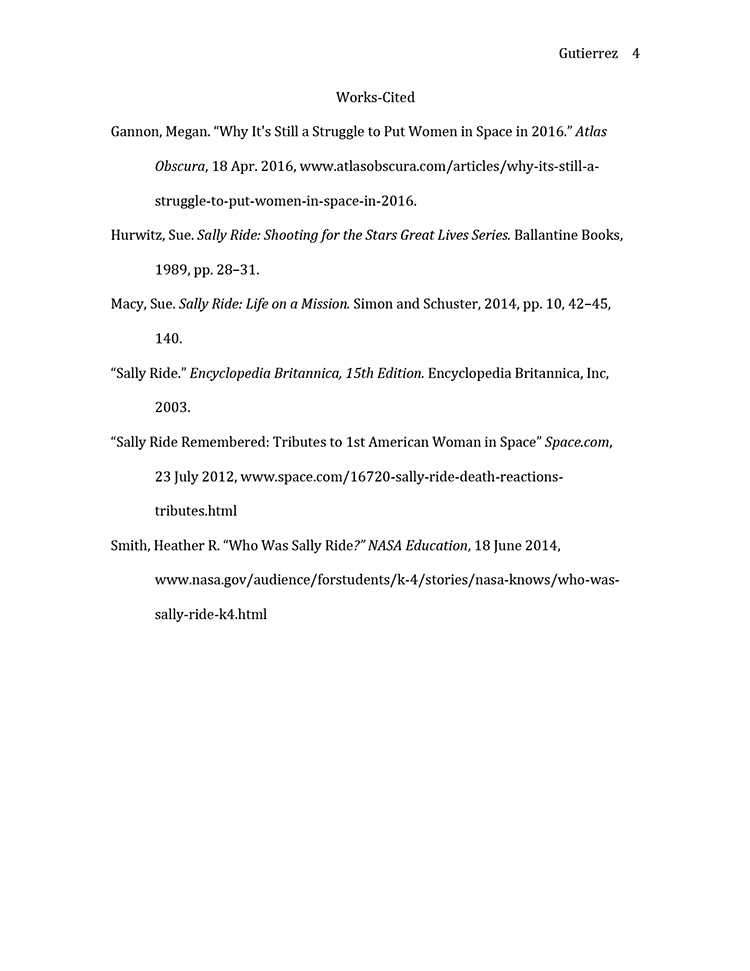
Gutierrez 4
Works-Cited Page
Sources CitedGannon, Megan. “Why It's Still a Struggle to Put Women in Space in 2016.” Atlas Obscura, 18 Apr. 2016, www.atlasobscura.com/articles/why-its-still-a-struggle-to-put-women-in-space-in-2016.
Hurwitz, Sue. Sally Ride: Shooting for the Stars Great Lives Series. Ballantine Books, 1989, pp. 28–31.
Print SourcesMacy, Sue. Sally Ride: Life on a Mission. Simon and Schuster, 2014, pp. 10, 42–45, 140.
“Sally Ride.” Encyclopedia Britannica, 15th Edition. Encyclopedia Britannica, Inc, 2003.
Digital Sources“Sally Ride Remembered: Tributes to 1st American Woman in Space.” Space.com, 23 July 2012, www.space.com/16720-sally-ride-death-reactions-tributes.html.
Smith, Heather R. “Who Was Sally Ride?” NASA Education, 18 June 2014, www.nasa.gov/audience/forstudents/k-4/stories/nasa-knows/who-was-sally-ride-k4.html.
Formatted Paper
Teaching Tip
This paper and the remaining instructions in this unit follow MLA style. Reference this sample as you lead students through the step-by-step process of creating a research report.
Respond to the report.
Answer these questions about the report.
- What is the focus statement for the report, and where is it located?
- What ideas in the body paragraphs support the focus statement?
- Why was it surprising that Sally Ride made it to space?
- How does the writer end the report?
- How does the writer show where she found information about Sally Ride?