Prewriting for Research Reports
Of all the forms of academic writing, research reports require the most planning. The good news is that the extra attention you give to prewriting will make it easier for you to draft your report.
Prewriting to Select a Topic
For your report, you will research an important person from the past or present. As you consider topic choices, note people who truly interest you, because you will be spending a lot of time learning about them.
Create a cluster.
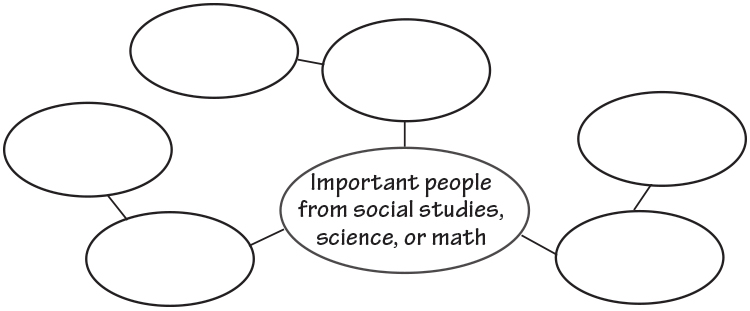
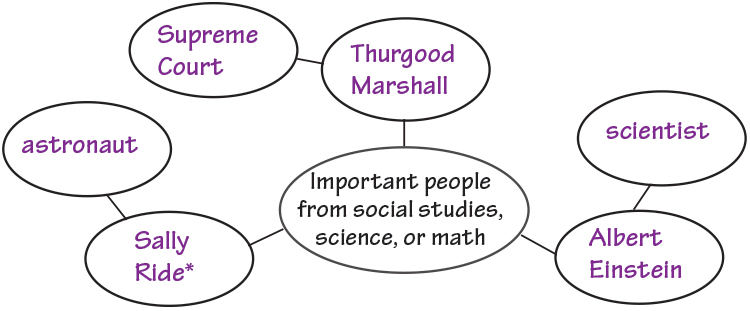
Create a cluster about historical figures from social studies, science, or math. Add names in the first branch of circles. Write a detail about the person in the second branch. Finally, put a star by the person you want to write about.
Other Ways to Discover Topic Ideas
Search online or scan your school books for influential figures. Also try freewriting for topics.
Prewriting for Research Questions
Now that you have decided on a topic for your report, you need to find out what you already know about the person and what you want to learn.
Record what you know.
List all the things that you definitely know to be true about your topic. Then list any information you are not completely sure of.
What I Know
What I Think I Know
Ask research questions.
List at least five questions about the person that you need to explore. Use the sample 5 Ws and H questions as a guide, but be sure to list questions that you don’t know the answers to.
Sample Questions
Who helped Sally Ride get to space?
When did she go to space?
What did she do in space?
Why is she so important?
How did she become an astronaut?
What did she do after space?
Where did she travel to in space?
How does her legacy continue today?
What I Still Need to Know
Prewriting to Research Print Sources
Print sources such as books, textbooks, magazines, newspapers, and encyclopedias can help you learn about your topic. Your school and community libraries contain print sources. Ask a librarian or media specialist for help finding these sources.
Do library research.
Follow the instructions for using a library’s computer catalog. Then list two useful print sources you find about your topic. Also mark the category of the print source.
- Ask a librarian to show you a computer catalog, which lists sources according to titles, authors, and subjects. Type the topic in the search box. Then review the results.
Source 1:
Type: Book? Magazine? Newspaper? Encyclopedia? Other?
Source 2:
Type: Book? Magazine? Newspaper? Encyclopedia? Other?
Teaching Tip
Students will need to visit their school or community library to complete this activity. Consider scheduling a class period in a library of your choice.
Evaluate print sources.
Ask and answer these questions to decide if your print sources contain useful and trustworthy information. If you can’t answer “yes” for each question, look for a new source.
- Does the source contain information about my topic?
- Does the information answer a question I have about my topic?
- Is the information current or published recently?
- Does the information seem fair and complete?
Prewriting to Research Online Sources
Online sources such Web sites, blogs, podcasts, and videos can help you learn about your topic. A search engine is a good resource for finding online sources.
Use a search engine.
Follow the instructions for using a search engine. Then list the names and URL of the sources you find about your topic. The URL is the address of the Web page, such as www.k12.thoughtfullearning.com.
- Type your topic into the search engine: Sally Ride
- For narrower results, add a more specific word or phrase related to your research questions before or after the topic: Sally Ride Challenger Flight
Source 1:
URL:
Source 2:
URL:
Evaluate online sources.
Ask and answer these questions to decide if an online source contains useful and trustworthy information. If you can’t answer “yes” for each question, look for a new source.
- Does the source contain information about my topic?
- Does the information answer a question I have about my topic?
- Is the information current or published recently?
- Does the person or organization who made the site have a good reputation?
Prewriting to Paraphrase and Quote
When you use an idea from another source, you should paraphrase or quote the idea. Paraphrasing means writing the idea in your own words. Quoting means using the exact words of the idea with quotation marks. Here is a sample paraphrase and quote of a passage from the Library of Congress.
George Washington Carver was a man with a peanut plan. Back in 1900, cotton farmers in the South worried that cotton crops were sucking all the nutrients out of the soil. Carver understood that certain plants put nutrients back in the soil. One of those plants was the peanut. He suggested farmers rotate their crops: cotton one year, and then peanuts the next year. His plan worked! The crop rotation not only saved the cotton but also produced a huge harvest of peanuts.
Paraphrase:
George Washington Carver discovered that growing peanuts every other year could save cotton farms in the South.
Quote:
According to the Library of Congress, “He suggested farmers rotate their crops: cotton one year, and then peanuts the next year.”
Teaching Tip
When students paraphrase or quote ideas in their research reports, they will need to cite, or give credit, for the idea. In-text citations will be addressed later in this unit, but you may want to address them here as well.
Paraphrase and quote.
Paraphrase and quote an idea from the following selection from the Library of Congress.
Have you ever been treated unfairly because of your age, the color of your skin, or where you live? Thurgood Marshall spent his life making sure all people were treated fairly, especially under the law. He was a lawyer that helped end segregation, and later became the first African-American Supreme Court justice.
-
Paraphrase the passage:
-
Quote a line or lines from the passage:
Teaching Tip
Paraphrasing and quoting help students avoid plagiarism, the act of using other’s ideas as their own.
Prewriting to Gather Source Information
Fill in a gathering grid.
Follow the instructions. Then fill in the blank gathering grid for your research topic.
A gathering grid can help you keep track of the information you research. Here's how to fill one in:
- Write your topic in the left corner.
- Write your sources on the top row.
- Write your research questions on the left column.
- In the blank boxes, paraphrase or quote answers from each source. Leave the box blank if the source does not provide an answer.
Topic |
Source 1 |
Source 2 |
Source 3 |
Question 1 |
|||
Question 2 |
|||
Question 3 |
|||
Question 4 |
Topic
Source 1
Source 2
Source 3
Question 1
Source 1
Source 2
Source 3
Question 2
Source 1
Source 2
Source 3
Question 3
Source 1
Source 2
Source 3
Question 4
Source 1
Source 2
Source 3
Teaching Tip
Remind students that they can use their gathering grid when they draft their reports. That way they don’t have to recall all of the information from memory.
Prewriting to Credit Sources
Record the publication information for each of your sources. This information will help you give credit for the ideas you use from them.
Books
Author (Last name, First name). Title (in italics). Publisher, Year of Publication, Page Number (pp.#).
Hurwitz, Sue. Sally Ride: Shooting for the Stars Great Lives Series. Ballantine Books, 1989, pp. 28–31.
Magazine/Newspaper Articles
Author. “Title of Article” (in quotes). Title of Publication (in italics), Date, Page Number (pp.#).
Grady, Denise. “American Woman Who Shattered Space Ceiling.” The New York Times, 23 July 2012, pp. A1.
Web sites
Author (if available). “Article name.” Title of Site (in italics), Date of creation, URL.
Smith, Heather R. “Who Was Sally Ride?” NASA Education, 18 June 2014,
www.nasa.gov/audience/forstudents/k-4/storie/nasa-knows/who-was-sally-ride-k4.html
Create citations.
Follow the instructions for citing different types of sources. Then use the publication information provided to create citations.
- Book: Thurgood Marshall: Young Justice by Meryl Henderson, published by Simon & Schuster in 1998, pages 8–11
- Magazine: “Thurgood Marshall: The Brain of the Civil Rights Movement” by Adam Cohen from Time on June 14, 1999, page 24
- Web site: “Biographies of the Robes” from PBS: The Supreme Court, created in 2006,
www.pbs.org/wnet/supremecourt/future/robes.html.
Teaching Tip
The works-cited entries on this page follow MLA documentation style.
Prewriting to Form a Focus Statement
Write your focus statement.
Read about focus statements. Then write two different focus statements of your own. Decide which statement would work best for your research report.
A focus statement tells what your research report will be about. The focus statement names the topic and a special thought or feeling about the topic.
Sally Ride’s trailblazing journey to outer space (topic) opened doors for women interested in science and space (special thought).
Focus Statement 1
- Name your topic.
- Give a special thought about it.
- Write a focus statement.
Focus Statement 2
- Name your topic.
- Give a special thought about it.
- Write a focus statement.
Prewriting to Outline Your Report
Create an outline.
Follow the instructions for creating an outline. Then create an outline for your report.
An outline is an organized list that previews what you want to say in your report. On the first level (I, II, III, IV), write sentences that support your focus statement. On the second level (A, B, C, D), write details that support the idea in the level above it.
Outline
Focus Statement:
Teaching Tip
Encourage students to use the information they gathered in their gathering grid while developing their outline. Each first level sentence could focus on answering a different research question.