Revising Research Reports
After you write a first draft, you can improve your writing through a series of revisions. When you revise, you think about the “big picture,” including the overall structure of your writing (beginning, middle, and ending) and the focus, main ideas, and supporting details you use. These activities will help you revise.
Revising to Cite Evidence
As you revise your first draft, search for and replace general ideas and unsupported opinions with factual evidence from your sources.
-
General Idea: Sally Ride did some important things in space.
-
Factual Evidence: Sally Ride spent six days in space, where she helped place satellites in orbit.
-
Opinion: I bet Ride was surprised to see an advertisement from NASA.
-
Factual evidence: It was the first time that women were invited to apply to astronaut program (Smith).
Replace general ideas and unsupported opinions.
Find three general ideas or unsupported opinions from your report. Then find evidence from one of your sources to support each idea. Add the revisions to your report.
- General idea/opinion:
- General idea/opinion:
- General idea/opinion:
Specific evidence:
Specific evidence:
Specific evidence:
Revising to Connect Ideas
By adding transitions between paragraphs and sentences, you can make your writing easier to read and understand.
Time Order Transitions
These transitions help signal the order in which things happen.
first
next
then
finally
before
during / while
after / afterwards
later
Transitions to Add Information
These transitions signal new information or ideas.
along with
also
another
for example
next
for instance
as well
in addition
Add transitions.
Revise the following sentences by adding transition words to connect the ideas. Underline the transition added. One example is provided.
- Thurgood Marshall graduated from high school in 1926. He attended Lincoln University.
- Marshall experienced discrimination. He was rejected by a law school because he was black.
- Marshall was a successful trial lawyer for many years. He became a Supreme Court Justice.
- He ruled in favor of individual rights. He supported social issues.
Thurgood Marshall graduated from high school in 1926. Afterwards, he attended Lincoln University.
Revising with a Peer Response
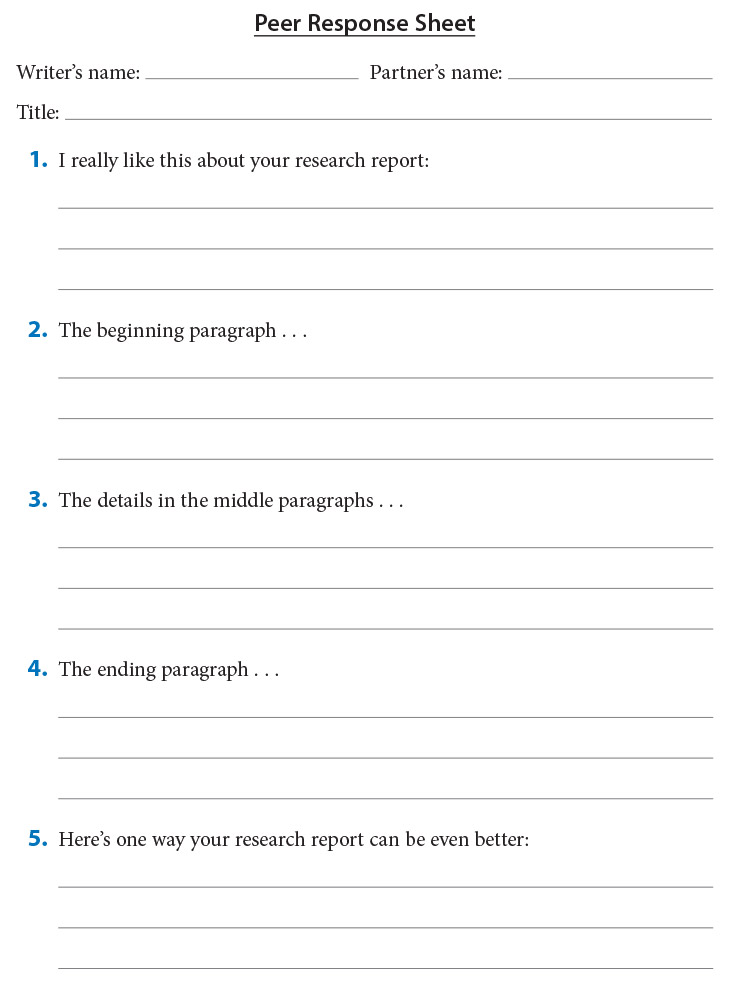
Share your writing.
Have a trusted classmate read your research report and complete the form.
Revising in Action
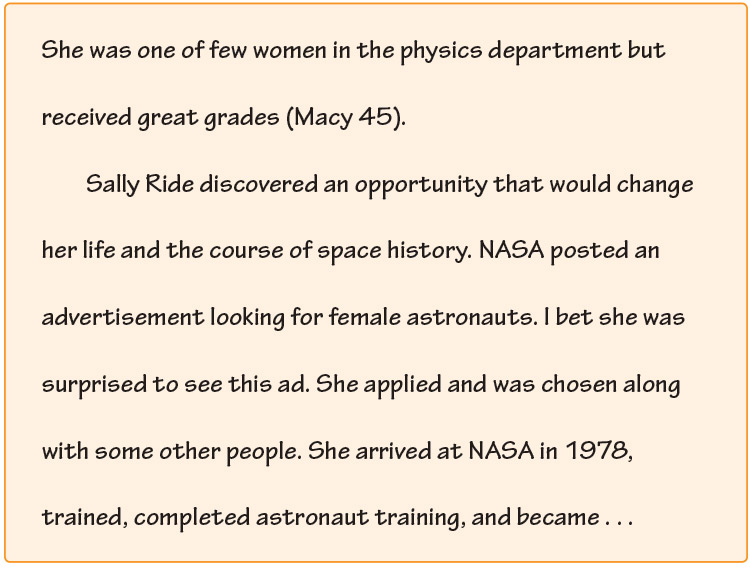
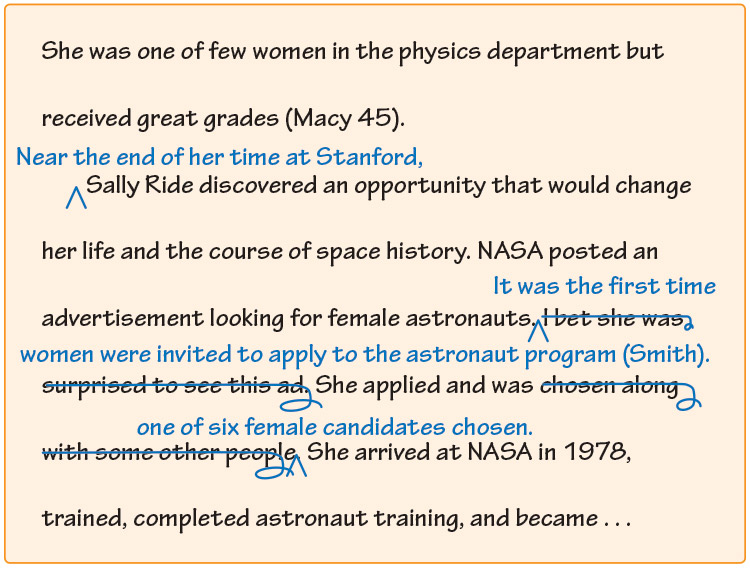
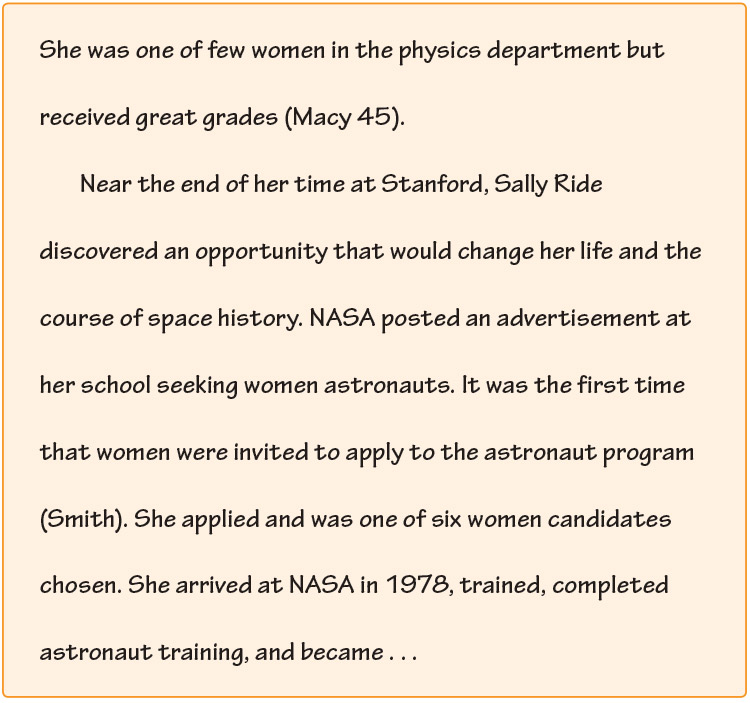
When you revise, you add, delete, rewrite, and rearrange your writing to make it clearer. Here are some revisions to “The Legacy of Sally Ride.”
-
Paragraph Before Revising
-
A transitional phrase is added and two general ideas are replaced with specific evidence.
-
Paragraph After Revising
Revise with a checklist.
Read each line. When you can answer each question with a yes, check it off.
Ideas
- Is my topic an interesting person?
- Did I research information using print and online sources?
- Did I record the publication information from the sources?
- Did I cite the sources in the report when I used their ideas?
Organization
- Do I start with an interesting lead that builds to my focus statement?
- Do facts and details support my focus and topic sentences?
- Do each of my body paragraphs include topic sentences?
- Does the ending paragraph summarize why the person was
important?
Voice
- Do I sound knowledgeable about my topic?
- Is my voice appropriate to the topic and audience?
Word Choice
- Do I use specific nouns and active verbs?
- Have I cut any wordiness?
Sentence Fluency
- Do transitions connect ideas?
- Do the sentences read smoothly?