Understanding Controlling Sentences
As you read, watch for two types of controlling sentences.
A thesis statement tells what an essay or article is about. It usually appears in the first paragraph, often at the end.
Why did writing get invented? To recount the exploits of great heroes like Gilgamesh and Odysseus? No, those epics are only 3,000 to 4,000 years old. To inscribe the laws of the land, as in the Code of Hammurabi? That's another good guess, but it wasn't the first reason. Writing began 5,000 years ago because of goats.
A topic sentence tells what a paragraph is about. It usually appears at the start of a middle paragraph.
That practical business tool transformed human civilization. It marked the shift from prehistoric times (before written records) to modern times. Writing has come a long way since the days of clay tablets. Now we have emails, Facebook statuses, tweets, and texts, not to mention stock exchange tickers that robots can read faster than we can. . . .
Find controlling sentences.
In the following speech by Eleanor Roosevelt, underline each controlling sentence.
Listen to "Excerpt from 'The Struggle for Human Rights' "
Hide audio
Excerpt from "The Struggle for Human Rights"
On September 28, 1948, in Paris, Eleanor Roosevelt, chair of the United Nations Committee on Human Rights, presented the following speech in defense of adopting the Universal Declaration of Human Rights.
I have come this evening to talk with you on one of the greatest issues of our time—that is the preservation of human freedom. . . . The Human Rights Commission was given as its first and most important task the preparation of an International Bill of Rights. The General Assembly, which opened its third session here in Paris a few days ago, will have before it the first fruit of the Commission's labors in this task, that is the International Declaration of Human Rights.
The Declaration was finally completed after much work during the last session of the Human Rights Commission in New York in the spring of 1948. The Economic and Social Council has sent it without recommendation to the General Assembly, together with other documents transmitted by the Human Rights Commission. . . . The Declaration has come from the Human Rights Commission with unanimous acceptance except for four abstentions—the U.S.S.R., Yugoslavia, Ukraine, and Byelorussia. The reason for this is a fundamental difference in the conception of human rights as they exist in these states and in certain other Member States in the United Nations.
In the discussion before the Assembly, I think it should be made crystal clear what these differences are, and tonight I want to spend a little time making them clear to you. It seems to me there is a valid reason for taking the time today to think carefully and clearly on the subject of human rights, because in the acceptance and observance of these rights lies the root, I believe, of our chance of peace in the future, and for the strengthening of the United Nations organization to the point where it can maintain peace in the future.
We must not be confused about what freedom is. Basic human rights are simple and easily understood: freedom of speech and a free press; freedom of religion and worship; freedom of assembly and the right of petition; the right of men to be secure in their homes and free from unreasonable search and seizure and from arbitrary arrest and punishment.
We must not be deluded by the efforts of the forces of reaction to prostitute the great words of our free tradition and thereby to confuse the struggle. Democracy, freedom, human rights have come to have a definite meaning to the people of the world which we must not allow any nation to so change that they are made synonymous with suppression and dictatorship.
There are basic differences that show up even in the use of words between a democratic and a totalitarian country. For instance "democracy" means one thing to the U.S.S.R. and another to the U.S.A. and, I know, France. I have served since the first meeting of the nuclear commission on the Human Rights Commission, and I think this point stands out clearly.
The U.S.S.R. Representatives assert that they already have achieved many things which we, in what they call the "bourgeois democracies" cannot achieve because their government controls the accomplishment of these things. Our government seems powerless to them because, in the last analysis, it is controlled by the people. They would not put it that way—they would say that the people in the U.S.S.R. control their government by allowing their government to have certain absolute rights. We, on the other hand, feel that certain rights can never be granted to the government, but must be kept in the hands of the people.
For instance, the U.S.S.R. will assert that their press is free because the state makes it free by providing the machinery, the paper, and even the money for salaries for the people who work on the paper. They state that there is no control over what is printed in the various papers that they subsidize in this manner, such, for instance, as a trade-union paper. But what would happen if a paper were to print ideas which were critical of the basic policies and beliefs of the Communist government? I am sure some good reason would be found for abolishing the paper.
It is true that there have been many cases where newspapers in the U.S.S.R. have criticized officials and their actions and have been responsible for the removal of those officials, but in doing so they did not criticize anything which was fundamental to Communist beliefs. They simply criticized methods of doing things, so one must differentiate between things which are permissible, such as criticism of any individual or of the manner of doing things, and the criticism of a belief which would be considered vital to the acceptance of Communism. . . .
I think the best example one can give of this basic difference of the use of terms is “the right to work.” The Soviet Union insists that this is a basic right which it alone can guarantee because it alone provides full employment by the government. But the right to work in the Soviet Union means the assignment of workers to do whatever task is given to them by the government without an opportunity for the people to participate in the decision that the government should do this. A society in which everyone works is not necessarily a free society and may indeed be a slave society; on the other hand, a society in which there is widespread economic insecurity can turn freedom into a barren and vapid right for millions of people.
We in the United States have come to realize it means freedom to choose one’s job, to work or not to work as one desires. We, in the United States, have come to realize, however, that people have a right to demand that their government will not allow them to starve because as individuals they cannot find work of the kind they are accustomed to doing and this is a decision brought about by public opinion which came as a result of the great depression in which many people were out of work, but we would not consider in the United States that we had gained any freedom if we were compelled to follow a dictatorial assignment to work where and when we were told. The right of choice would seem to us an important, fundamental freedom.
I have great sympathy with the Russian people. They love their country and have always defended it valiantly against invaders. They have been through a period of revolution, as a result of which they were for a time cut off from outside contact. They have not lost their resulting suspicion of other countries and the great difficulty is today that their government encourages this suspicion and seems to believe that force alone will bring them respect.
We, in the democracies, believe in a kind of international respect and action which is reciprocal. We do not think others should treat us differently from the way they wish to be treated. It is interference in other countries that especially stirs up antagonism against the Soviet Government. If it wishes to feel secure in developing its economic and political theories within its territory, then it should grant to others that same security. We believe in the freedom of people to make their own mistakes. We do not interfere with them, and they should not interfere with others.
The basic problem confronting the world today, as I said in the beginning, is the preservation of human freedom for the individual and consequently for the society of which he is a part. We are fighting this battle again today as it was fought at the time of the French Revolution and at the time of the American Revolution. The issue of human liberty is as decisive now as it was then. . . .
The totalitarian state typically places the will of the people second to decrees promulgated by a few men at the top. . . . Naturally there must always be consideration of the rights of others; but in a democracy this is not a restriction. Indeed, in our democracies we make our freedoms secure because each of us is expected to respect the rights of others and we are free to make our own laws. Freedom for our peoples is not only a right, but also a tool. Freedom of speech, freedom of the press, freedom of information, freedom of assembly—these are not just abstract ideals to us; they are tools with which we create a way of life, a way of life in which we can enjoy freedom. . . .
The final expression of the opinion of the people with us is through free and honest elections, with valid choices on basic issues and candidates. The secret ballot is an essential to free elections but you must have a choice before you. I have heard my husband say many times that a people need never lose their freedom if they kept their right to a secret ballot and if they used that secret ballot to the full. Basic decisions of our society are made through the expressed will of the people. That is why when we see these liberties threatened, instead of falling apart, our nation becomes unified and our democracies come together as a unified group in spite of our varied backgrounds and many racial strains. . . .
The U.S.S.R. claims it has reached a point where all races within her borders are officially considered equal and have equal rights and they insist that they have no discrimination where minorities are concerned. . . . This is a laudable objective but there are other aspects of the development of freedom for the individual which are essential before the mere absence of discrimination is worth much, and these are lacking in the Soviet Union. Unless they are being denied freedoms which they want and which they see other people have, people do not usually complain of discrimination. It is these other freedoms—the basic freedoms of speech, of the press, of religion and conscience, of assembly, of fair trial and freedom from arbitrary arrest and punishment, which a totalitarian government cannot safely give its people and which give meaning to freedom from discrimination.
It is my belief, and I am sure it is also yours, that the struggle for democracy and freedom is a critical struggle, for their preservation is essential to the great objective of the United Nations to maintain international peace and security. Among free men the end cannot justify the means. We know the patterns of totalitarianism—the single political party, the control of schools, press, radio, the arts, the sciences, and the church to support autocratic authority; these are the age-old patterns against which men have struggled for three thousand years. These are the signs of reaction, retreat, and retrogression. The United Nations must hold fast to the heritage of freedom won by the struggle of its people; it must help us to pass it on to generations to come. . . .
The field of human rights is not one in which compromise on fundamental principles is possible. The work of the Commission on Human Rights is illustrative. The Declaration of Human Rights provides: “Everyone has the right to leave any country, including his own.” The Soviet Representative said he would agree to this right if a single phrase was added to it—”in accordance with the procedure laid down in the laws of that country.” It is obvious that to accept this would be not only to compromise but to nullify the right stated. This case forcefully illustrates the importance of the proposition that we must ever be alert not to compromise fundamental human rights merely for the sake of reaching unanimity and thus lose them.
As I see it, it is not going to be easy to attain unanimity with respect to our different concepts of government and human rights. The struggle is bound to be difficult and one in which we must be firm but patient. If we adhere faithfully to our principles I think it is possible for us to maintain freedom and to do so peacefully and without recourse to force.
The future must see the broadening of human rights throughout the world. People who have glimpsed freedom will never be content until they have secured it for themselves. In a truest sense, human rights are a fundamental object of law and government in a just society. Human rights exist to the degree that they are respected by people in relations with each other and by governments in relations with their citizens. . . .
Excerpt from "The Struggle for Human Rights"
On September 28, 1948, in Paris, Eleanor Roosevelt, chair of the United Nations Committee on Human Rights, presented the following speech in defense of adopting the Universal Declaration of Human Rights.
I have come this evening to talk with you on one of the greatest issues of our time—that is the preservation of human freedom. . . . The Human Rights Commission was given as its first and most important task the preparation of an International Bill of Rights. The General Assembly, which opened its third session here in Paris a few days ago, will have before it the first fruit of the Commission's labors in this task, that is the International Declaration of Human Rights.
The Declaration was finally completed after much work during the last session of the Human Rights Commission in New York in the spring of 1948. The Economic and Social Council has sent it without recommendation to the General Assembly, together with other documents transmitted by the Human Rights Commission. . . . The Declaration has come from the Human Rights Commission with unanimous acceptance except for four abstentions—the U.S.S.R., Yugoslavia, Ukraine, and Byelorussia. The reason for this is a fundamental difference in the conception of human rights as they exist in these states and in certain other Member States in the United Nations.
In the discussion before the Assembly, I think it should be made crystal clear what these differences are, and tonight I want to spend a little time making them clear to you. It seems to me there is a valid reason for taking the time today to think carefully and clearly on the subject of human rights, because in the acceptance and observance of these rights lies the root, I believe, of our chance of peace in the future, and for the strengthening of the United Nations organization to the point where it can maintain peace in the future.
We must not be confused about what freedom is. Basic human rights are simple and easily understood: freedom of speech and a free press; freedom of religion and worship; freedom of assembly and the right of petition; the right of men to be secure in their homes and free from unreasonable search and seizure and from arbitrary arrest and punishment.
We must not be deluded by the efforts of the forces of reaction to prostitute the great words of our free tradition and thereby to confuse the struggle. Democracy, freedom, human rights have come to have a definite meaning to the people of the world which we must not allow any nation to so change that they are made synonymous with suppression and dictatorship.
There are basic differences that show up even in the use of words between a democratic and a totalitarian country. For instance "democracy" means one thing to the U.S.S.R. and another to the U.S.A. and, I know, France. I have served since the first meeting of the nuclear commission on the Human Rights Commission, and I think this point stands out clearly.
The U.S.S.R. Representatives assert that they already have achieved many things which we, in what they call the "bourgeois democracies" cannot achieve because their government controls the accomplishment of these things. Our government seems powerless to them because, in the last analysis, it is controlled by the people. They would not put it that way—they would say that the people in the U.S.S.R. control their government by allowing their government to have certain absolute rights. We, on the other hand, feel that certain rights can never be granted to the government, but must be kept in the hands of the people.
For instance, the U.S.S.R. will assert that their press is free because the state makes it free by providing the machinery, the paper, and even the money for salaries for the people who work on the paper. They state that there is no control over what is printed in the various papers that they subsidize in this manner, such, for instance, as a trade-union paper. But what would happen if a paper were to print ideas which were critical of the basic policies and beliefs of the Communist government? I am sure some good reason would be found for abolishing the paper.
It is true that there have been many cases where newspapers in the U.S.S.R. have criticized officials and their actions and have been responsible for the removal of those officials, but in doing so they did not criticize anything which was fundamental to Communist beliefs. They simply criticized methods of doing things, so one must differentiate between things which are permissible, such as criticism of any individual or of the manner of doing things, and the criticism of a belief which would be considered vital to the acceptance of Communism. . . .
I think the best example one can give of this basic difference of the use of terms is “the right to work.” The Soviet Union insists that this is a basic right which it alone can guarantee because it alone provides full employment by the government. But the right to work in the Soviet Union means the assignment of workers to do whatever task is given to them by the government without an opportunity for the people to participate in the decision that the government should do this. A society in which everyone works is not necessarily a free society and may indeed be a slave society; on the other hand, a society in which there is widespread economic insecurity can turn freedom into a barren and vapid right for millions of people.
We in the United States have come to realize it means freedom to choose one’s job, to work or not to work as one desires. We, in the United States, have come to realize, however, that people have a right to demand that their government will not allow them to starve because as individuals they cannot find work of the kind they are accustomed to doing and this is a decision brought about by public opinion which came as a result of the great depression in which many people were out of work, but we would not consider in the United States that we had gained any freedom if we were compelled to follow a dictatorial assignment to work where and when we were told. The right of choice would seem to us an important, fundamental freedom.
I have great sympathy with the Russian people. They love their country and have always defended it valiantly against invaders. They have been through a period of revolution, as a result of which they were for a time cut off from outside contact. They have not lost their resulting suspicion of other countries and the great difficulty is today that their government encourages this suspicion and seems to believe that force alone will bring them respect.
We, in the democracies, believe in a kind of international respect and action which is reciprocal. We do not think others should treat us differently from the way they wish to be treated. It is interference in other countries that especially stirs up antagonism against the Soviet Government. If it wishes to feel secure in developing its economic and political theories within its territory, then it should grant to others that same security. We believe in the freedom of people to make their own mistakes. We do not interfere with them, and they should not interfere with others.
The basic problem confronting the world today, as I said in the beginning, is the preservation of human freedom for the individual and consequently for the society of which he is a part. We are fighting this battle again today as it was fought at the time of the French Revolution and at the time of the American Revolution. The issue of human liberty is as decisive now as it was then. . . .
The totalitarian state typically places the will of the people second to decrees promulgated by a few men at the top. . . . Naturally there must always be consideration of the rights of others; but in a democracy this is not a restriction. Indeed, in our democracies we make our freedoms secure because each of us is expected to respect the rights of others and we are free to make our own laws. Freedom for our peoples is not only a right, but also a tool. Freedom of speech, freedom of the press, freedom of information, freedom of assembly—these are not just abstract ideals to us; they are tools with which we create a way of life, a way of life in which we can enjoy freedom. . . .
The final expression of the opinion of the people with us is through free and honest elections, with valid choices on basic issues and candidates. The secret ballot is an essential to free elections but you must have a choice before you. I have heard my husband say many times that a people need never lose their freedom if they kept their right to a secret ballot and if they used that secret ballot to the full. Basic decisions of our society are made through the expressed will of the people. That is why when we see these liberties threatened, instead of falling apart, our nation becomes unified and our democracies come together as a unified group in spite of our varied backgrounds and many racial strains. . . .
The U.S.S.R. claims it has reached a point where all races within her borders are officially considered equal and have equal rights and they insist that they have no discrimination where minorities are concerned. . . . This is a laudable objective but there are other aspects of the development of freedom for the individual which are essential before the mere absence of discrimination is worth much, and these are lacking in the Soviet Union. Unless they are being denied freedoms which they want and which they see other people have, people do not usually complain of discrimination. It is these other freedoms—the basic freedoms of speech, of the press, of religion and conscience, of assembly, of fair trial and freedom from arbitrary arrest and punishment, which a totalitarian government cannot safely give its people and which give meaning to freedom from discrimination.
It is my belief, and I am sure it is also yours, that the struggle for democracy and freedom is a critical struggle, for their preservation is essential to the great objective of the United Nations to maintain international peace and security. Among free men the end cannot justify the means. We know the patterns of totalitarianism—the single political party, the control of schools, press, radio, the arts, the sciences, and the church to support autocratic authority; these are the age-old patterns against which men have struggled for three thousand years. These are the signs of reaction, retreat, and retrogression. The United Nations must hold fast to the heritage of freedom won by the struggle of its people; it must help us to pass it on to generations to come. . . .
The field of human rights is not one in which compromise on fundamental principles is possible. The work of the Commission on Human Rights is illustrative. The Declaration of Human Rights provides: “Everyone has the right to leave any country, including his own.” The Soviet Representative said he would agree to this right if a single phrase was added to it—”in accordance with the procedure laid down in the laws of that country.” It is obvious that to accept this would be not only to compromise but to nullify the right stated. This case forcefully illustrates the importance of the proposition that we must ever be alert not to compromise fundamental human rights merely for the sake of reaching unanimity and thus lose them.
As I see it, it is not going to be easy to attain unanimity with respect to our different concepts of government and human rights. The struggle is bound to be difficult and one in which we must be firm but patient. If we adhere faithfully to our principles I think it is possible for us to maintain freedom and to do so peacefully and without recourse to force.
The future must see the broadening of human rights throughout the world. People who have glimpsed freedom will never be content until they have secured it for themselves. In a truest sense, human rights are a fundamental object of law and government in a just society. Human rights exist to the degree that they are respected by people in relations with each other and by governments in relations with their citizens. . . .
Analyzing Controlling Sentences
A controlling sentence does two jobs: It names the topic and gives a special thought or two about it.
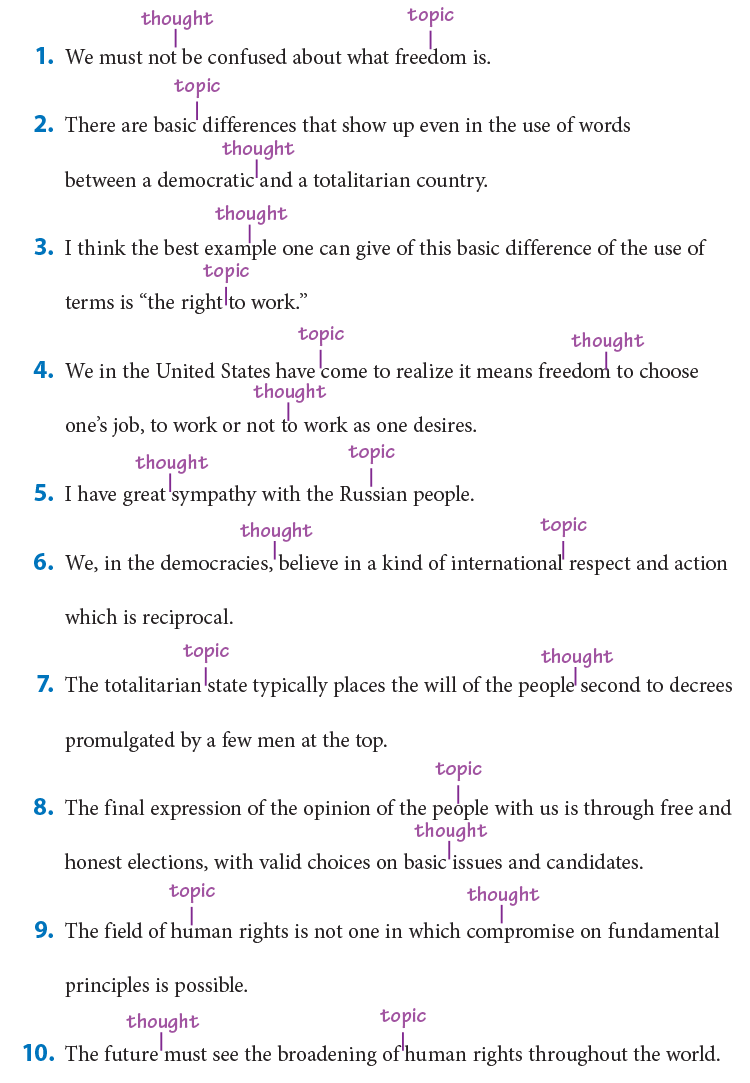
I have come this evening to talk with you (thought) on one of the greatest issues of our time—that is the preservation of human freedom (topic).
The Declaration (topic) was finally completed after much work during the last session of the Human Rights Commission in New York in the spring of 1948 (thought).
We must not be deluded by the efforts of the forces of reaction (topic) to prostitute the great words of our free tradition (thought) and thereby to confuse the struggle (thought).
Note that the topic of the controlling sentence isn't always the subject of the sentence. Instead, it is the main idea of the paragraph (in case of a topic sentence) or the whole text (in case of a thesis statement). Being able to identify the topic of the sentence and the special thought conveyed about the topic helps you quickly grasp the key points of any text you read.
Analyze controlling sentences.
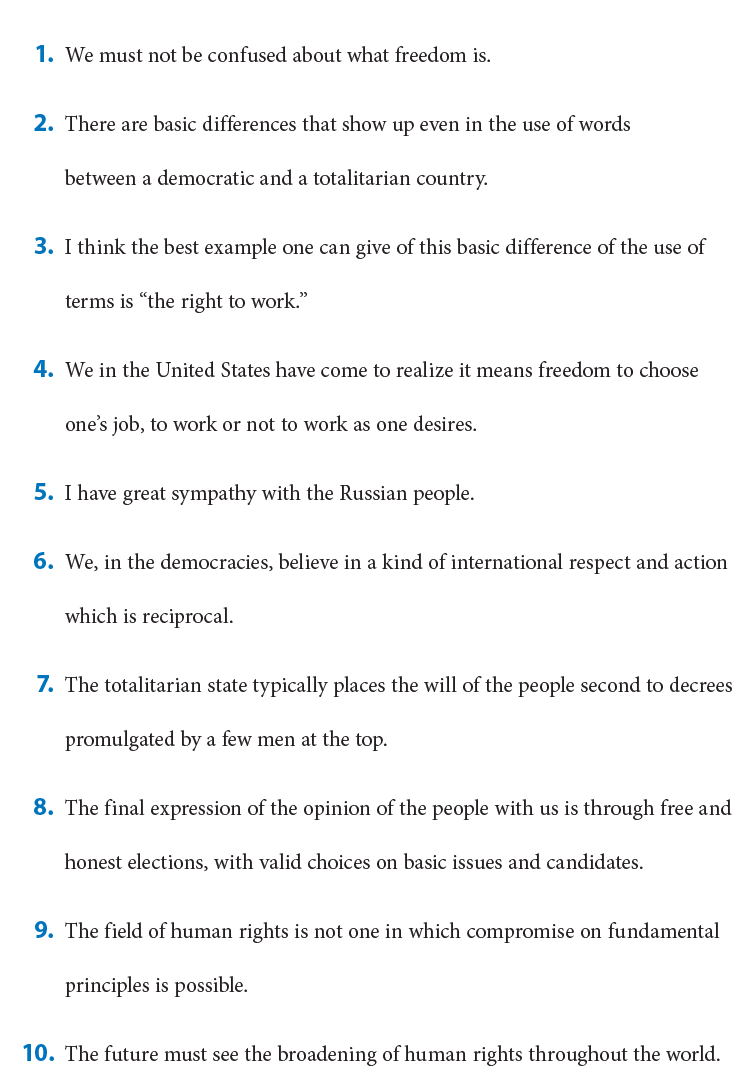
For each of these sentences, identify the topic and the special thought. Some sentences may have more than one special thought.
Inferring Controlling Sentences
If you can’t find a controlling sentence, you can infer one—creating one of your own. Read the following paragraph. Then read a controlling sentence that one reader inferred by stating the topic and the special thought about it.
Long ago in London during a discussion with Mr. Vyshinsky, he told me there was no such thing as freedom for the individual in the world. All freedom of the individual was conditioned by the rights of other individuals. That of course, I granted. I said: “We approach the question from a different point of view. We here in the United Nations are trying to develop ideals which will be broader in outlook, which will consider first the rights of man, which will consider what makes man more free; not governments, but man.”
The United Nations holds that human rights (topic) are the rights of individuals, not collectives (thought).
Infer controlling sentences.
For each paragraph, write a controlling sentence that states the topic and provides a special thought.
Naturally there must always be consideration of the rights of others; but in a democracy this is not a restriction. Indeed, in our democracies we make our freedoms secure because each of us is expected to respect the rights of others and we are free to make our own laws. Freedom for our peoples is not only a right, but also a tool. Freedom of speech, freedom of the press, freedom of information, freedom of assembly—these are not just abstract ideals to us; they are tools with which we create a way of life, a way of life in which we can enjoy freedom.
Sometimes the processes of democracy are slow, and I have known some of our leaders to say that a benevolent dictatorship would accomplish the ends desired in a much shorter time than it takes to go through the democratic processes of discussion and the slow formation of public opinion. But there is no way of insuring that a dictatorship will remain benevolent or that power once in the hands of a few will be returned to the people without struggle or revolution. This we have learned by experience and we accept the slow processes of democracy because we know that shortcuts compromise principles on which no compromise is possible.
Teaching Tip
Encourage students not just to name the topic and special thought, but to write controlling sentences that express the ideas using the voice of Eleanor Roosevelt.