Revising Narrative Arguments
Now that you have combined the argument and narrative portions of your work into one essay, you can take a look at the whole document. Some ideas may be stretched thin, needing more elaboration. Others may be redundant, needing cuts and better pacing. The two activities that follow will help you revise your combined draft.
Revising to Elaborate Ideas
When ideas feel thin, you can elaborate by imagining what questions a reader would ask. Then you can answer the reader’s main questions using a variety of details at a variety of levels. The writer of “Equity Matters” imagined the following interview, answering the reader’s questions in a number of different ways.
Writer: Like female students, male students get tagged with gender stereotypes that affect everything from what classes they are expected to take to how comfortable they are expressing their feelings.
Reader: Aren’t gender stereotypes based on actual differences between males and females?
Writer: Standard IQ tests as well as tests of mathematical aptitude show no significant difference between female and male students.
Reader: But aren’t women more social than men, and aren't men more aggressive than women?
Writer: Studies have a difficult time determining whether differences in sociability and aggression have more to do with biology (X and Y chromosomes and hormonal differences) or with cultural expectations. But scientists can definitively say that gender stereotypes strongly impact the behavior of males and females.
Reader: And what are the effects of these gender stereotypes?
Writer: The stereotype that men are more aggressive excuses some forms of harassment as "boys will be boys" and discourages women from taking dominant roles. Stereotypes also stigmatize social men and solitary women.
Reader: What can be done to challenge these stereotypes?
Writer: We can begin by recognizing that gender roles are culturally dependent, differing around the world and throughout time. Then we can examine the gender roles prevalent in our own culture and work to reduce stereotypes and improve openness.
Note how the writer answers “aren’t gender stereotypes based on actual differences?” with test results, and “aren’t women more social . . . and men more aggressive?” with scientific studies. She answers “what are the effects?” with examples, and “what can be done to challenge these stereotypes?” with specific propositions. By using different types of details in different levels of specificity, the writer fully explains the topic for the reader.
Elaborate explanations and arguments.
Place a piece of paper over a “thin” paragraph. Slide the paper down to read the first sentence and then write a question about it. Slide the paper down to reveal the next sentence and write another question. Keep going. At the end of the paragraph, answer the questions in your list. Then add some details to elaborate your ideas.
Teaching Tip
This activity works even better for partners. Have partners trade essays and write readers’ questions. Then have partners return the essays and questions so that writers can revise to include answers.
Revising for Pace
In the narrative portions of your paper, pacing is key. How much or little should you share about your experience? You want to engage your readers, but too much detail leaves them bored.
Too Much Detail
I ran for student council president, building my platform on gender issues in athletics. I made blue and pink posters with national statistics about gender inequality in high school sports. I stapled them to the school bulletin boards and taped them on lockers. The hallways looked ready for a big gender reveal party. When it was time to give my campaign speech, I was really nervous. My hands were sweating, and I stared blankly at the sold-out auditorium as the crowd murmured in boredom. Someone burped loudly and everybody laughed. When the laughter subsided, I started my speech, which began with a lament about how girls drop out of high school sports earlier than guys. Then I moved on to the social pressures facing female athletes. Then I spoke about body objectification, and, finally, poor playing conditions. I ended the speech, hands still sweating, by asking my fellow classmates to support me and my push for equality.
On the other hand, too little detail leaves readers unsure about your point.
Too Little Detail
I ran for student council president. I gave a campaign speech about what female athletes deal with in high school sports.
You need to dive into deep detail in an important moment and then surface for a quick summary of other action before diving into detail again.
Appropriate Detail
I ran for student council president, building my platform on my athletics pitch. In my campaign speech, I lamented how girls drop out of high school sports earlier than guys. I identified the social pressures, body objectification, and poor playing conditions female athletes face. And I asked my fellow classmates to support me and my push for equality.
Focus on significant events. In “Equity Matters,” the subsequent conversation with friends revealed important lessons about the writer’s experience, while putting up campaign posters did not.
Review your pacing.
Reread your narrative argument. If an unimportant event drags on, delete some details or replace the passage with a single summary sentence. If an important event gets glossed over, add details so readers can experience it firsthand. Continue working until all parts have effective pacing.
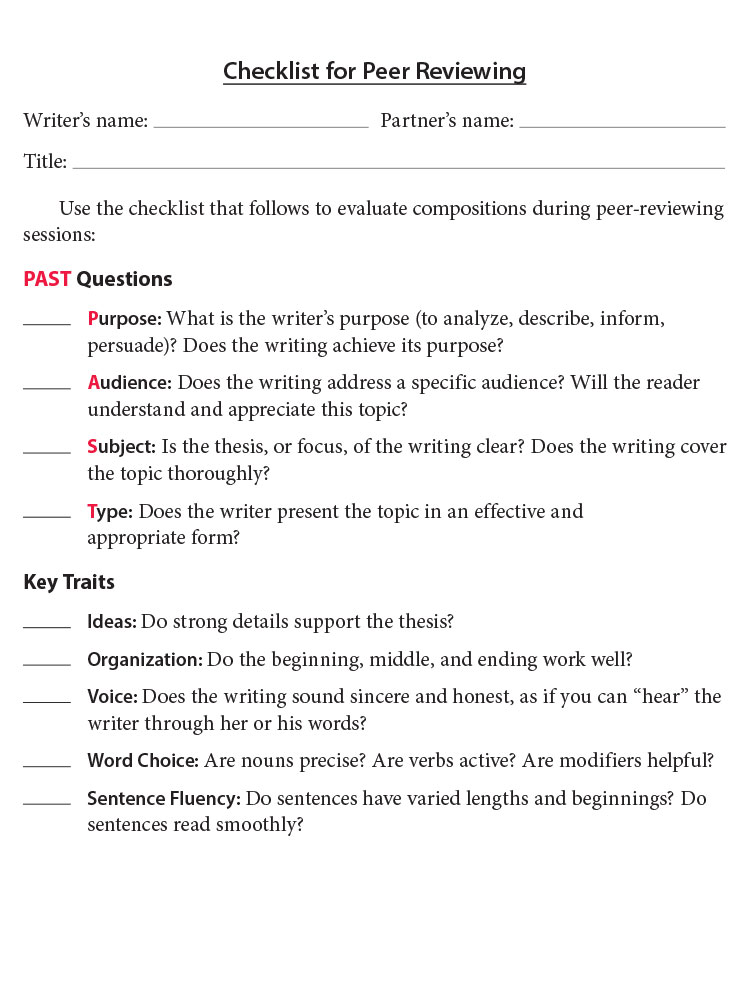
Sharing with a Peer Response
Share your writing.
Provide your narrative argument and this form to a classmate, asking for a peer review.
Revising in Action
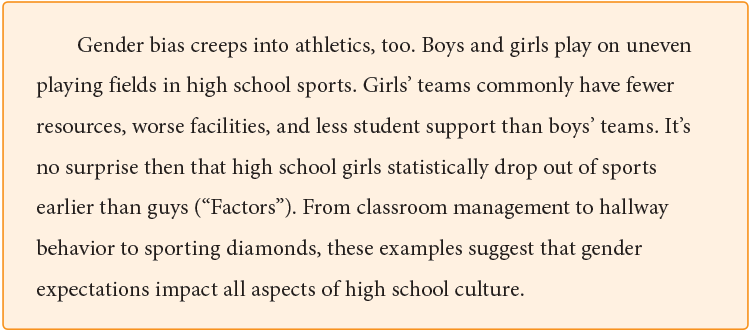
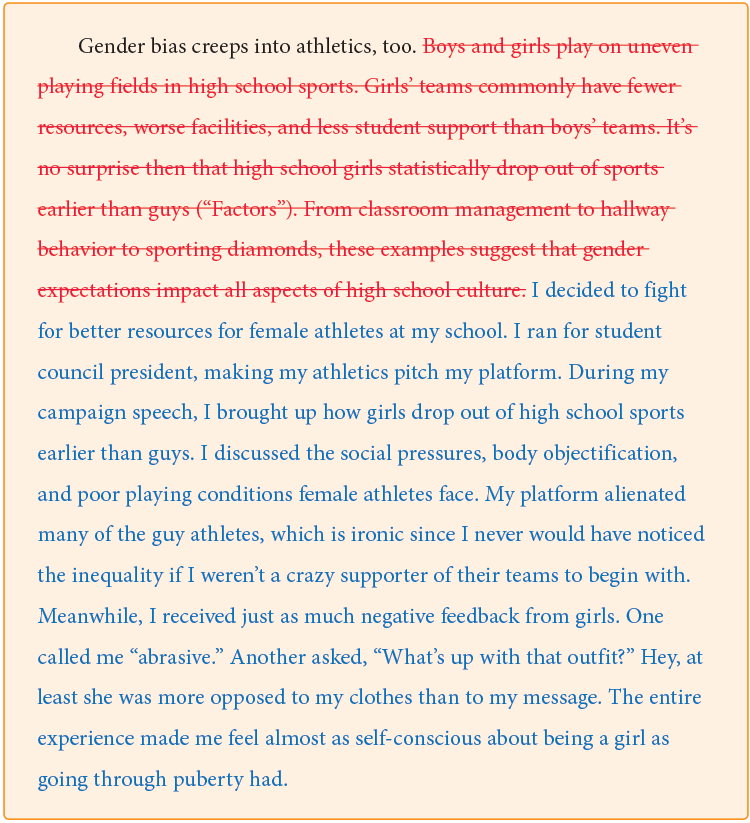
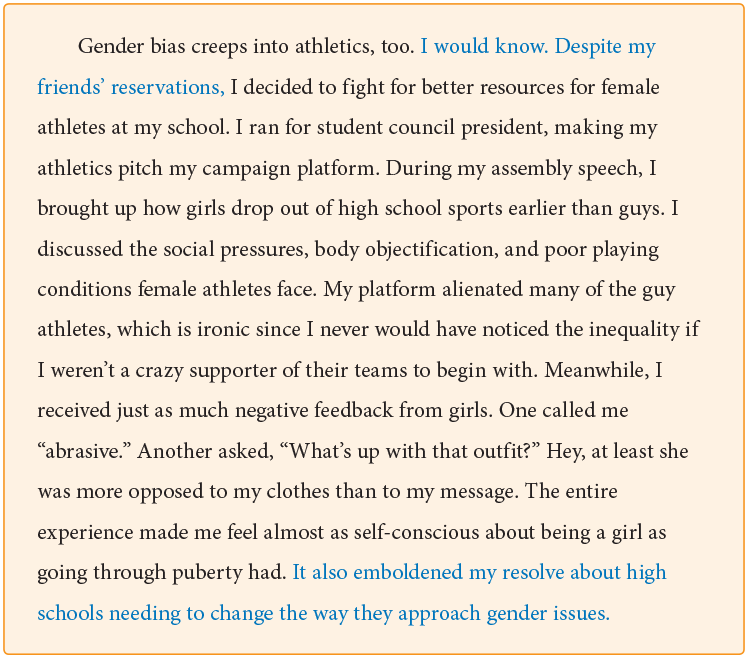
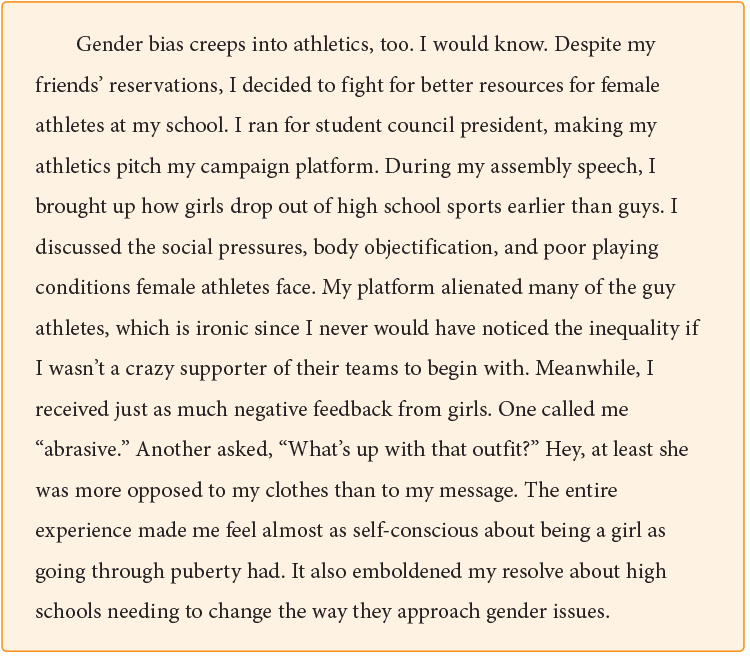
When you revise, you add, delete, rewrite, and rearrange your writing to make it clearer. Here are some revisions to “Equity Matters.” Click the arrows to trace the progression of the student’s paper, showing how she elaborated her argument using details from her narrative and added transitions to connect the new material.
-
Excerpt Before Revisions
-
Specific details elaborate ideas to answer readers’ questions and improve pacing.
-
New transitions smooth the shifts between narrative and argument.
-
Excerpt After Revisions
Revise with a checklist.
As you revise your narrative argument, ask yourself the questions on this checklist. When you can answer a question yes, check it off. Continue revising until all questions are checked off.
- Does the writing include a mix of narration and classic argumentation?
- Does the beginning capture the reader's attention and lead up to a clear position statement?
- Does the argument use strong logic and reasons?
- Does the argument support reasons with sufficient evidence?
- Are the transitions between narrative and argument parts clear and logical?
- Is the voice for argument parts analytical and persuasive?
- Is the voice for the narrative passionate and personable?
- Do sentences read smoothly and vary in lengths and beginnings?