CCSS.ELA-LITERACY.W.9-10.3.A

By Anonymous (not verified), 16 March, 2026
This narrative tells of a local protest to make positive change in the writer's community.
By Anonymous (not verified), 16 March, 2026
A student recalls visiting a nursing home for a volunteere project.
By Anonymous (not verified), 16 March, 2026
This model describes the writers experience at a family wedding.
By Anonymous (not verified), 16 March, 2026
A student describes an interesting experience with the "Think-About-It" baby.
By Anonymous (not verified), 12 March, 2026

Assembling Your Narrative Argument

By now you have completed drafts of an argument essay and a narrative. Great work! The two main components of your narrative argument are ready to go. Now comes the fun part—combining both forms into a single paper. Finding the right mix is not an exact science. You'll need to experiment with different arrangements to create your strongest argument. The activities in this lesson will help.

Combining Argument and Narrative

Follow these steps to blend your two separate essays into a narrative argument. As you work through the steps, remember that you can add, cut, rewrite, and rearrange parts of both original pieces as needed.

  1. Make your original argument essay the base of your paper.
  2. Read over both pieces one more time.
  3. Decide what portions of your narrative support your argument.
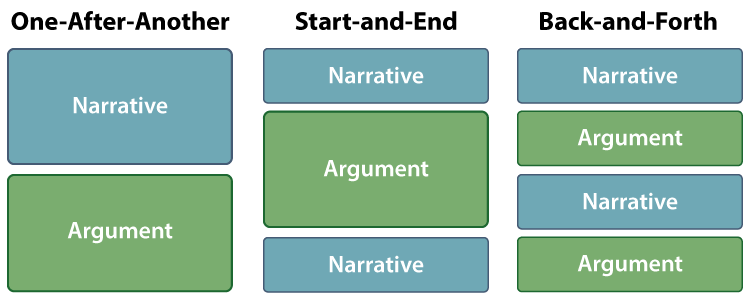
  4. Experiment with different combinations of narration and argumentation. Here are three common ways to organize a narrative argument:
    • One-After-Another: Start with your full narrative and transition to your full argument or vice versa.
    • Start-and-End: Start with a portion of your narrative, transition to your argument, and then return to your narrative.
    • Back-and-Forth: Start with your narrative or argument and transition back and forth multiple times between both pieces.

Narrative Argument Organizer

  1. Evaluate the results. Which pattern most effectively strengthens the argument? Which pattern is easiest to follow? Which pattern will most likely get readers to empathize with your position?
  2. Choose a pattern.
  3. Add parts (or all) of your narrative to your argument essay. If you are working in a word-processing program, you can simply copy and paste the parts. Reword sections as needed to improve the flow.
By Anonymous (not verified), 12 March, 2026

Writing a Narrative

After identifying your focus and gathering details about it, you are ready to write your narrative. Remember that a narrative is more than a chronological list of events. It is a true-life story with characters and conflict, so you need to build it like a story. The activities on this page will help.

Writing the Narrative Beginning

The beginning of your narrative has a number of jobs:

  • Catch the reader's attention.
  • Introduce the main character (person of focus).
  • Describe the setting (time and place).
  • Create conflict.

Write the beginning.

Experiment with strategies for capturing the reader's interest. Use the examples below for inspiration. Then develop a beginning that introduces the main character, describes the setting, and sets up the conflict.

  1. Start in the middle of the action.

    Flush with determination, I stepped up to the podium. I had a strong speech. I had a strong message. I was ready to fight for equal rights. So how did I know it was all doomed?

  2. Use interesting dialogue.

    "There goes Drama Jess again. Making something out of nothing." Girls with an opinion get that a lot in high school.

  3. Pose a fascinating question.

    What does justice mean to you?

  4. Set up the conflict.

    I’m a sports fanatic. I’m also a girl. I thought by now my gender wouldn't be an issue, but last school year showed it still is.

By Anonymous (not verified), 12 March, 2026

Revising Résumés and Cover Letters

So you've done the hard part, actually writing the résumé and cover letter. Take a little break if you can. Then come back to them. You want to make sure these two documents do the best job of representing you to a potential employer. Is there some critical piece of information that you forgot to include? Is there some extraneous piece of information that you don't need? In revision, you can make sure your documents have all the "right stuff."

Revising for Key Details

Remember that your cover letter and résumé are really meant for the employer, not for you. You already know who you are. The employer needs to know, so these documents should provide the key details without distraction. You can check for details by reviewing item 3 on the prewriting activity "Take the Employer's Perspective."

3. What kind of employee would make life better for this contact person?

A part-time reporter who can take any assignment, attend an event, interview those involved, take photos, research carefully, check facts, write a news article or feature article, create an effective headline, and digitally submit materials on or before deadline.

What employer needs did you fail to address in your cover letter and résumé? For example, Joyce realized that she forgot to mention that she is a skilled photographer, so she can provide images for her articles. She added a line to the "Skills and Qualifications" section of her résumé.

By Anonymous (not verified), 12 March, 2026

Writing Your Résumé

If you've done your prewriting work, creating a résumé should be fairly straightforward. Simply fill in each section with your information. The activities below will help you use parallel construction and telegraphic style.

Writing with Parallel Structure and Telegraphic Style

All similar elements in your résumé should use parallel structure, which means the same grammatical form. For example, each work experience item should list job title, employer, dates of employment, and duties—in that order, with the same punctuation and treatment for each element. By contrast, lists of skills and qualifications might all be adjectives:

WORK EXPERIENCE

  • Lifeguard—Campground Pool, Summers 2016 to present: Work closely with manager and liaison, guard Olympic-sized pool, . . .
  • Stocker/bagger—Rioldi's Market, Fall-Spring 2017 to present: Work closely with store manager, stock shelves, . . .
By Anonymous (not verified), 12 March, 2026

Prewriting for Résumés and Cover Letters

Though your reader begins with your cover letter and ends with your résumé, you need to work the other way around. Your first step is to create a general résumé that captures the most important details about your experience and education, for any job. Once you have a résumé, you can adjust it to fit a specific job opportunity. And then you can write a separate cover letter to apply for the job. Start by thinking about who you are.

Prewriting to Gather Details About Yourself

Before you write your résumé, you should think about your experiences and skills. At this point you don't need to worry about résumé sections or parallel structure or "telegraphic style." You just need to think about what you've learned, and what you have to offer employers. Answering questions can help.

  1. What three words would friends use to describe you and why?

    They would call me "funny and intense and weird." I like to make jokes to get friends to laugh, but when I'm serious about something, I'm super serious. Also, I'm serious about things most people aren't, like whether food can touch on a plate or whether your toothbrush can go in a cup with others (it shouldn't).

  2. What three words would teachers use to describe you and why?

    They would call me "hard-working, smart, and nice." I want to get good grades, so I work hard in class and on homework. That makes me come off as smart because I'm well prepared. But I'm also nice. I help other people who are having trouble.

  3. What would your dream job be?

    I'd like to be an air-traffic controller, preferably in the Navy on an aircraft carrier. I love everything about airplanes, especially military airplanes, but I get motion sick, so I'd rather be controlling them than piloting them. An aircraft carrier is probably big enough I wouldn't get motion sick.

  4. What job are you best suited for right now?

    I've been a lifeguard for two summers, so I know that job really well. I'd like to move up to be pool manager. It's a lot more hours but also a lot more pay. I could use the money for college.

  5. What experience do you have that suits you for the job?

    Guarding, cleaning up the pool, staffing the front desk, being in the locker-rooms, repairs, filter cleaning, working with everybody, you name it. Also, I've been a stocker and bagger at Rioldi's for two years, so I know about hard work and following directions.

  6. What education do you have that suits you for the job?

    I'm about to graduate high school. They want someone with at least a high school diploma. Also, I have Lifeguard Instructor certification. That's the latest one.

  7. Have you gotten any awards or honors?

    I'm in National Honor Society and I've got a letter for Swim Team.

By Anonymous (not verified), 12 March, 2026

Warm-Up for Résumé Writing

In tribal societies, pretty much everybody has to do everything: hunting, gathering, making tools, building shelters, fetching water, hauling goods, fighting predators, bartering, teaching, learning, and so on. In modern societies, people specialize. Most people don't grow their own wheat or make their own circular saws or build their own houses. Instead, they pay experts who can do these tasks much more effectively and efficiently while meanwhile making money doing something they are experts in.

Your schooling is starting you on the road to becoming an expert in something. Your first few jobs will continue that journey. Just as you've learned a great deal in school, you will learn even more as you work and develop expertise. But how do you build a bridge from the classroom to the workplace? You start by writing an effective résumé.

What Is a Résumé?

Listen to "What Is a Résumé?"

Your browser does not support the audio tag.

Hide audio

Writing Literary Analysis
© Thoughtful Learning 2018

A résumé is a document that helps potential employers understand who you are: your objectives, experience, skills, education, and awards. The word résumé comes from the French "resume," meaning to "take back, assume again, or regain." In other words, when you are writing a résumé, you are regaining all of the experiences you've had that can prepare you to succeed in a new opportunity. Some people also use the term c.v. or curriculum vitae, which means "course of one's life."

Thinking About the Course of Your Life

You began life as a single cell. You now have a trillion of them. That's a lot of change to go through. You can reflect over the long course of your life by completing a time line. For each period, list key experiences, educational influences, and who you became. Here's the course of one student's life.