CCSS.ELA-LITERACY.W.11-12.1.E

By Anonymous (not verified), 16 March, 2026
A high school student prepared this speech to deliver at a local meeting of Veterans of Foreign Wars. The speech combines narrative and argumentation to build a vision for the future of the United States.
By Anonymous (not verified), 16 March, 2026
This good problem-solution essay argues for renewable, carbon-neutral ethanol fuel to reduce green-house emissions and support energy independence.
By Anonymous (not verified), 16 March, 2026
This strong problem-solution essay focuses on a renewable and carbon-neutral energy option that could power the future and save the environment.
By Anonymous (not verified), 16 March, 2026
In this fair problem-solution essay, a student addresses the problem of climate change by suggesting an alternative fuel source.
By Anonymous (not verified), 16 March, 2026
In this poor problem-solution essay, a student argues for the use of ethanol.
By Anonymous (not verified), 16 March, 2026
In this persuasive speech for Honors Public Speaking, a student imagines his inauguration as the 49th U.S. President in the middle of the 21st Century.
By Anonymous (not verified), 16 March, 2026
In this inauguration speech, a student parodies ineffective speech making but as a result creates a less-than-effective piece of rhetoric.
By Anonymous (not verified), 12 March, 2026

Assessing with Rubrics

Test graders will use a rubric to judge the quality of your writing for assessment. They typically provide a score of 0–4, 0–6, or even 0–8 for each category on the rubric, such as Focus, Organization, Evidence, Language, and Conventions. Then they add up these scores and divide by the number of categories to get the overall average score. By using the following rubrics to judge your own assessment writing, you can become aware of what testers are looking for and can improve your scores in the future.

Assess with an argument rubric.

Use the following rubric to score argument or persuasive essays for assessment.
By Anonymous (not verified), 12 March, 2026

Assembling Your Narrative Argument

By now you have completed drafts of an argument essay and a narrative. Great work! The two main components of your narrative argument are ready to go. Now comes the fun part—combining both forms into a single paper. Finding the right mix is not an exact science. You'll need to experiment with different arrangements to create your strongest argument. The activities in this lesson will help.

Combining Argument and Narrative

Follow these steps to blend your two separate essays into a narrative argument. As you work through the steps, remember that you can add, cut, rewrite, and rearrange parts of both original pieces as needed.

  1. Make your original argument essay the base of your paper.
  2. Read over both pieces one more time.
  3. Decide what portions of your narrative support your argument.
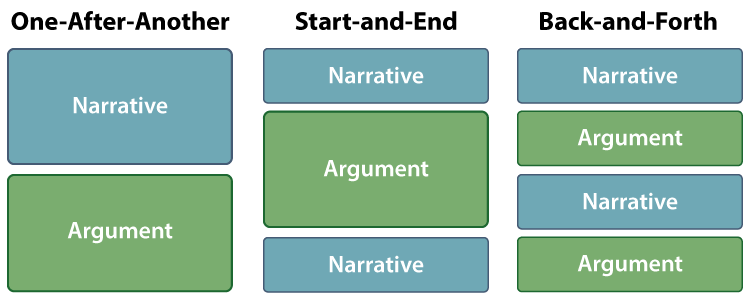
  4. Experiment with different combinations of narration and argumentation. Here are three common ways to organize a narrative argument:
    • One-After-Another: Start with your full narrative and transition to your full argument or vice versa.
    • Start-and-End: Start with a portion of your narrative, transition to your argument, and then return to your narrative.
    • Back-and-Forth: Start with your narrative or argument and transition back and forth multiple times between both pieces.

Narrative Argument Organizer

  1. Evaluate the results. Which pattern most effectively strengthens the argument? Which pattern is easiest to follow? Which pattern will most likely get readers to empathize with your position?
  2. Choose a pattern.
  3. Add parts (or all) of your narrative to your argument essay. If you are working in a word-processing program, you can simply copy and paste the parts. Reword sections as needed to improve the flow.