CCSS.ELA-LITERACY.W.6.1.E

By Anonymous (not verified), 12 March, 2026

Revising Advertisement Essays

After you write a first draft, you're ready to revise. You need to think about how well you have connected your product to the needs of readers. You also need to make sure you haven't used any unfair appeals, which actually weaken your argument. These activities will help you revise.

Revising to Appeal to Readers

You can't convince people to buy your product by showing how it will help you. You must convince them by showing how your product helps them. To do so effectively, you need to think about the needs of your audience.
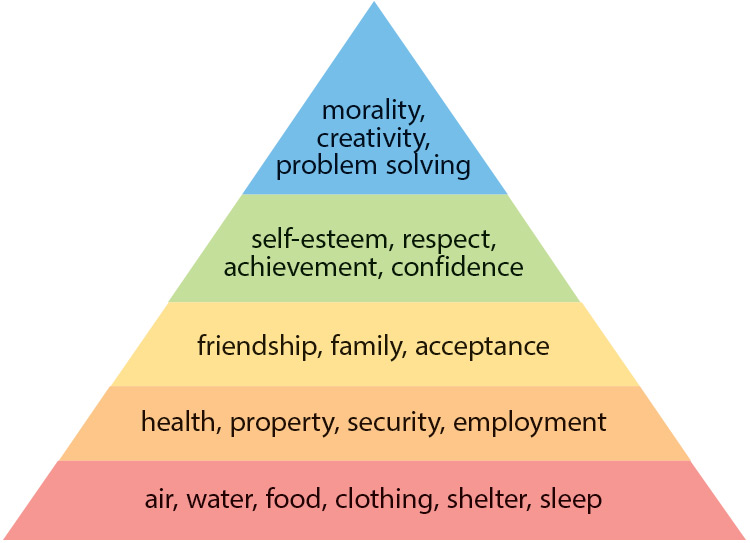
Basic Needs Pyramid

The American psychologist Abraham Maslow created a pyramid that showed different levels of human need. At the bottom, you'll find basic needs: air, water, food, and so on. On the next level, you'll find needs that build on those, and so on, going up to morality, creativity, and problem solving at the top. You can use this pyramid to connect your product to the needs of your readers.

Connect to readers' needs.

Answer the following questions to think of ways your product helps readers.

  1. How does your product connect with readers' basic needs (bottom-level)?
  2. How does your product connect with readers' intermediate needs (middle three levels)?
  3. How does your product connect with readers' upper-level needs (top triangle)?
  4. Choose three needs from the list above. For each one, write a sentence that appeals to your reader, showing how the person benefits from the product.
By Anonymous (not verified), 12 March, 2026

Writing an Advertisement Essay

Now that you have chosen a product to promote, listed reasons to use it, and gathered details to support your reasons, you are ready to connect your ideas in a first draft. These writing activities will help you create a strong beginning, middle, and ending. You'll also read another student's advertisement essay to see how all of the parts came together.

Writing the Beginning Paragraph

The first sentence is the lead. It should capture your reader’s interest, getting people interested in your product.

Write a lead.

Review each lead-writing strategy and write an example of your own.

  1. Ask the reader a question.

    What weighs less than a pound and could save your life?

  2. Start with a story.

    After school, you walk out the door and throw on your backpack. You unlock your bike from the bike rack. Then you hop on and ride off. What’s missing from this picture?

  3. Begin with an important quotation.

    "Wear a helmet now. Finish living later." That's just one slogan of many submitted to the recent Bicycle Helmet Safety Slogan Contest.

  4. Make a surprising statement.

    When bike fatalaties occur, 97 percent of the time, the rider had no helmet.

Write your beginning paragraph.

Write your lead and then provide details as you work toward your opinion statement. Write the opinion statement as the last sentence in the beginning paragraph.

Lead Sentence

Detail Sentences

Opinion Statement

By Anonymous (not verified), 12 March, 2026

Writing a Persuasive Essay

Once you finish prewriting, you are ready to create the first draft of your essay. These writing activities will help you create a strong beginning, middle, and ending for your persuasive essay.

Writing the Beginning Paragraph

The beginning paragraph of your essay is very important. It should get the reader interested in your topic, and it should state your opinion. To gain your reader’s interest, share some important background information, ask a question, begin with a quotation, or start with a surprising statement.

Read a sample, and write your beginning paragraph.

Read this beginning paragraph, and then write your own.

Topic NamedMany local schools have decided to install metal detectors. But are metal detectors the answer for all schools?Key Question The answer to this question for King Middle School is no. Our school has a good safety record. For this and other reasons, metal Opinion Statement detectors are not needed.

Beginning Paragraph

By Anonymous (not verified), 12 March, 2026

Revising Promotion Essays

After you write a first draft, you'll be ready to start reviewing and revising. When you revise, you think about the "big picture," including your opinion, reasons, and details and the ways that you connect them into a beginning, middle, and ending. These activities will help you revise.

Revising to Answer Objections

Believe it or not, one of the most powerful ways to support your opinion is to consider the ideas of people who disagree. When you mention an opposing viewpoint, you show your reader that you have already thought about objections against your opinion. You also get the opportunity to handle the objection in one of three ways:

  • Refuting the objection means showing how the opposing idea is incorrect.

    Some people say that students who have to share instruments learn patience and cooperation. Unfortunately in the past, students who share instruments have only learned that band is not for them and have dropped out.

  • Addressing the objection means recognizing it is valid but has some limitations.

    Many people have suggested a fund-raiser to make money for new instruments. Though fund-raisers can be helpful, the cost of new instruments means a lot of effort to buy only a few instruments.

  • Conceding the objection means saying it is a good point while at the same time stressing the importance of your position.

    Yes, every student would prefer to play a new instrument. That's true. But a used instrument is better than nothing, which is what many students currently have.

Answer objections.

Think about three objections to your opinion and write them in the spaces provided. Then, under each objection, write a response that refutes, addresses, or concedes the objection.

Objection 1:

Answer 1 (Refute, Address, or Concede):

Objection 2:

Answer 2 (Refute, Address, or Concede):

Objection 3:

Answer 3 (Refute, Address, or Concede):

By Anonymous (not verified), 12 March, 2026

Writing a Promotion Essay

Once you have selected a topic, formed an opinion, and organized reasons to support the opinion, you are ready to write a first draft of your essay. These writing activities will help you create a strong beginning, middle, and ending. You'll also read another student's promotion essay to see how all of the parts came together.

Writing the Beginning Paragraph

The first sentence is called the lead. It should capture your reader’s attention, introducing the cause in an interesting way.

Write a lead.

Review each lead-writing strategy and write an example of your own.

  1. Ask a provocative question about the topic.

    What does a trumpet player sound like without a trumpet?

  2. Start with a surprising fact or detail about the topic.

    The trumpet section of our band has ten players but only six trumpets.

  3. Tell a little story about the topic.

    The first time I played my trumpet in concert, I realized I had made a friend for life.

Write your beginning paragraph.

Write your lead and then provide details as you work toward your opinion statement. Write the opinion statement as the last sentence in the beginning paragraph.

Cheating in America Did you know that 7 out of 10 students have cheated at least once in the past year? Did you know that 50 percent of those students have cheated more than twice? These shocking statistics are from a survey of 9,000 U.S. high school students. Incredibly, teachers may even be encouraging their students to cheat! Last year at a school in Detroit, teachers allegedly provided their students with answers to statewide standard tests. Students at the school told investigators that they were promised pizza and money if they cheated on the test as told.
Summer: 15 Days or 2 1/2 Months? The final bell rings. It’s the last day of school, and summer has finally come! Students don’t have to think about school for at least another 2 1/2 months. That is the way it should always be. Schools should continue using the traditional calendar and not a year-round schedule. There are numerous downsides to year-round schooling. It has no positive effects on education, it adds to costs, and it disrupts the long-awaited summer vacation. Contrary to the well-accepted belief, year-round schooling has no constructive impact on education.
Hang Up and Drive You see it every day, especially in freeway traffic. A car is weaving back and forth, speeding up then slowing down, or suddenly stopping. No, it’s not a drunk driver. It’s a cell-phone driver. Cell phones are used everywhere, but on the road they are a dangerous distraction to drivers and should be prohibited. The New England Journal of Medicine reported that “motorists using a cell phone were four times more likely to have an accident than those not using a phone.” The major problem is that the driver is not focused on the road, but on his or her conversation.
Musical Arts “Fine arts are important in the curriculum because of what they do for learning,” stated Patty Taylor, arts consultant for the California State Department of Education. In other words, the arts, especially music, should be part of every school’s curriculum at every grade level. Music makes students smarter, gives children something positive to do, and builds self-confidence. Most students don’t have a chance to learn music outside of school, and everyone deserves that opportunity. Students would be much smarter if they had some music experience.
To: Heidi Larson Dear Dr. Larson: Your accountant, Rusty Silhacek, is my neighbor. He mentioned that your office stays very busy, so I wondered if you could use some extra help. I would like to apply for a position as a part-time veterinary assistant. As far as animal care goes, I’m experienced in feeding, bathing, exercising, and cleaning up after small and large animals. I truly love animals and have always given them special attention and care. I would be available to help after school and on weekends. I would be happy to come in for an interview at your convenience.