CCSS.ELA-LITERACY.W.9-10.6

By Anonymous (not verified), 12 March, 2026

Writing a Personal Essay

After listing events on a time line and gathering different details about them, you are ready to write your personal essay. But a personal essay is more than a chronological list of events. It is a true-life story with you as the hero, so you need to build it like a story. The activities on this page will help.

Writing the Beginning

The beginning of your essay has a number of jobs:

  • Catch the reader's attention
  • Introduce the character (yourself)
  • Describe the setting (time and place)
  • Create conflict

You can click on the side notes of this excerpt to see how the sample student essay does all of these things in a compact space:

Catch Attention Winter wouldn't let go. Tired gray snow clung to the curbs. Tired gray clouds clung to the sky. The lion of March still prowled, growling its storms and hissing its sleet, and Introduce Character I wondered why Mom ever chose to move to Wisconsin.

Create Conflict A job. I got it. A break-up. Yeah. Life happened. She started over, and so did I. Again.

Describe Setting This time, I changed schools mid-semester, which meant I lost half my credits and had to play catch-up in every class. I knew nobody and didn't have any real desire to make friends. How long would we be here? I trudged to school and trudged home and sat in that gray apartment flipping through Snapchats to see the full-color lives of my friends back in Florida.

"I'm taking a second job," Mom told me one night. "So I won't be home most evenings."

This excerpt catches the reader's attention by creating an intriguing mood. You can experiment with other opening strategies.

Write the beginning.

Experiment with strategies for capturing the reader's interest. Use the examples below for inspiration. Then develop a beginning that introduces you, describes the setting, and creates conflict.

  1. Start in the middle of the action.

    A lump in my throat, I grabbed a script and took the stage in front of a theater filled with strangers. Old strangers. How did I wind up here?

  2. Use interesting dialogue.

    "If you get cast in this show, you're going to have to swear. Onstage. Loudly."

  3. Pose a fascinating question.

    Do caterpillars know what they are doing when they entomb themselves in a chrysalis, or do they just figure they've finally gone crazy? I felt slightly crazy when I buried myself in two months of rehearsals for On Golden Pond.

  4. Make a startling statement.

    Sometimes guts are smarter than brains.

By Anonymous (not verified), 12 March, 2026

Prewriting for Personal Essays

The word recall means exactly what it says: "call a memory back into mind." The word recollect is much the same: "collect memories again." Even the word remember means "put the parts back together again." So, the first part of the process of writing a personal essay is calling back and collecting and reassembling the many memories you have of key periods in your life. You'll start by selecting a specific period to explore.

By Anonymous (not verified), 12 March, 2026

Warm-Up for Personal Essays

What is your very first memory? Was it splashing in a bathtub with little plastic boats, or sharing a cookie with the kid who lived next door, or seeing a reindeer in a holiday parade? People say that your very first memory says a lot about who you are. Why? Because the experience meant something to you at the time and still means something to you now—since you've held onto it all these years.

In fact, the reason we can't remember our earliest years is that we hadn't yet begun to develop what psychologists call autobiographical memory. You probably learned to walk when you were very young but have no memory of it. That's because you didn't start to fashion a mental narrative of your life until you were about three years old. At that point, you started remembering experiences because they helped to explain who you are. Your very sense of self is tied to the memories you have and the stories you tell about them.

You can explore an especially important period in your life by writing a personal essay.

What Is a Personal Essay?

Listen to "What Is a Personal Essay?"

Your browser does not support the audio tag.

Hide audio

Writing Literary Analysis
© Thoughtful Learning 2018

A personal essay is a narrative about an important time in your life, showing how it shaped who you are. Instead of focusing on just one event, a personal essay relates a number of events over an extended time frame, weaving them together into a "story of you." It won't be enough just to put details in chronological order—first this happened . . . then that happened . . . and afterward this other thing. . . . Instead, you need to show the significance of each event and build them into a narrative arc. You'll learn how in the coming lessons. First, though, you can warm up by imagining you have a time machine.

Thinking About Your Past

In the book Harry Potter and the Prisoner of Azkaban, chronic overachiever Hermione Granger uses a "time-turner" to jump back in time and attend a second class while her first self was busy studying in a different class. Now imagine that you have your own time-turner—but you won't be using it to attend classes.

Also, your time-turner works a bit differently. It takes you back to relive three months of your life. You don't watch yourself from the outside. You experience everything again, only this time with your memories of the future riding along. What time period would you choose? Why?

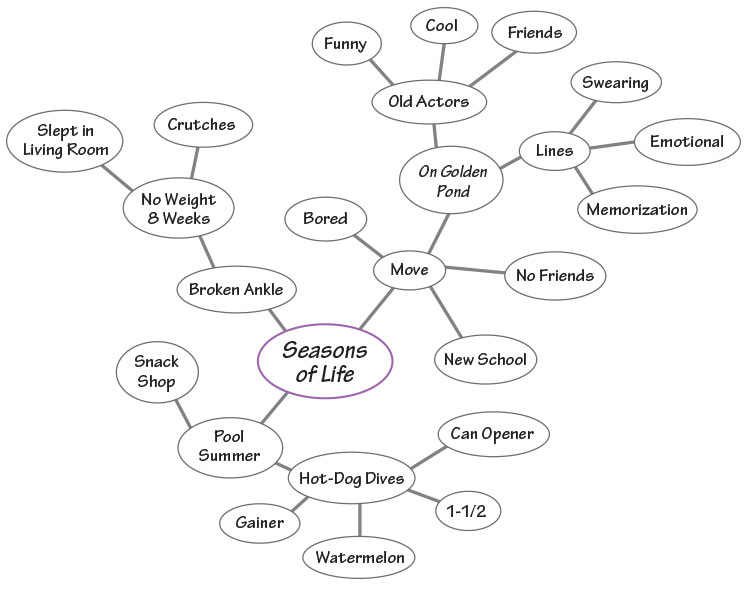
You can use a cluster to explore possible times. Think of "seasons of your life" (approximately three months) and write down at least three such time periods. Then explore each season by adding images, thoughts, actions, and sensations. Use this student cluster as inspiration:

Cluster Diagram