CCSS.ELA-LITERACY.L.9-10.4

By Anonymous (not verified), 12 March, 2026

Answering Multiple-Choice Questions Nonfiction Assessment VI

The PARCC and Smarter Balanced assessments and other tests of the Common Core English standards use multiple-choice questions to check your ability to revise and edit texts. The SAT and ACT also include these sorts of questions.

The following multiple choice questions test your understanding of conventions: punctuation, spelling, grammar, and sentences. Then you will find a reading and a set of questions to test your paragraph-revision skills.

Respond to questions about conventions.

Carefully read each question and possible response before selecting your answer. If the underlined section is already correct, select NO CHANGE.

By Anonymous (not verified), 12 March, 2026

Warm-Up for Comparison-Contrast Essays

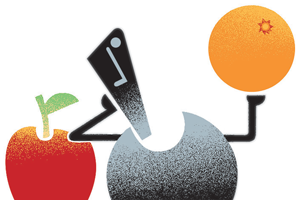
People often say, "You can't compare apples and oranges." Of course you can. Apples and oranges are both fist-sized fruits with an outer protective covering, sweet inner flesh, and seeds. Both grow on trees and appear in supermarkets. Both come in delicious varieties. These fruits are different in many ways as well: color, texture, taste, vitamins, acidity, availability, seasons, and so on. By comparing and contrasting apples and oranges, you learn more about each.

This kind of analytical thinking can help you understand just about any two topics, whether protagonists in novels or types of respiratory systems in animals or generals in the Civil War. In this unit, you'll select two topics from your own areas of study or from personal interest and compare and contrast them.

What Are Comparing and Contrasting?

Listen to "What Are Comparing and Contrasting?"

Your browser does not support the audio tag.

Hide audio
Writing Comparing and Contrasting Essays
© Thoughtful Learning 2018

When you compare two topics, you find the similarities between them. When you contrast them, you focus on differences. Yes, you can compare and contrast apples and oranges, but your thinking needs to use parallel structure. In other words, you compare and contrast the appearance of both, and then the taste, and then the color. You shouldn't say, "While an orange has a tangy, slightly acidic taste, an apple comes in different colors." You shouldn't compare the taste of the orange to the color of the apple.

As you can see, a comparison-contrast essay needs to keep ideas neatly sorted. You have two separate topics, the similarities and differences between them, and the many points of comparison and contrast. This unit will help you manage all of this complexity, thinking effectively about your topics and developing a clear, thorough, and compelling essay.

You can warm up your thinking by comparing and contrasting yourself and one of your friends or family members.

Thinking About People

You may have a lot in common with a friend or family member, or very little in common, or some combination. You can analyze the similarities and differences between yourself and a person you like by writing about each of you, point by point. One student compared and contrasted himself to his best friend by completing the following chart.
By Anonymous (not verified), 12 March, 2026

Understanding Vocabulary

When you read an unfamiliar word, you need to figure out its meaning based on how it is used. You can use the following context clues to guess a meaning.

Word parts

let you assemble meaning from prefixes, suffixes, and roots.

The Mars rover has autonomous navigation abilities.

(The prefix auto means “self,” the root nom means “law,” and the suffix ous means "having to do with," so autonomous must mean “having self-rule,” or "self-governing" or "self-guiding.")

Cause-and-effect

clues let you infer meaning.

In the first year of the Civil War, Lincoln suspended the writ of habeas corpus so that he could hold rebels in jail without having to bring them to trial.

(If suspending a writ of habeas corpus means that people can be held without trial, the writ of habeas corpus must prevent the government from holding people in jail without trial.)

Definitions

embedded within the text spell out the meaning.

Ovo-lacto vegetarians consume eggs and milk as well as plants but avoid other animal products.

(Ovo-lacto vegetarians consume eggs, milk, and plants; ovo means "egg," lacto means "milk," and vegetarian means "plant eater.”)

A series

includes an unknown word with known words of the same type.

Whether they spot a brown bear, grizzly, or Kodiak, hikers should keep their distance.

(Since brown bears and grizzlies are North American bears, the Kodiak must also be a species of North American bear.)

Examples

provide specific instances of general ideas.

Algebra 1 and 2 and Geometry are prerequisites for Trigonometry.

(Algebra 1 and 2 and Geometry are basic high school math courses, while Trigonometry is an advanced high school math course, so a prerequisite must be a basic course required before taking an advanced course.)

Synonyms

have the same meaning as the unfamiliar word.

For this year's solo and ensemble contest, you could sing a song or an aria.

(An aria must be a sort of song.)

Antonyms

have the opposite meaning as an unfamiliar word.

After months of public appearances, the candidate enjoyed a weekend of reclusion.

(As the opposite of "public appearances," reclusion must mean "being away from other people.")

Tone

reveals the writer’s thoughts about a word.

The early summer evening was redolent with apple blossoms, charcoal smoke, and fresh-mown grass.

(The pleasant smells in an early summer evening suggests that redolent means "fragrantly scented.")

By Anonymous (not verified), 12 March, 2026

Warm-Up for Definition Essays

Words let you think. When you don't have a word for something, you can't think very effectively about it. For example, you might think very little about the pencils you use, but having terms for different kinds of pencils can awaken your thinking:

  • Hexie: a pencil with six flat sides
  • Rounder: a pencil with a round bore
  • Flatty: a carpenter's pencil, made not to break in a pocket and sharpened by whittling
  • Dentcil: a pencil that has been chewed
  • Penstub: a pencil that has been sharpened too many times; a golf pencil
  • One-shot: a pencil with no eraser
  • Mulligan: a pencil with a large eraser
  • Fakecil: a pencil that won't sharpen correctly, with a tip of wood that doesn't write
  • Lightsee: a #3 pencil that doesn't write darkly enough to be easily read
  • Smudgie: a #1 pencil that writes like a crayon and smears
  • Spock: a mechanical pencil
  • Horseleg: an oversized pencil that doesn't fit in a sharpener

Check your pencils.

Check your backpack or locker to see how many of each type of pencil you can find. How many pencils fit more than one term? (For example, a chewed pencil with no eraser would be a dentcil one-shot.) What other words could you invent for different types of pencils? Which of these made-up terms interests you most and why?

What Is a Definition Essay?

Listen to "What Is a Definition Essay?"

Your browser does not support the audio tag.

Hide audio

Writing Definition Essays
© Thoughtful Learning 2018

A definition essay deeply explores the meaning of a term. It includes dictionary definitions (denotations), but goes far beyond, providing examples, etymology, synonyms, antonyms, and other details. Instead of defining the term narrowly, a definition essay seeks many connections and applies the term in many contexts.

The poet William Blake once noted that one could "see a world in a grain of sand," which is what you'll be doing when you write your definition essay. One interesting word, like a grain of sand, can lead you to many connections with the much wider world. To warm up your thinking, you can start by explaining a school-appropriate slang term to an older person.

Thinking About a Slang Term

Every generation has its own slang—words used in special ways that are generally not understood by people in the older generation. If you use a slang term in the presence of an older person, you may be asked what the term means. For example, the term "woke" in its modern slang usage has a very specific meaning: