Editing Persuasive Essays
After making big changes to improve your persuasive essay, you need to make little (but important) changes to correct any remaining errors. When you edit, you look for problems with sentences, punctuation, capitalization, grammar, usage, and spelling. The following activities will help you edit and publish your writing.
Editing for Subject-Verb Agreement
The two past-tense forms of the “be” verb (was and were) often cause problems when it comes to subject-verb agreement. (Was is singular, and were is plural.)
Katrice was in study hall when the first alarm went off.
"Katrice" is a singular subject, and "was" is a singular verb.
The lunch trays were found in a huge cupboard.
“Trays” is a plural subject, and “were” is a plural verb. The subject and verb agree in number.
Note: Always use the plural verb “were” with the subject “you,” whether “you” is singular or plural in number.
You were the hardest worker at the festival.
In this sentence “you” is a singular subject.
You were the last students to finish the test.
In this sentence “you” is a plural subject.
Choose the correct verb.
Highlight or underline the verb that agrees in number with the subject in each of the following sentences. Make a copy of this Google doc or download a Word template.
- We (was, werewere) going to the mall to look for new shoes.
- My three best friends (was, werewere) late for the bus.
- During the first quarter, Aldwin (waswas, were) poked in the eye.
- You (was, werewere) the only student to answer every question.
- Bianca (waswas, were) on the honor roll every quarter last year.
- You (was, werewere) the first fans to enter the field house.
- Five students (was, werewere) honored during the assembly.
- My uncle (waswas, were) living in Florida when I visited him.
- We (was, werewere) late for school this morning.
- You (was, werewere) a true friend last night.
Check subject-verb agreement.
Review your essay to make sure the subjects and verbs agree. Pay special attention to "be" verbs.
Editing for the Right Word
Some words sound the same but have different meanings and spellings.
Practice your speech until you're confident in what you want to say.
- Your is “owned by you.”
- You’re is a contraction of “you are.”
It's okay if its not perfect at first.
- It’s is a contraction of “it is.”
- Its is “owned by it.”
Listeners will give you their support if they're certain you care about your topic.
- They’re is a contraction of “they are.”'
- Their is “owned by them.”
When these word have apostrophes (’), they are contractions. When they don’t, they show ownership.
Watch the video "Using the Right Word."
Hide video
Choose the right word.
Underline the correct word in parentheses.
- (Its, It'sIt's) natural to feel nervous about public speaking.Remember, (your, you'reyou're) not the first person to feel anxious about giving a speech.There are many ways to ease (youryour, you’re) stage fright.(Your, You'reYou're) more likely to feel confident going into (youryour, you’re) speech with practice and repetition.Some people say (its, it'sit's) best to practice out loud in front of the mirror.Other people say (their, they'rethey're) more comfortable after practicing in front of (they’re, theirtheir) friends and family.Speakers do best when when (their, they'rethey're) knowledgeable and enthusiastic about (theirtheir, they’re) topic.Research your topic thoroughly so that can you speak knowledgeably about (itsits, it’s) important parts or features.When (its, it'sit's) time to give your speech, stand up straight, take a deep breath, and begin.Introduce your listeners to what (their, they'rethey're) about to learn.
Editing in Action
When you edit, you check to make sure your essay is correct.
-
Paragraph Before Edits
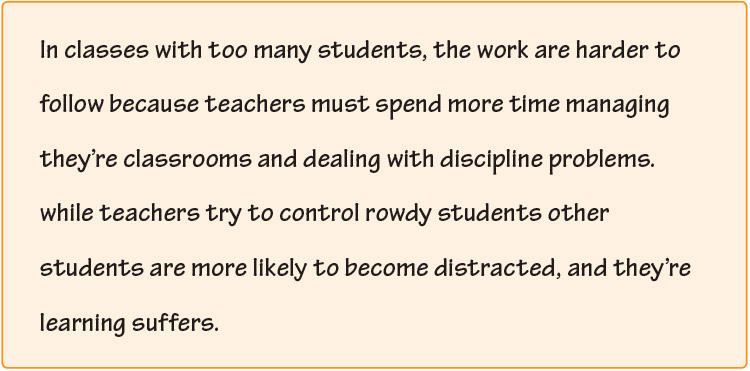
-
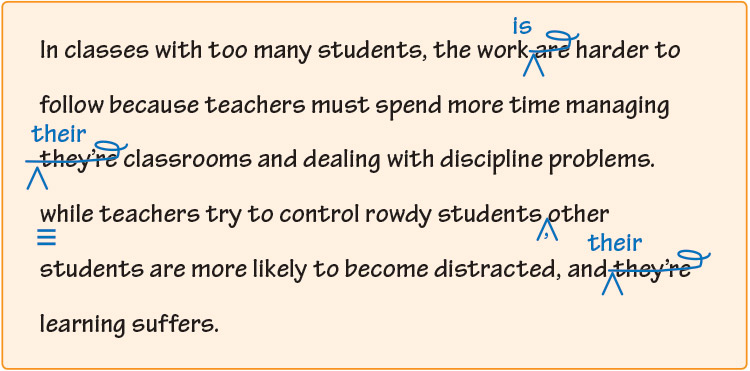
Agreement and usage errors are fixed as well as missing capital letters and commas.
-
Paragraph After Edits
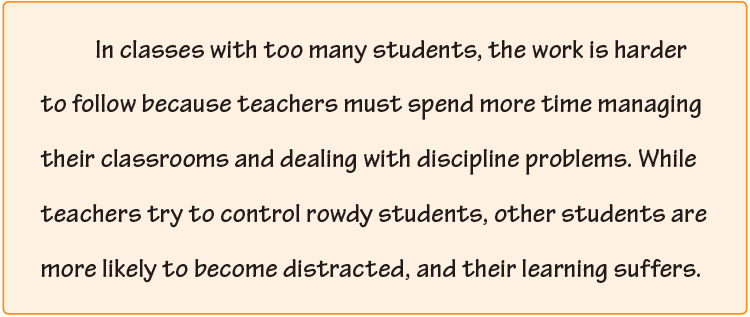
Edit with a checklist.
Read each line. When you can answer each question with a yes, check it off.
Punctuation
- Did I close each sentence with an end punctuation mark?
- Do commas follow four or more introductory words?
Capitalization
- Are the first words in sentences capitalized?
- Are proper names of people, places, and things capitalized?
Grammar
- Do all subjects and verbs agree?
- Are sentences complete (no fragments or run-ons)?
Usage
- Are words used correctly (your/you’re, their/they’re, its/it’s)?
- Are may, might, must, and other helping verbs used correctly?
Spelling
- Did I check for spelling?
- Did I use a dictionary or the spell checker on my computer?
Publishing Persuasive Essays
When you publish your persuasive essay, you make it public, sharing it with others. First, you need to make a clean final copy of your work. Then you should find ways to share your writing with classmates, your teacher, your family, and your friends.
Publishing a Final Copy
Create a final copy of your writing.
Include your revising and editing changes and read over your work a final time. (If you are working on a computer, spell-check your work.)
Reflecting on Your Writing
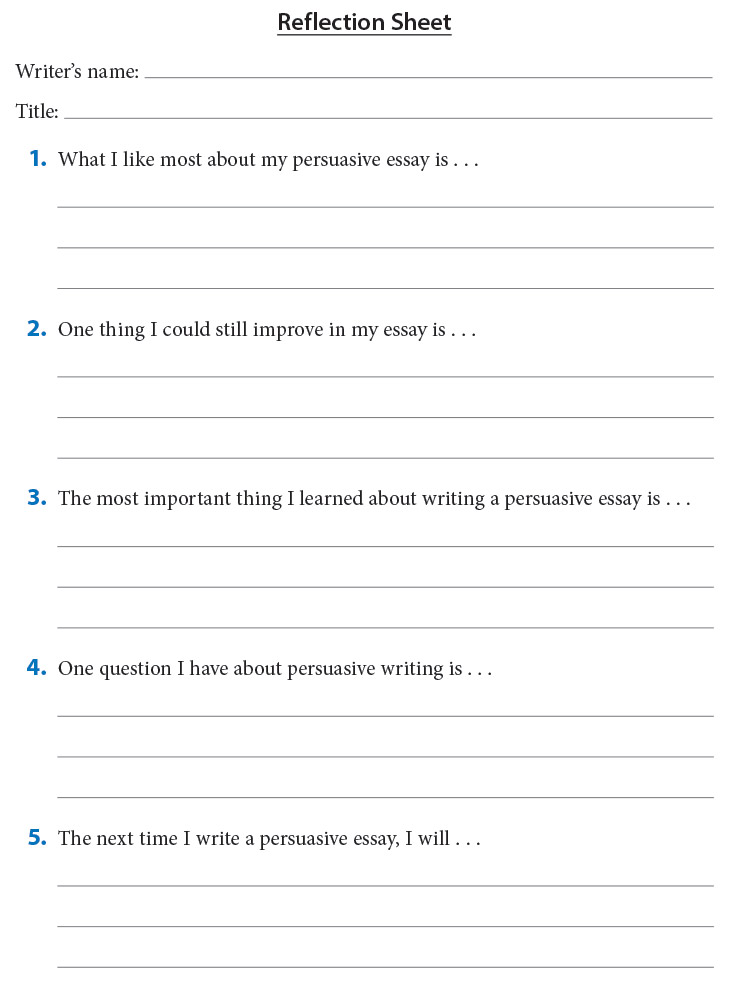
Reflect on your writing.
Complete the following form to think about what you learned.