Editing Phase Autobiographies
After making big changes to improve your phase autobiography, you need to make little changes (editing) to correct any remaining errors. You'll look for problems with sentences, punctuation, capitalization, grammar, usage, and spelling. The following activities will help you edit your writing.
Editing Possessives
In writing, possessives are used to show ownership. Read the following rules and examples about forming possessives.
- To form the possessive of a singular noun or an indefinite pronoun, add ’s. (Indefinite pronouns include one, anybody, nobody, somebody, anyone, no one, someone.)
the dog’s ball, Jess’s book, someone’s backpack
- To form the possessive of most plural nouns (those that end in s), add only the apostrophe.
the boys’ locker room, the teachers’ lounge, the Smiths’ party
- To form the possessive of irregular plural nouns (those that do not end in s), add ’s.
the children’s toys, women’s basketball
Form possessives.
If the possessive form in any of the following sentences is incorrect or missing, replace it with the correct form. Use the rules and examples above as a guide.
-
Joes train has been delayed. Joe’s train has been delayed.
-
My books pages are stuck together. My book’s pages are stuck together.
-
The mens’ locker room is down the hall. The men’s locker room is down the hall.
-
The women basketball game lasted two hours. The women's basketball game lasted two hours.
-
I poured the cat food into Henry’s bowl. I poured the cat food into Henry’s bowl. (correct)
-
The party is at the Green’s house. The party is at the Greens’ house.
-
The outcome of the election is anybodys’ guess. The outcome of the election is anybody’s guess.
-
The closet was full of children’s toys. The closet was full of children’s toys. (correct)
-
The first baseman missed the coachs’ sign. The first baseman missed the coach’s sign.
-
Alisha met her friends at Janets’ house. Alisha met her friends at Janet’s house.
Check possessive forms in your phase autobiography.
Review your essay to make sure you have correctly used possessive forms. Correct any errors you find.
Editing Dashes
A dash is a special form of punctuation that, when used appropriately, can add style and interest to your writing. Here are three common uses for a dash.
- To Indicate a Sudden Break
There is one thing—actually several—that my parents dislike about smartphones: being "connected" all the time, looking out for drivers who are texting on the phone, and getting "surprise" charges on the phone bill.
- To Set Off Added Information
Interest in clean energy systems—including solar, wind, and geothermal—is creating thousands of new jobs.
- To Emphasize the Idea That Follows It
I know one thing for sure about my aunt—she's always thinking of others.
Insert dashes.
In the sentences below, insert dashes where they are needed.
-
The Warriors had one aim and one aim only winning. The Warriors had one aim and one aim only—winning.
-
I think the Warriors proved proved beyond a shadow of a doubt that they had more overall talent than anyone else. I think the Warriors proved—proved beyond a shadow of a doubt—that they had more overall talent than anyone else.
-
After 82 regular season games and 24 postseason games, the players had one thing in mind a long vacation without any basketball. After 82 regular season games and 24 postseason games, the players had one thing in mind—a long vacation without any basketball.
-
Playing more than 100 games can be wearing even on the most dedicated player. Playing more than 100 games can be wearing—even on the most dedicated player.
-
Each Warriors player received something special a championship ring. Each Warriors player received something special—a championship ring.
Edit for dashes.
Reread your phase autobiography to see if any part would be improved by adding a dash.
Teaching Tip
When dashes are overused, they lose impact. Recommend that students save them for special spots in their writing.
Editing in Action
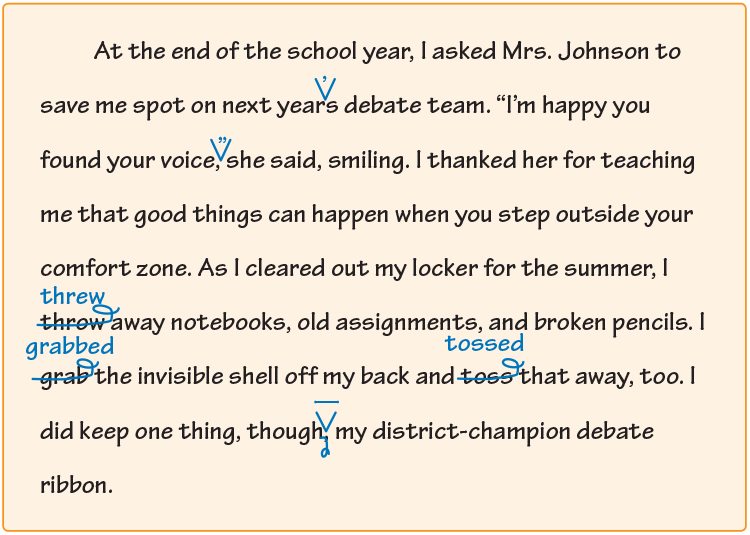
When you edit, you check to make sure your writing is correct.
-
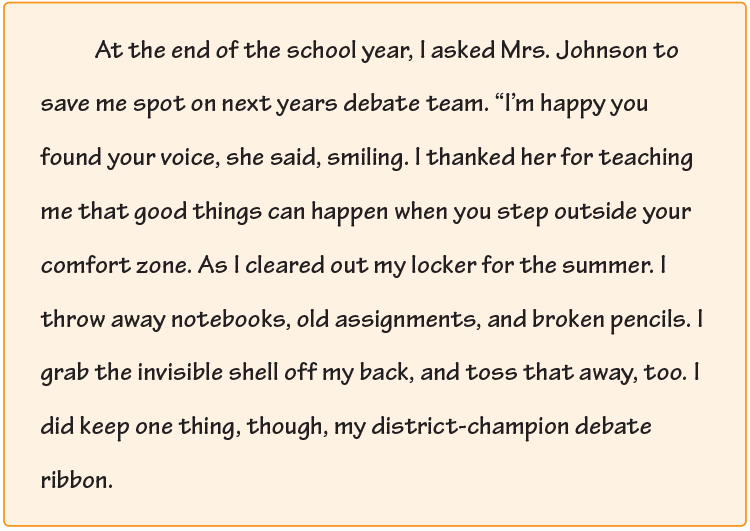
Paragraph Before Edits
-
An apostrophe is added to show possession; quotation marks are added to close dialogue; new verbs are used to fix an improper shift in voice; and a dash is added.
-
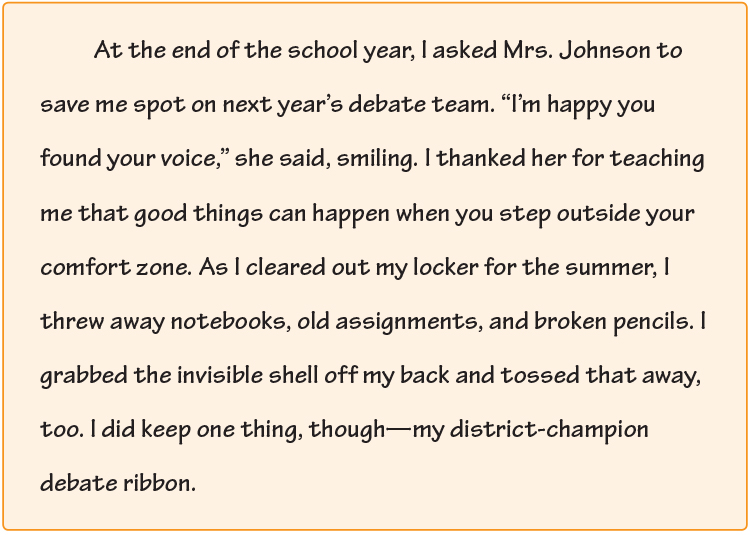
Paragraph After Edits
Edit with a checklist.
Read each line. When you can answer each question with a yes, check it off.
Punctuation
- Did I close each sentence with an end punctuation mark?
- Do I enclose dialogue in quotation marks?
- Do I use apostrophes to show possession and ownership?
Capitalization
- Did I start all sentences with capital letters?
- Did I capitalize the names of people and places?
Grammar
- Are my sentences free of run-ons and comma splices?
- Do I avoid improper shifts in voice?
- Do the subjects and verbs agree in number? (The van honks; the cars stop.)
Usage
- Did I correctly use commonly confused words (affect/effect)?
Spelling
- Did I use a dictionary or the spell checker to check my spelling?
Publishing Phase Autobiographies
When you publish your phase autobiography, you make it public, sharing it with others. First, you need to make a clean final copy of your work. Then you should find ways to share what you have written in print or online.
Publishing a Final Copy
Create a final copy of your writing.
Include your editing changes and read over your work a final time. (If you are working on a computer, spell check your work.)
Reflecting on Your Writing
Reflect on your writing.
Complete the following form to think about what you learned.