Editing Promotion Essays
Revising makes big improvements to your writing while editing focuses on little (but important) corrections. You'll look for problems with sentences, punctuation, capitalization, grammar, usage, and spelling. The following activities will help you edit your promotion essay.
Editing to Vary Sentence Beginnings
The most basic sentence starts with a subject and tells what happens to it:
The woman ran across the street.
Notice how plain the sentence is? One way to make sentences more interesting is to vary their beginnings. For example, you can begin a sentence with a word, phrase, or clause.
Word
Frightened, the woman ran across the street.
Phrase
Without pausing, the woman ran across the street.
Clause
Because she was frightened, the woman ran across the street.
Vary sentence beginnings.
Rewrite each choppy paragraph, varying the sentence beginnings by adding a word, phrase, or clause. (You don’t have to vary every sentence.)
- Our school auditorium is too small, dark, and unpleasant. The auditorium leaks when it rains. The chairs are uncomfortable. People don’t enjoy coming to our concerts. More people might come if the auditorium were bright, clean, and comfortable. Students would enjoy performing more. It is clear we should build a new auditorium.
- The kids in our neighborhood are often bored, and they need a safe place to hang out. They go to the fast-food restaurant on the corner after school. They spend time at the mall on weekends, but these places are not always open. These places don’t provide interesting, constructive activities. It would be a good idea to open a sports and recreation center in the neighborhood.
Edit for varied sentence beginnings.
Reread your essay, watching for sentences that all sound alike. If you find any, edit sentence beginnings to improve the flow.
Editing Comparatives and Superlatives
Adjectives and adverbs have three forms: positive, comparative, and superlative. The positive form is just the normal adjective or adverb, describing an object, person, idea, or action.
Gerald is tall.
The comparative form compares two objects, people, ideas, or actions. Most comparatives are made by adding the suffix -er.
Gerald is taller than I am.
The superlative form compares three or more objects, people, ideas, or actions. Most superlatives are made by adding the suffix -est.
Gerald is the tallest of the three Taylor brothers.
Many words are changed by adding -er or -est. Longer words require more or most (or less or least). Still other words are irregular, taking special comparative and superlative forms.
| Positive | Comparative | Superlative |
| Short Big Funny |
Shorter Bigger Funnier |
Shortest Biggest Funniest |
| Honest Important |
More honest Less important |
Most honest Least important |
| Good Bad |
Better Worse |
Best Worst |
Correct modifiers.
In the following sentences, replace any incorrect adjectives or adverbs with the correct form. (Remember that a comparative must compare two things and a superlative must compare three or more.)
-
Which of the two brothers is shortest? Which of the two brothers is shorter?
-
Who is oldest, you or your sister? Who is older, you or your sister?
-
I had five pictures taken, and the last one was the worse. I had five pictures taken, and the last one was the worst.
-
That movie was the most long movie I have ever seen. That movie was the longest movie I have ever seen.
-
Which of the three movies did you like better? Which of the three movies did you like best?
-
The sequel was more good than the original. The sequel was better than the original.
-
Todd is most social than his brother Tim. Todd is more social than his brother Tim.
-
The candidate gave a badder speech than the previous one. The candidate gave a worse speech than the previous one.
-
That was the worse speech I ever heard. That was the worst speech I ever heard.
-
Let's hope the next speech is gooder than this one. Let's hope the next speech is better than this one.
Edit for correct modifiers.
Reread your essay, paying attention to positive, comparative, and superlative forms of modifiers. If you find any incorrect modifiers, fix them.
Editing in Action
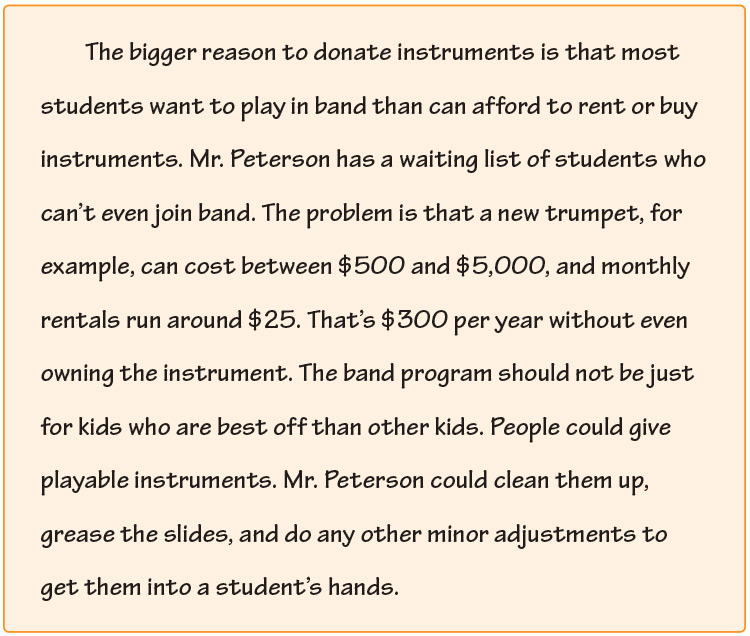
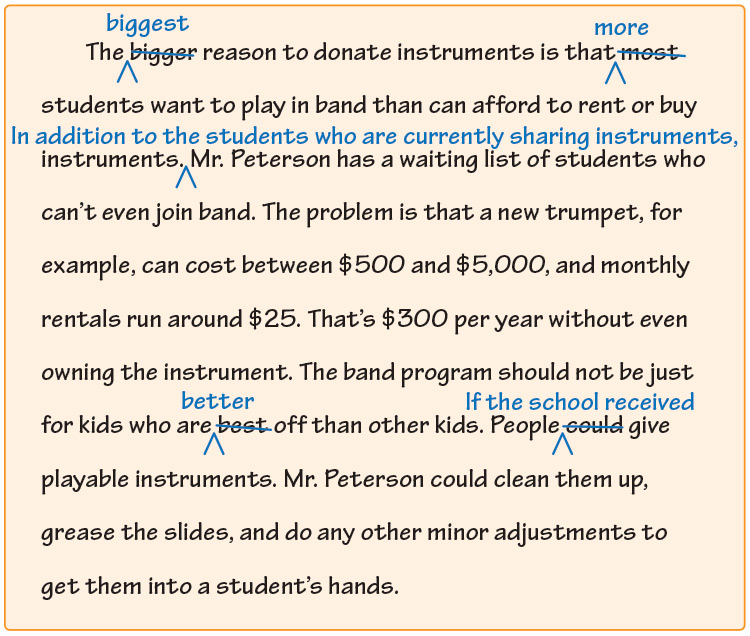
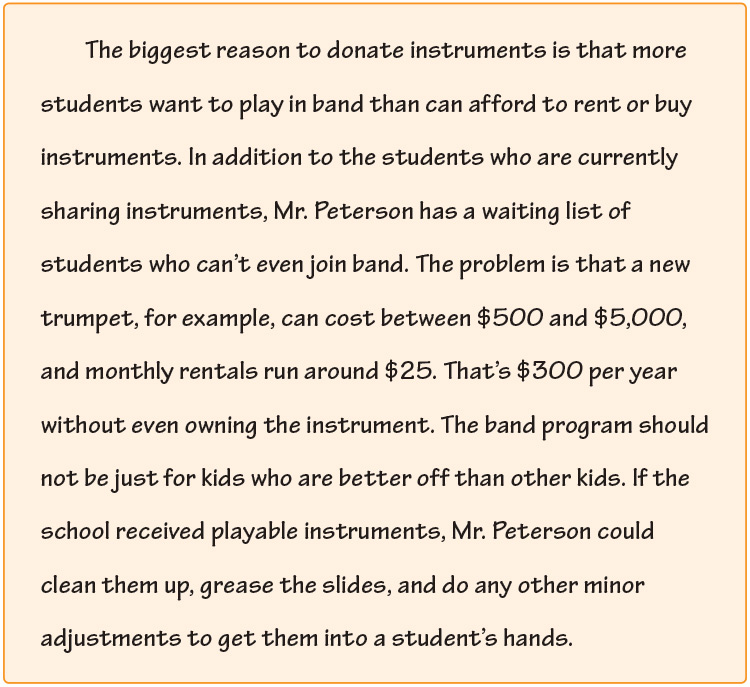
When you edit, you check to make sure your essay is correct.
-
Before Edits
-
Incorrect modifiers are fixed and sentence beginnings are edited for variety and flow.
-
After Edits
Edit with a checklist.
Read each line. When you can answer each question with a yes, check it off.
Punctuation
- Did I close each sentence with an end punctuation mark?
- Do commas follow four or more introductory words?
Capitalization
- Did I start all sentences with capital letters?
- Did I capitalize the names of people and places?
Grammar
- Did I use the correct form of verbs (give, gave, given)?
- Do the subjects and verbs agree in number? (Birds sing; David whistles.)
Usage
- Did I use an appropriate level of language?
- Did I correctly use commonly confused words (affect/effect)?
Spelling
- Did I check for spelling errors?
- Did I use a dictionary or the spell checker on my computer?
Publishing Promotion Essays
When you publish your writing, you make it public. First, you need to make a clean final copy of your work. Then you should find ways to share what you have written with classmates, your teacher, your family, and your friends.
Publishing a Final Copy
Create a final copy of your promotion essay.
Include your editing changes and read over your work a final time. (If you are working on a computer, spell check your work.)
Reflecting on Your Writing
Reflect on your writing.
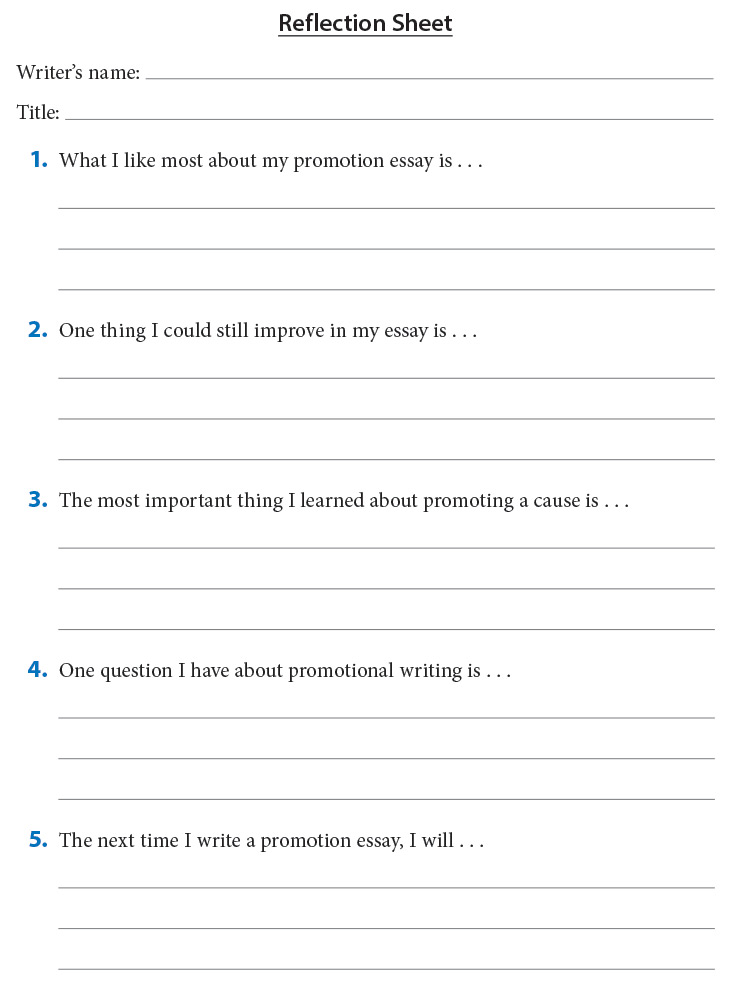
Complete the following form to think about what you learned.