Prewriting for Argument Essays
When two people have opposite opinions about a controversial topic, a loud argument can result. A logical argument also involves a controversial topic but uses reasoning instead of shouts. These activities will help you find a controversial topic, research the issue, develop a position about it, and organize your supporting reasons.
Prewriting to Consider Controversies
In the warm-up to this unit, you thought about three different types of controversial positions: opinions, proposals, and hypotheses. You thought about controversies you encountered among friends, family, and teachers. In search of a topic for your argument essay, you should also consider controversies farther afield.
One student thought about the following controversial positions that he encountered at school, read about in local and national newspapers, and discovered on Google News.
Controversies
|
Opinions (People think . . .) |
Proposals (People should . . .) |
Hypotheses (Something is happening because . . .) |
|
|
School News |
Students think we have too many tests. |
The school should shift to online textbooks. |
Teacher morale is low because society undervalues them. |
|
Local Newspaper |
Restaurant owners think allowing food trucks would be a disaster. |
The city council should allow food trucks into our community. |
Flooding downtown is becoming more frequent because of new developments along the river. |
|
National Newspaper |
People think they need to choose a side politically, but the middle is where work gets done. |
We should consider the Australian model in addressing our gun-violence problem. |
Lax restrictions on lobbying and campaign finance make our country open to the highest bidder. |
| Google News |
Europeans think they can no longer count on the U.S. as an ally. |
We should fill the many diplomatic vacancies in the U.S. State Department. |
The shift toward nationalism in many countries is caused by a large influx of refugees from neighbors. |
Write down one controversial position that interests you:
I'm interested in the food-truck controversy. People at school are talking about it, and the local paper had a long article about a city council meeting where the topic blew up.
What reasons do people give to support this position?
Young people want food trucks for new, affordable food options. Restaurants don't want them because of competition and parking.
Do you agree or disagree with this position? What reasons do you have?
I don't know my position yet. I like the idea of more options for eating and attracting more people to our city, but I also see the point of restaurant owners who have a big investment here. I'll have to do further research to make up my mind.
Research controversies.
Search news sources to find controversial topics from your school, community, nation, and world. Fill in a gathering grid like the one above. Then answer the questions below it.
Prewriting to Research the Topic
After you've selected a controversy that interests you, you need to research the topic to understand it fully. Consider all sides of the issue. Then state your own position and list reasons for and against it. Review the following pro-con chart, which gathers reasons for and against a controversial position on food trucks:
Controversial Position
Waterford should allow food trucks in the city limits.
|
PRO |
CON |
|
|
Research pros and cons.
Research your controversial topic and state an initial opinion about it. Then gather reasons from your research, filling out a pro/con chart like the one above.
Teaching Tip
Let students know that it is perfectly okay to change their minds about a controversial issue. Learning all sides of an argument allows students to take an informed position. It also helps them reason with those who have an opposing view.
Prewriting to Organize Your Argument
A logical argument begins with givens that everyone agrees on and moves toward a conclusion that some readers might disagree with. If your audience shares your view already, you have many more givens in common, so you can start by outlining all of the reasons your position is strong. If your audience is opposed to your position, you need to meet them where they are by recognizing and answering their objections first before you provide your reasons for the position. Note these two different patterns of organization:
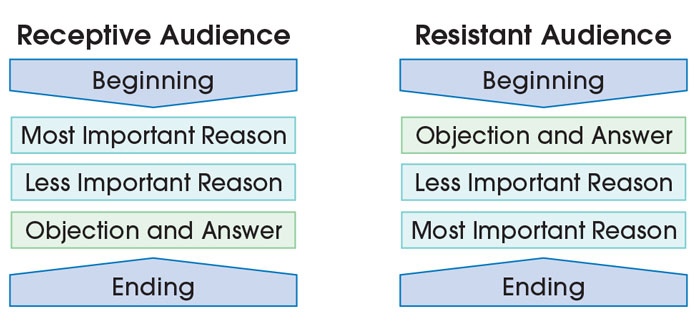
The student writing about food trucks decided that many people in his audience—adults on the city council—would oppose allowing food trucks in the city, so he organized his outline to address a resistant audience:
Position Statement: Waterford should allow food trucks in the city limits.
- Objection and Answer: Some people fear that food trucks will unfairly compete with existing restaurants, but regulations can prevent any conflict.
- First Reason: Food trucks would bring to Waterford a dining revolution that is sweeping the nation.
- Next Reason: Food trucks can provide new opportunities for entrepreneurs.
- Most Important Reason: We can't allow special interests groups to limit competition in food service in Waterford.
Outline your argument.
Think about the intended audience for your argument essay. Are they receptive or resistant? Select the appropriate organizational pattern, and write an outline for your argument.
Teaching Tip
Help students understand that the art of persuasion requires thinking about what readers want. You cannot persuade readers by convincing them that an idea is good for you. Instead, you must demonstrate how the idea is good for them. Keeping the reader in mind will strengthen students' argument essays.