Revising Character Analyses
After you have completed a first draft of your analysis, set it aside awhile before you begin revising. Once you get some distance from it, you'll be able to see it with fresh eyes. Then look for opportunities to improve your draft. The following activities will assist you.
Revising to Connect Characters to Themes
An effective character analysis should show how the words and actions of the characters demonstrate larger themes. Often themes express life lessons, social or cultural realities, or moral dilemmas. Answering critical questions about the character can help you identify themes:
- Why is this character so interesting?
Ghost is interesting because he tries to outrun his past, but doing so leads to bad decisions in his present.
- What is the most critical moment for this character?
On the day he's supposed to get his uniform, his coach finds out he stole the track shoes.
- If this character could do one thing over, what would it be?
He would have asked his mom or coach to help him get a pair of track shoes for the season.
- What emotion best defines this character?
Ghost experiences many emotions, but the two that pop up the most are anger and resentment. He doesn't feel comfortable with himself until he lets others into his life.
- What can you learn from the character?
You have to accept your past to move on toward a better future. Sometimes trying to solve problems all by yourself can make them worse.
Discover themes.
Answer the following questions about the character(s) you analyzed. After you have answers, consider what thematic connections you might add to your first draft.
- Why is this character so interesting?
- What is the most critical moment for this character?
- If this character could do one thing over, what would it be?
- What emotion best defines this character?
- What can you learn from the character?
Revising to Improve Sentence Flow
Writing sounds choppy and repetitive when it contains too many short sentences or sentences that all start the same way. To discover this problem, read your first draft out loud.
If your writing starts to sound choppy like this, try combining some of the sentences. Sentence combining is the act of making one smoother, more detailed sentence out of two or more short, choppy sentences. The following strategies can you help you combine sentences:
Combine with key words: Move a key word from one sentence to the other sentence.
Revised: He and his wife live in a colorless house.
Combine with phrases or clauses: Move groups of words into another sentence to combine them.
Revised: They live in a colorless house with a wall of televisions, which his wife stares at all day.
Combine with a series of words or phrases: Ideas from shorter sentences can be combined into one sentence using a series.
Revised: He likes the fancy uniform, the thrill of the burn, and his status as a firefighter.
Combine with connecting words: Two separate sentences can be combined using a comma and a connecting word (and, but, or, nor, for, so, yet).
Revised: He’s thirty years old and married, but he can’t remember where or how he met his wife.
Practice sentence combining.
Use the strategies from above to combine the following short, choppy sentences. After you have answers, consider what thematic connections you might add to your first draft.
- A male cheetah moved among the trees of the savannah. He moved carefully.
- Cheetahs can purr. They can chirp. They can also moan.
- Cheetahs' most common habitat is open grassland. They can also be found in dense woodland.
- Cheetah cubs are born with long gray fur. This allows them to blend into their surroundings.
- Suddenly, the grass parted. A cat appeared. It was a spotted cat. (Note: You can use two different strategies to combine these sentences.)
Check for sentence fluency.
Read your developing draft out loud. Do any parts sound choppy? Try some of the sentence combining strategies to improve the flow.
Revising with a Peer Response
Share your writing.
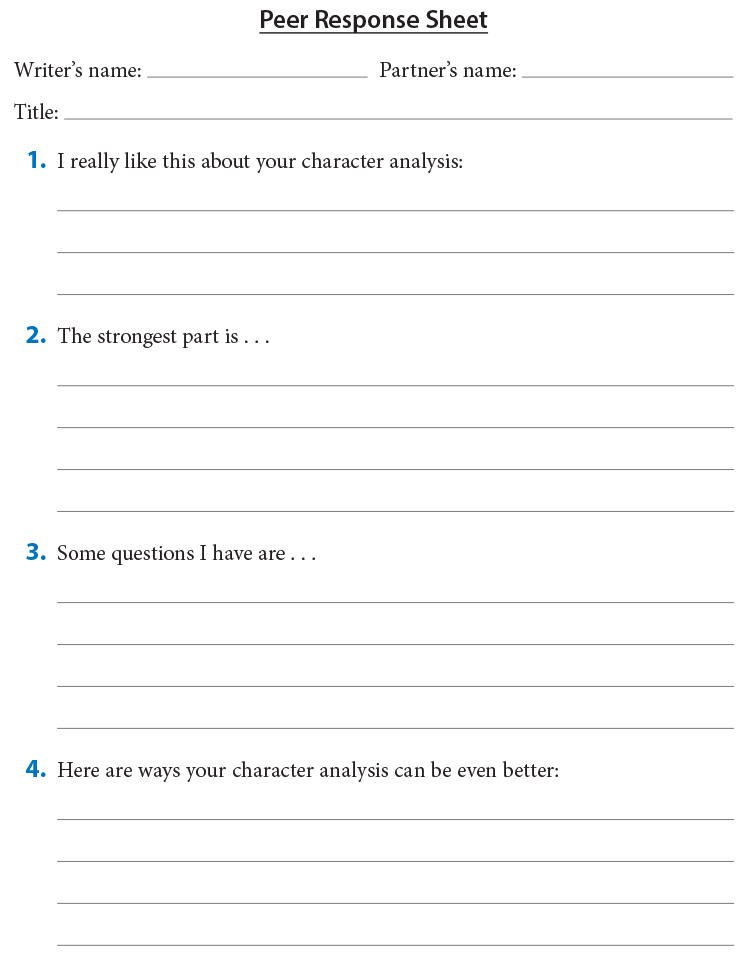
Have a trusted classmate read your review and complete the form.
Revising in Action
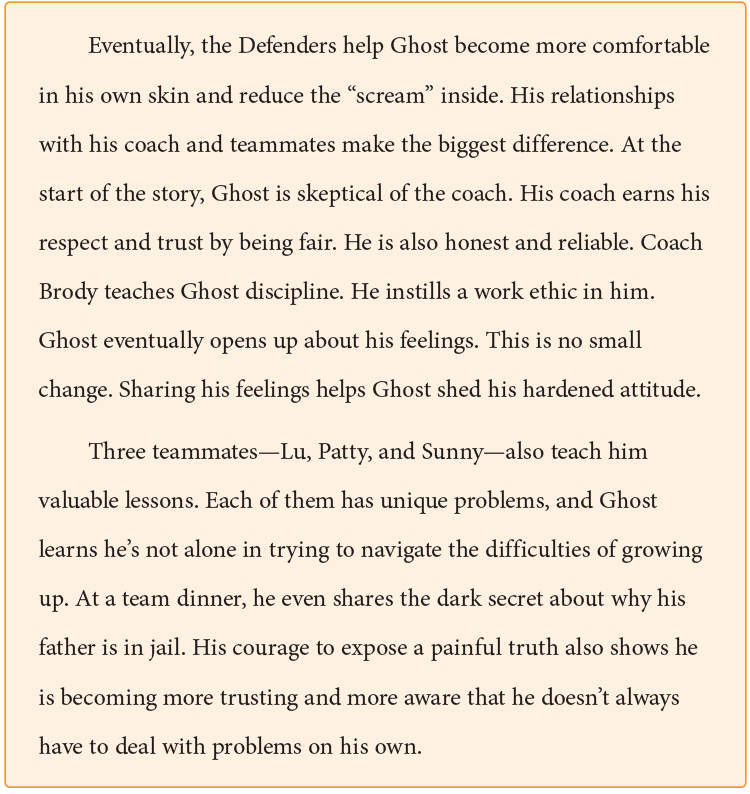
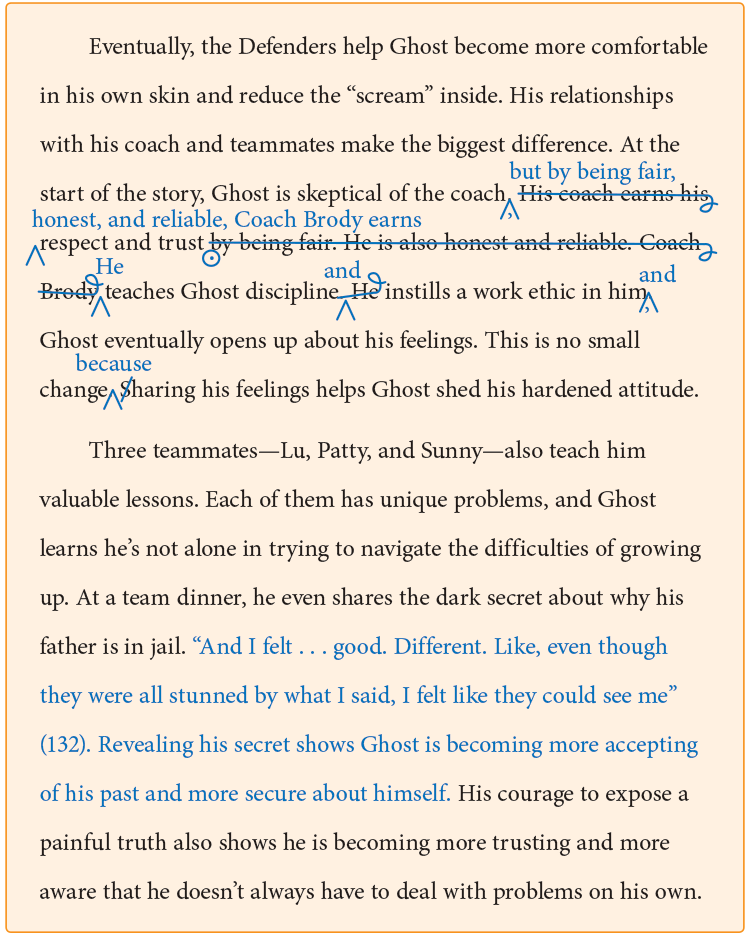
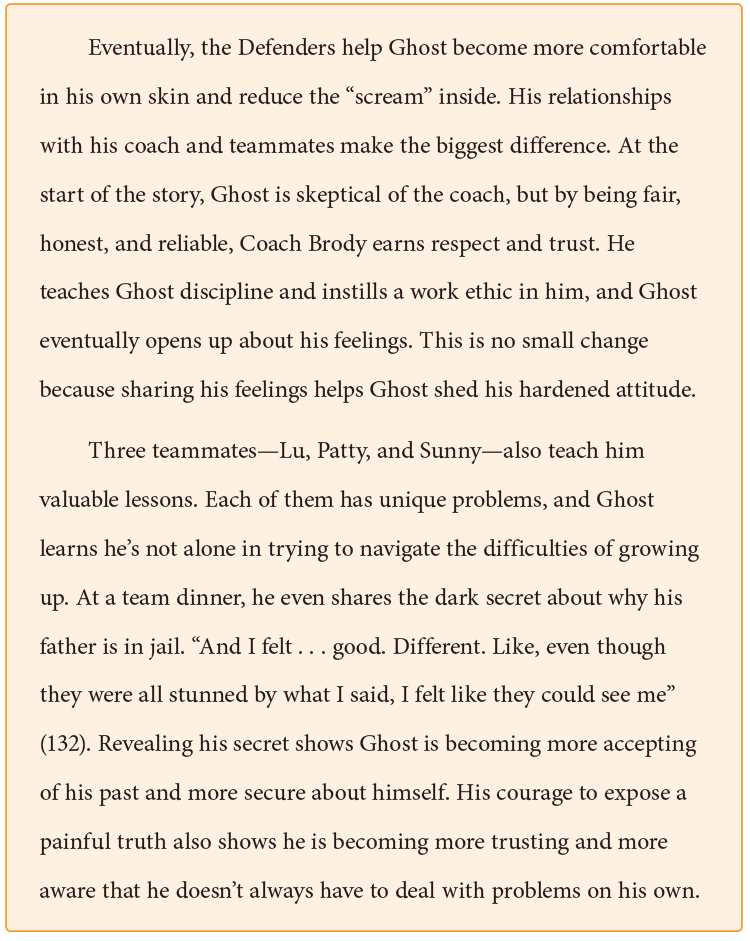
When you revise, you add, delete, rewrite, and rearrange your writing to make it clearer. Here are some revisions to the character analysis of Castle Crenshaw from Ghost.
-
Paragraph Before Revising
-
Combining sentences improves flow, and thematic connections deepen analysis.
-
Paragraph After Revising
Revise with a checklist.
Read each line. When you can answer each question with a yes, check it off.
Developing Your Ideas
- Does the analysis have a strong lead that catches the reader's interest?
- Does the thesis statement clearly focus on one or more characters and connect them to a major theme?
- Does the topic sentence of each body paragraph name a specific main point that supports the thesis?
- Does evidence from the literature provide solid support for the analysis?
- Does the voice sound knowledgeable and interested?
- Do transition words and phrases connect ideas and create a smooth flow of thought?
- Do the sentences read smoothly?