Revising Historical Narratives
Once you draft your historical narrative, take a break and come back to it to see it freshly. When you revise, you make sure the people, places, and events are clearly described and the writing captures the story in a vivid way. These activities will help you revise.
Revising to Add Dialogue
Dialogue refers to the words spoken by characters. Even though you might not know the exact things people said in the past, you can still add dialogue to your story. The trick is to use words and language that make sense for the time period.
- Too modern:
“Chill out,” said Meriwether Lewis. “We got this.”
- More realistic:
“We must remain calm,” said Meriwether Lewis. “The task is attainable.”
Add dialogue.
Use the tips and examples to help create dialogue for your historical narrative. Revise existing dialogue to make it sound realistic.
- Create a conversation between two characters.
“Which direction do you favor, Captain Lewis?” asked Clark.
“You have navigated us this far,” I responded. “I trust the south branch will keep us on the Missouri.”
- Use language that represents the time in history.
“Captain Lewis, might that be the Great Falls?”
- Use dialogue to help move your story along.
“We shall navigate the south branch farther and will not return until we reach the Great Falls,” I said.
Revising the Point of View
Point of view is the angle from which the story is told. Your narrative should use first-person point of view, meaning it is told from the perspective of one of the characters. Here are some characteristics of first-person point of view:
- Uses first-person pronouns: I, my, mine, me, we, our, ours, and us
- Reveals inner thoughts and feelings of the narrator
- Cannot reveal inner thoughts and feelings of other characters
Use first-person point of view.
The following sentences use third-person point of view. Rewrite them in first-person point of view. An example is provided for you.
- As they sped toward the building, Phil eyed red and orange flames leaping out of windows. This is no small fire, he thought. The truck screeched to a halt, and Crew 48 scrambled into action.
As we sped toward the building, I eyed red and orange flames leaping out of windows. This is no small fire, I thought. The truck screeched to a halt, and we scrambled into action.
- They were the first responders on the scene, so Phil quickly assessed the situation and assigned tasks to his crew.
- Kicking in a door, Phil led his crew into the burning building. Only then did they hear the screams coming from upstairs.
- They found two frightened children. “Take my hand,” Phil said. “We’ll get you out of here.” But what is the safest way out, he wondered.
Revising Word Choice
Check for specific nouns, vivid verbs, and colorful adjectives.
Specific Nouns
Specific nouns make narratives clearer for readers.
| General Nouns |
leader |
landform |
weather |
| Specific Nouns |
William Clark |
Rocky Mountains |
mist |
Vivid Verbs
Vivid verbs add clarity and punch to actions.
| General Verbs |
sent |
worsen |
fell |
| Vivid Verbs |
dispatched |
doomed |
plunged |
Colorful Adjectives
Colorful adjectives help create clear pictures and descriptions.
| General Adjective |
big Rockies |
bad mood |
some foam |
| Colorful Adjective |
mighty Rockies |
sour mood |
bubbly white foam |
Replace general nouns, verbs, and adjectives.
The example nouns, verbs, and adjectives are too general. Replace them with specific and colorful words.
Nouns
- relative
- dog
- boat
- clothes
Verbs
- went away
- talked
- watched
- ran
Adjectives
- small space
- nice weather
- funny look
- bad food
Revising with a Peer Response
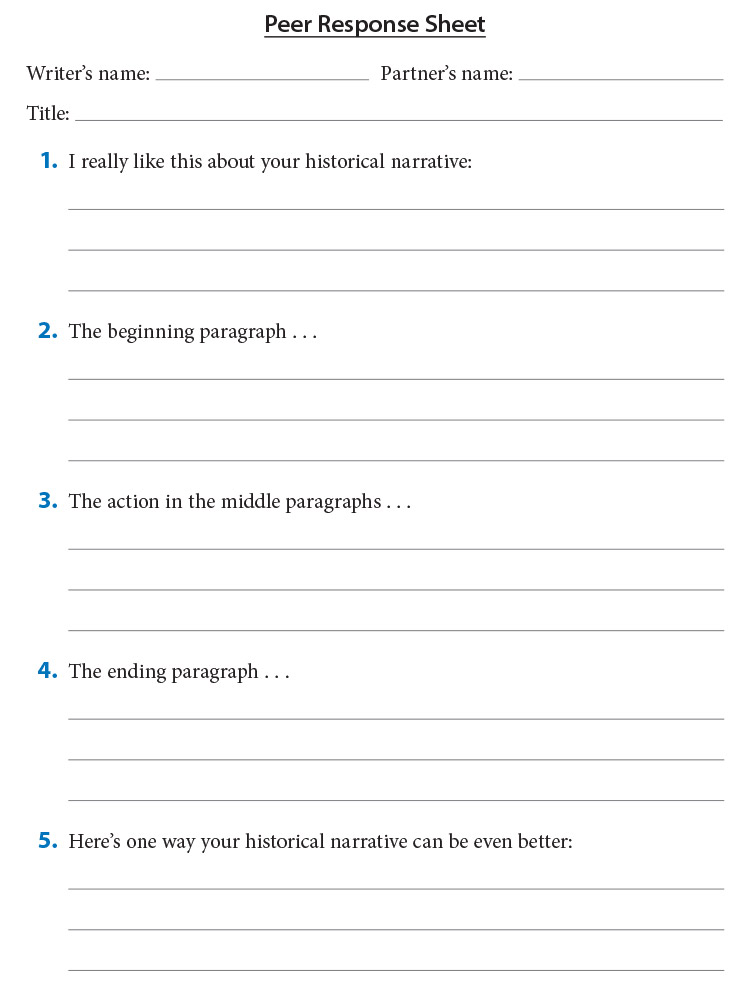
Share your writing.
Have a trusted classmate read your historical narrative and complete the form.
Revising in Action
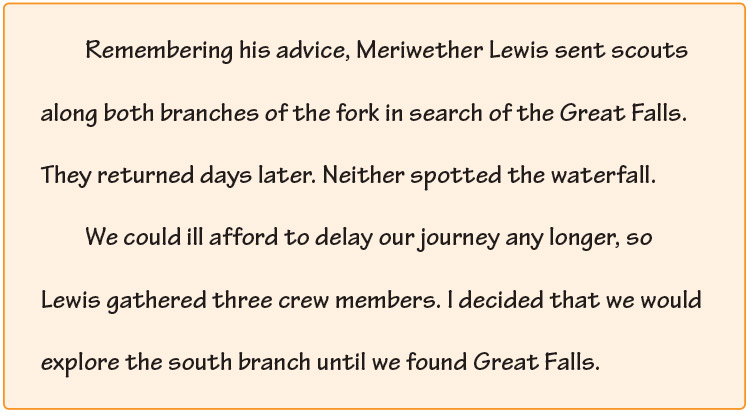
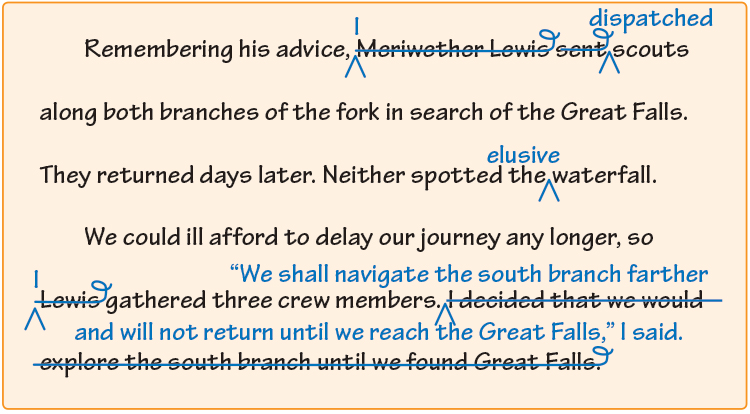
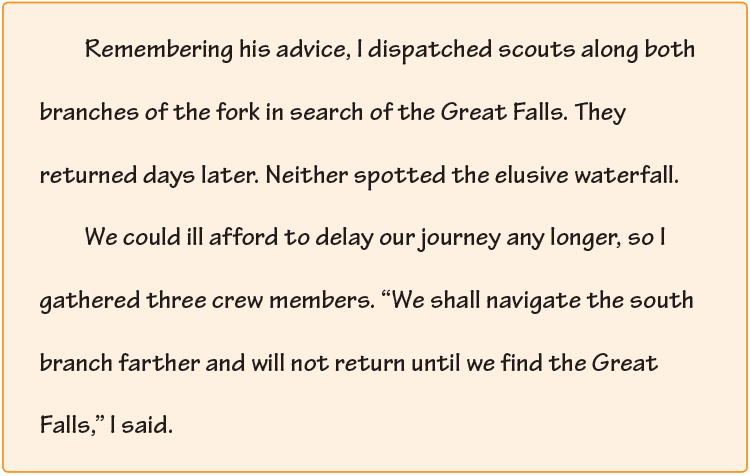
When you revise, you add, delete, rewrite, and rearrange your writing to make it clearer. Here are some revisions to “A Fork in the River.”
-
Paragraph Before Revisions
-
Revisions made to change the point of view, improve word choice, and add dialogue
-
Paragraph After Revisions
Revise with a checklist.
Read each line. When you can answer each question with a yes, check it off.
Ideas
- Is my story based on facts from a certain time in history?
- Does my story include a main problem, obstacle, or conflict that the character attempts to overcome?
- Do the characters’ words and actions make sense for that historical time period?
Organization
- Does the beginning introduce the main action (problem, obstacle, or conflict) in an interesting way?
- Do the middle paragraphs lead up to a resolution to the main action?
- Are the details organized chronologically (time order)?
- Does the story end in a logical, satisfying way?
Voice
- Is my story told from the first-person point of view of one of the characters?
- Does the dialogue sound appropriate for the time period?
Word Choice
- Do I use specific nouns, vivid verbs, and colorful adjectives?
- Are my words well chosen for the time period?
Sentence Fluency
- Are my sentences clear and complete?
- Do my sentences flow smoothly?