Revising Phase Autobiographies
After you've completed a first draft of your phase autobiography, take a break before you begin revising. The break will give you a fresh perspective as you evaluate the ideas, organization, voice, and fluency of your draft.
Revising to Use Showing Details
When you write about a memorable time in your life, you will probably include details about how you and others in your story felt. However, good writers don’t just “tell” about an important emotion; instead, they “show” the feeling by sharing the actions and words of the character. The following example demonstrates this rule of writing: “Show, don’t tell.”
Writing That Tells
Peggy and Sam were surprised by the beautiful sunset.
(The writer “tells” you how Peggy and Sam felt about the sunset.)
Writing That Shows
Peggy and Sam stopped shouting and stared at the sunset. They stood still and silent as the giant orange sun sank behind the hills, turning the sky to a rosy glow. Sam reached for Peggy’s hand. Her eyes were wide and shining. “I don’t even remember why we were arguing,” he whispered.
(The writer uses dialogue, sensory details, and specific words to “show” you how Peggy and Sam felt about the sunset.)
Examples of “Showing” Details
Here are three ways to “show” instead “tell” in your writing.
- Use dialogue to give the characters a voice.
- Add sensory details to help readers see, hear, smell, taste, and feel the experience.
- Use similes, metaphors, and other creative comparisons.
“Anna, your mom and I have signed you up for debate club,” Mrs. Johnson said. “We know you have a strong voice inside you; it’s time to let it out.”
When it was my turn, my face reddened and glistened with sweat.
I went as white as a ghost. There was no turning back.
Replace “telling” passages.
Rewrite the following “telling” passages so that they do a better job of “showing.” Consider using dialogue, sensory details, and other specific words in your revisions. The first one is done for you.
- I had never been so scared in my whole life.
The hair on the back of my neck stood out like the bristles of a scrub brush. I tried to breathe deeply, but the air got stuck just above my diaphragm.
- I admit it. I was jealous of my little sister.
- He was angrier than I had ever seen him.
Evaluate your writing for too much “telling.”
Identify passages in your writing that do too much “telling.” Replace the passages with “showing” details.
Revising for Style
When you write, you should choose words that convey your message in the best way. Every word has a dictionary definition (denotation), but it also has a connotation. Words can be close in meaning but different in feeling—having either a positive, negative, or neutral connotation. Study the following example.
Positive connotation:
A fearless soldier sought a gap in the enemy’s lines.
(A fearless person takes risks without fearing consequence, but is admirable for doing so. “Fearless” has a positive connotation.)
Negative connotation:
A reckless soldier sought a gap in the enemy’s lines.
(A reckless person takes risks without fearing consequence, but is foolish for doing so. “Reckless” has a negative connotation.)
Read for positive connotation.
Read the pairs of sentences that follow. The underlined words have different connotations. Choose the sentence with the word that has a “positive” connotation.
-
a. The models in the catalog are slender.
b. The models in the catalog are skinny. a. The models in the catalog are slender.
b. The models in the catalog are skinny. -
a. Uncle Theo is stingy with his money.
b. Uncle Theo is thrifty with his money. a. Uncle Theo is stingy with his money.
b. Uncle Theo is thrifty with his money. -
a. My brother is a picky eater.
b. My brother is a careful eater. a. My brother is a picky eater.
b. My brother is a careful eater. -
a. The speech was unending.
b. The speech was long. a. The speech was unending.
b. The speech was long.
Read for negative connotation.
Choose the sentence with the word that has a “negative” connotation.
-
a. Nick’s answer was blunt.
b. Nick’s answer was honest. a. Nick’s answer was blunt.
b. Nick’s answer was honest. -
a. Janice is steady in her beliefs.
b. Janice is rigid in her beliefs. a. Janice is steady in her beliefs.
b. Janice is rigid in her beliefs. -
a. Clancy is determined.
b. Clancy is stubborn. a. Clancy is determined.
b. Clancy is stubborn. -
a. Toby has a unique personality.
b. Toby has an odd personality. a. Toby has a unique personality.
b. Toby has an odd personality.
Read for connotation.
Closely read your draft, checking your words for connotation. Replace any words that use improper connotation.
Revising with a Peer Response
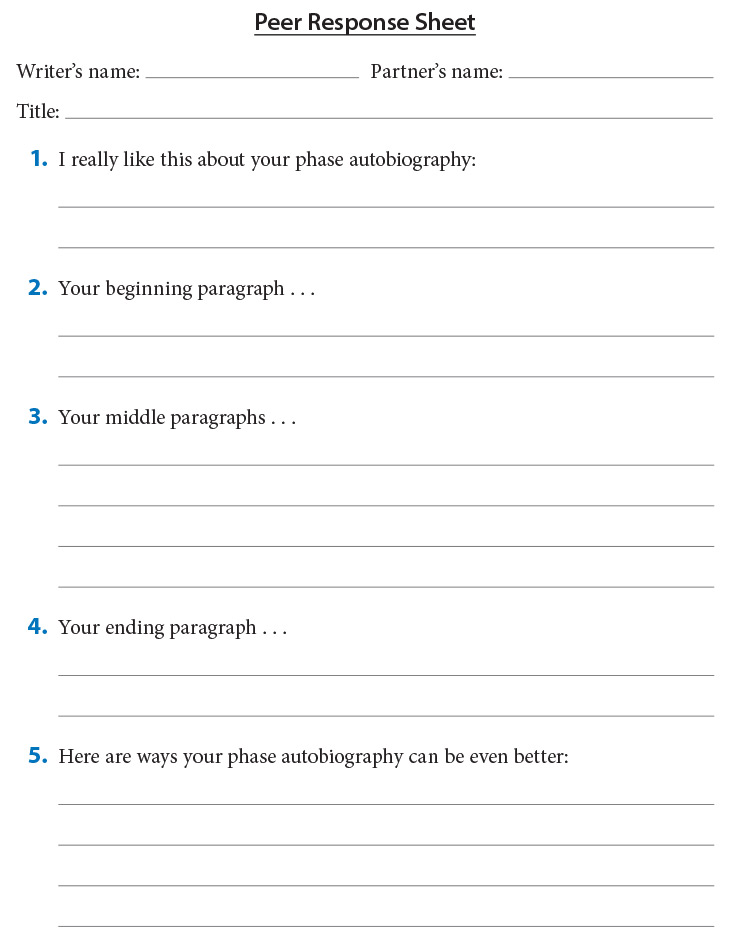
Share your writing.
Have a trusted classmate read your phase autobiography and complete the form.
Revising in Action
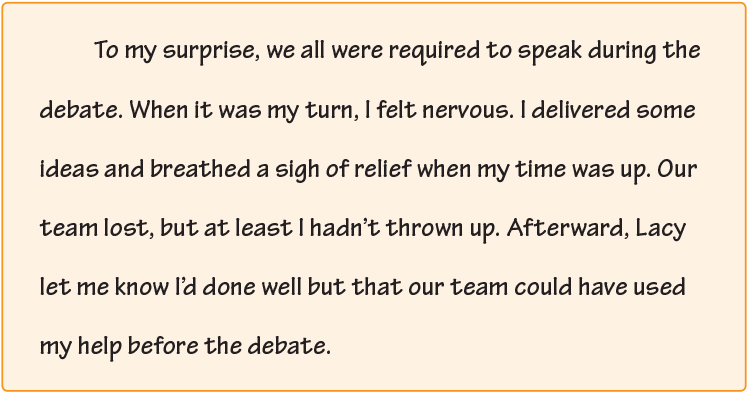
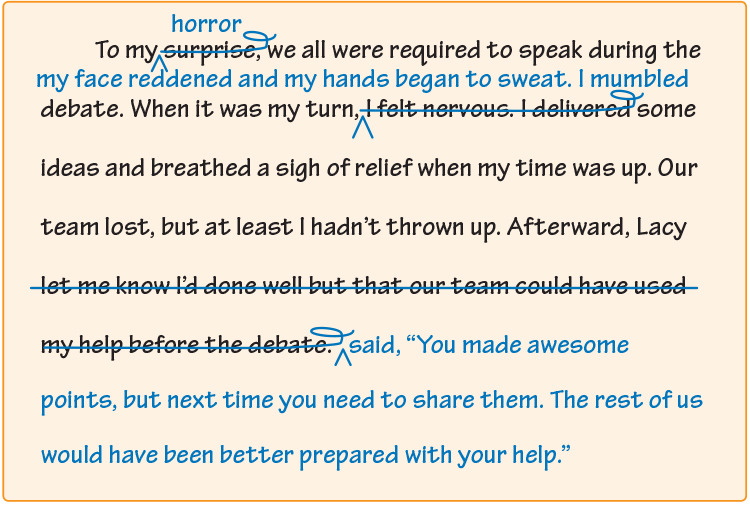
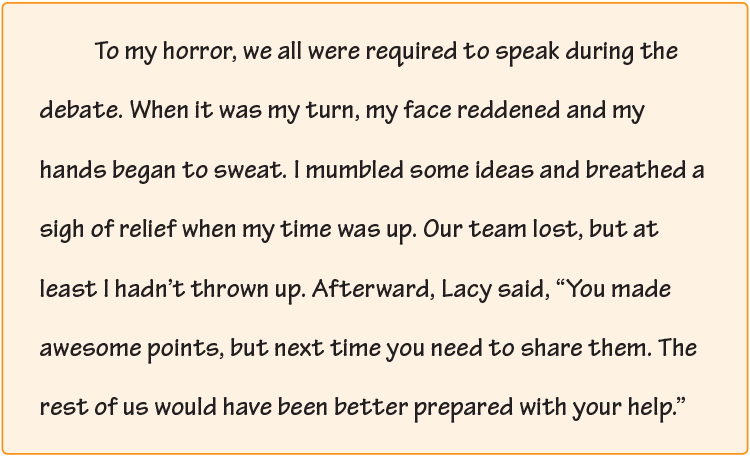
When you revise, you add, delete, rewrite, and rearrange your writing to make it clearer. Here are some revisions to “Up for Debate.”
-
Paragraph Before Edits
-
A word is replaced for more accurate connotation and "telling" details are revised to "show."
-
Paragraph After Edits
Revise with a checklist.
Read each line. When you can answer each question with a yes, check it off.
Ideas
- Does the writing focus on a specific phase or time period from my life?
- Do I leave out unnecessary details?
- Does the writing contain sufficient “showing” details?
- Does the writing reveal how I changed and/or what I learned from the phase?
Organization
- Does the beginning pull readers into the story?
- Are actions presented in chronological (time) order?
- Do time-order transitions connect my ideas?
Voice
- Is my feeling about the topic reflected in the writing?
Word Choice
- Do I use specific nouns and active verbs?
- Do my words have the proper connotation?
Sentence Fluency
- Do I have a variety of sentence lengths and beginnings?
- Do my sentences read smoothly?