Warm-Up for Reading and Writing Assessments

Reading is the process of turning 26 letters and a dozen punctuation marks into meaning. Viewed that way, it's almost a form of magic. You decode symbols and transform them into thoughts. But how did those symbols get there in the first place? Writing, of course. Someone had a set of insights and rendered them on the page using just 26 letters and a dozen punctuation marks. The encoding process of writing is just as magical and powerful as the decoding process of reading.
Reading and writing help you learn and think about any subject. They let you succeed in high school, college, and career. Not surprisingly, these skills loom large in all of the key assessments you take now and into the future: the Common Core assessments for high school English, the ACT and SAT, and the AP English assessments. Don't worry. Reading and writing might seem like magic, but you can practice these skills using the specific strategies in this unit. They will help you succeed on assessments and launch into a bright and thoughtful future.
What Is Assessment?
Listen to "What Is Assessment?"
Hide audio
The word assess means to "judge the value" of something. It originally meant "sit beside a judge" to determine the value of a piece of property for tax purposes. In its modern sense, an assessment is a test to measure the value of a set of skills, in this case reading and writing. You've been reading and writing from your earliest days in school, and all that work will help you succeed on the coming assessments you will face. You can also hone your skills with the specific strategies in this unit.
In the following activities, you’ll learn about close reading—reading to understand the thesis statement, topic sentences, details, and vocabulary of the nonfiction texts you’re assigned. You’ll also learn about writing for assessment—writing to express your own ideas during a test. Strong reading skills help you write and vice versa.
In this unit, you’ll learn the reading and writing skills that you need to succeed in nonfiction assessment. If you’d like to use these skills on a simulated assessment, see the unit “Practice Test for Reading and Writing.”
Thinking About Close Reading
To read closely, you need to think about the ideas in a text. You can do this by asking and answering questions:
- Who wrote this text? Who was meant to read it?
- What is it about?
- Why did the person write it (to provide information, to argue for a position, to tell a story, to make people laugh or think)?
- How does the writer communicate the ideas in the text?
- Where and when did this text originally fit? Where and when does it fit now?
You probably recognize these questions as the 5 W's and H, which you've learned to ask all through your schooling. They apply to close reading because every text is a form of communication, with a sender (who), a message (what and why), a medium (how), a receiver (who again), and a context (where and when). Asking and answering the 5 W's and H can help you closely read any text.
Read closely.
Read the following article. Then answer the 5 W’s and H about it, rereading as necessary.
Listen to "Keeping Track of Goats"
Hide audio
Keeping Track of Goats
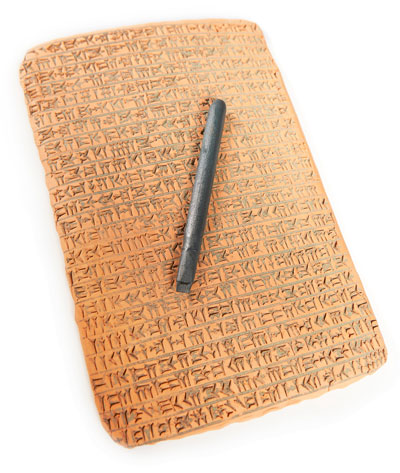
Akkad empire cuneiform on brown clay with sharpened writing tool (Couperfield, Shutterstock)
Why did writing get invented? To recount the exploits of great heroes like Gilgamesh and Odysseus? No, those epics are only 3,000 to 4,000 years old. To inscribe the laws of the land, as in the Code of Hammurabi? That's another good guess, but it wasn't the first reason. Writing began 5,000 years ago because of goats.
Imagine that a goatherd in the Fertile Crescent wanted to sell some goats to a rich buyer in some port along the Mediterranean. Let's say he drove his herd of 53 goats onto a ship to be delivered to his client. Now let's imagine that the ship arrived with 52 goats. The buyer paid for 52 and sent the cash back. Then the ship returned to the original dock, and the captain handed off payment for 51 goats. There's an obvious problem. The captain apparently ate one goat on his outward journey and pocketed the payment for another goat on his way back. What was a poor goatherd to do?
Write, that's what. The earliest form of writing, cuneiform on clay tablets, recorded the number of goats and carpets and vessels of wine sent for trade to distant ports. A merchant (or, more likely, a literate priest) counted each item in the shipment and used a sharpened stick to note them on a slab of clay, which was baked and sent along with the shipment. Another priest at the other end read the clay manifest and counted the goats and made the captain pay for any difference. Yes, writing was developed as a tool for businesses to keep track of shipments, inventories, and payments. It was a semi-magical way that a goatherd could speak to a client hundreds of miles away, letting them do business.
That practical business tool transformed human civilization. It marked the shift from prehistoric times (before written records) to modern times. Writing has come a long way since the days of clay tablets. Now we have emails, Facebook statuses, tweets, and texts, not to mention stock exchange tickers that robots can read faster than we can. But all of these advances in writing still perform the same basic magic as the cuneiform tablets. They let people talk to others hundreds or thousands of miles away, doing business, sharing ideas, and even describing a fabulous panini with sundried tomatoes and goat cheese. The medium of writing has changed thousands of times over the intervening years, but the point remains largely the same: keeping track of goats.
Rob King is a staff writer for Thoughtful Learning, developer of writing instructional materials.
- Who wrote this?
- What is it about?
- Where does the topic take place?
- When does it take place?
- Why is the topic important?
- How does the writer convey the ideas?
Teaching Tip
You may have taught a different strategy for close reading: SQ3R—Survey, Question, Read, Recite, and Review. The 5 W's and H provide a deeper dive into the second step of this process. Questioning a text before and after reading it helps students actively engage it.
Thinking About Writing for Assessment
The article "Keeping Track of Goats" is the type of nonfiction reading you might encounter on a test. You also might be asked to write a response to it. Typically, you'll be given a writing prompt. Just as you used questions to closely read the article, you can use questions to analyze the prompt and figure out what you are supposed to write.
Read, analyze, and answer a prompt.
Read the following prompt for assessment writing. Answer the questions after it, and then write your response.
The article "Keeping Track of Goats" describes an ancient scenario with a goatherd, a literate priest, a ship captain, another priest, and a customer. Which of these people was most empowered by this newfangled invention called writing? Write a brief reflection based on the scenario in the article. Use logical arguments to support your position.
- Purpose: Why are you writing?
- Audience: Who are you writing for?
- Subject What are you writing about?
- Type What form of writing should you create?
Write your response.
Teaching Tip
Questioning can help students gather their thoughts for writing. Good explanatory writing answers the reader’s questions about the topic.