Writing an Argument Essay
You've researched controversial topics in your school, community, nation, and world. You've stated a position and explored reasons for and against it. You've even outlined your argument and responded to objections. Now it's time to write your first draft. The following activities will guide you.
Writing the Argument Beginning
The beginning first needs to grab the reader's attention. Then it should introduce your topic and provide background leading up to your position statement. To get started with your beginning paragraph, you can experiment with different lead-writing strategies.
Write a lead sentence.
Write a different lead sentence(s) for each strategy to capture the reader's attention. Use the examples as inspiration.
- Ask a provocative question.
Why is gender such a taboo subject in high school?
- Provide a fascinating quotation.
"True equality means holding everyone accountable in the same way, regardless of race, gender, faith, ethnicity, or political ideology."
― Monica Crowley - Provide a surprising fact.
Did you know more than half of female students in grades 7-12 report experiencing some form of sexual harassment?
- Directly address the issue.
Recently a wave of women's empowerment has swept across the country, but it hasn't seemed to reach high schools.
Write your beginning paragraph.
Start with your lead, and then provide background and develop a paragraph leading to your position statement.
Writing the Middle Paragraphs
Develop a middle paragraph for each reason that supports your position statement. Organize these paragraphs using your outline (for a receptive audience) or follow a pattern for a resistant audience.
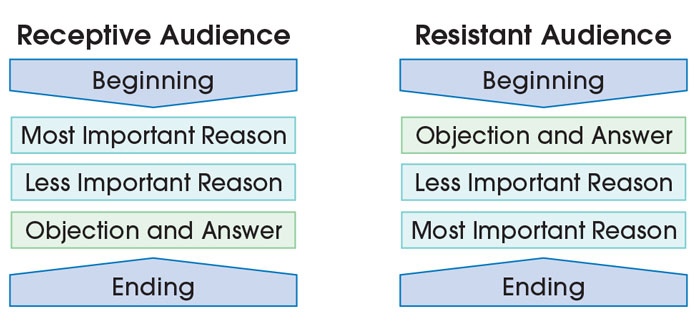
Write your middle paragraphs.
Start each paragraph with a topic sentence that provides a reason in support of your position statement. Provide facts, statistics, examples, definitions, and other details that support each reason. Answer objections in later middle paragraphs (for a receptive audience) or in early middle paragraphs (for a resistant audience).
Teacher Tip
Encourage students to use a logical, reasonable voice that still shows their commitment to their position. Overly emotional language (such as "ignorant sexist denialists just don't get what it's like to be a girl in high school") undercuts the effectiveness of the argument. Sterile language (such as "much has been said lately regarding gender equality") leaves the reader cold. A balanced but engaged voice (such as "creating a level playing field helps both sexes") does the best job of making the case for a controversial position.
Writing the Ending Paragraph
Just as your beginning paragraph needs to draw readers out of their own world and into the world of your argument, the ending paragraph needs to review your argument and help readers take the ideas with them. You can use a combination of ending strategies to accomplish this task.
Try ending strategies.
Write a sentence for each ending strategy, using the examples for inspiration.
- Summarize the value of your argument.
Ultimately, striving for gender equality improves the culture of high school for all students.
- Give a recommendation.
We would all do well to see the world once from the perspective of someone of the opposite sex.
- Use another powerful quotation.
Emma Watson encourages us to, "See gender as a spectrum instead of two sets of opposing ideals."
- Call the reader to action.
Speak up, speak out, and join the movement to make our schools gender equitable.
Write your ending paragraph.
Use some or all of the strategies you tried above as you build an ending paragraph for your argument essay.
Reading an Argument Essay
Read a student's argument essay.
As you read this draft, notice how the writer puts the parts together.
Teaching Tip
The sample paper follows Modern Language Association (MLA) style, though the works-cited page is not shown.
Sample Argument Essay
Listen to “Equity Matters”
Hide audio
Equity Matters
Lead Despite a recent national movement for women’s empowerment, the topic of gender equality remains taboo in many high schools. Many of us don’t realize the degree to which gender expectations impact our learning and well-being. Beginning Paragraph Those of us who do speak out against sexism in school are often ignored or ridiculed. It shouldn’t be that way. Position Statement High schools should challenge gender bias and create an equitable environment for all students.
Reasons So why and how should high schools promote gender equality? For starters, gender equality empowers all students, not just female ones. Too often equality measures get conflated with man-hating, when in fact they benefit guys as well as girls. Like female students, male students get tagged with gender stereotypes that affect everything from what classes they are expected to take to how comfortable they are expressing their feelings. In terms of class choices, certain subjects still get framed as stereotypically “masculine” (like science and math) or “feminine” (like English and choir). These long-standing stereotypes have negative consequences. Facts and Statistics A recent survey found that only 11 percent of high school girls were drawn to non-medical STEM careers versus 36 percent of males (Pittenger). Meanwhile, guys on average read less than their female classmates (Schwanenflugel and Knapp). High schools need to do a better job of addressing these issues. All students should feel comfortable pursuing academic and extracurricular interests free from the pressure of gender expectations.
Teachers can be a part of the solution by making their classes more gender equitable. STEM teachers can highlight female icons in those fields as well as male ones. English teachers can offer male (and female) students a wider choice in reading material and present works that challenge gender assumptions. Social studies teachers can delve into the history of gender roles. Teachers also need to rethink how they manage their classrooms. Did you know that female students are less likely to be called on in class than male peers? That teachers interrupt girls more often than guys? That guys are prompted to seek deeper answers to questions while girls are rewarded for keeping quiet (Chemaly)? These examples of gender bias are so socially ingrained that teachers may not even realize they are perpetuating them.
Middle Paragraphs While teachers may sometimes unknowingly commit bias, students carry it out in more overt ways. Hallways and cafeterias overflow with gendered comments about actions, appearance, and clothing choices. High school girls often face double standards when it comes to dating, relationships, and even their manner of speech. For instance, girls who are assertive often get called “bossy” or “aggressive” while boys who speak and act in similar ways are called “bold” or “confident.” The “weakness” of girls gets reinforced with age-old pejoratives like “manning up” and “throwing like a girl.” Such rhetoric is harmful to both genders. Boys who don't fit in stereotypical visions of masculinity get denigrated as well. Clearly, students need to be more aware of and sensitive to their words and language.
Gender bias creeps into athletics, too. In 1972, the federal government passed Title IX to prohibit exclusion from educational opportunities, including sports, on the basis of sex, but nearly 50 years later, high school sports are still not equal. Girls’ teams commonly have fewer resources, worse facilities, and less student support than boys’ teams. It’s no surprise then that high school girls statistically drop out of sports earlier than guys (“Factors”). From classroom management to hallway behavior to athletic endeavor, gender expectations impact all aspects of high school culture.
Another reason to challenge gender discrimination in high school is for the health and safety of students. While the #MeToo movement empowered adult women to voice their experiences with sexual harassment and assault, high school girls do not feel as empowered. Answers to Objections Some people will claim that the #MeToo movement deals with strictly adult problems. Sadly, that’s not the case. According to the American Association of University Women, more than half of female students in grades 7–12 reported experiencing some form of sexual harassment during the 2010–11 school year (“Crossing the Line”). Furthermore, fewer than 1 in 10 sexually abused teens feel comfortable asking for help (“Children and Teens”). Also concerning are instances of school districts underreporting or covering up incidents of reported abuse. High schools need to promote a culture of openness and accountability. That begins by making sure counselors watch for signs of abuse and take abuse allegations seriously. It also means teaching students what constitutes sexual harassment. PSAs, posters, guest speakers—schools need to facilitate frank conversations about the matter. Yes, such measures can make students feel uncomfortable, but that's a good thing! The whole point is to help students recognize and reduce gender bias.
At this point it may seem like many of these measures are tilted against guys. But creating a culture of openness supports the health and well-being of male students, too. From a young age, many guys are socially conditioned to hide their feelings. Challenging this expectation becomes crucial when you consider that one in five young people in America suffers from depression, anxiety, or other mental disorders. If males are taught that expressing their feelings is a sign of weakness, how will they ever feel empowered to admit they need help? In a recent survey, young men who believed that manhood meant being tough and bottling emotions were twice as likely to have considered suicide than young men who did not frame masculinity in those terms (Barker). Confronting gender expectations for both sexes is as much a health imperative as it is a social one.
Critics may insist that schools should not get involved in social justice issues like gender equality because they drive a certain political agenda, and schools and politics should not mix. Yet, public education has always been partly political. Politicians control school funding, districting boundaries, and learning standards. Treating students fairly and equally in school regardless of gender is a civil right already guaranteed by Title IX. Schools enforce certain political agendas most obviously by not fully addressing gender equity.
Ending Paragraph Ultimately, striving for gender equality improves the culture of high school for all students. When we feel safe and treated fairly regardless of gender, we are better prepared to learn. When we feel less pressured to look or dress a certain way, we feel more comfortable in our own skin. When we feel less inclined to conform to gender expectations, we are liberated to pursue new fields of study and extracurricular activities. Students, teachers, and staff all need the courage and candor to speak up, speak out, and make our schools gender equitable.
Teaching Tip
Students will have a mixed reaction to the topic of this argument. Some may argue gender issues are inappropriate to talk about in the context of K–12 education, while others may believe the writer didn't go far enough in addressing gender issues. For instance, the essay does not take a position on the recent movement for gender-neutral bathrooms. Such disagreement is productive. Students should want to write about topics other people disagree with. That is, after all, the basis of argumentation.