Writing a Comparison-Contrast Essay

By Anonymous (not verified), 12 March, 2026
Grade Level
Unit Lesson Body

Writing a Comparison-Contrast Essay

You've selected a topic, done your research, and formed a focus. Now it's time to write your first draft. Your draft doesn't have to be perfect: That's what revising and editing are for.

Writing the Beginning Paragraph

Write a lead.

Read each lead-writing strategy and example and write your own.

The first sentence in your essay should grab the reader’s attention. It is called a “lead.” The following activity will help you write an effective lead sentence.

  1. Explain why the subject matters:
  2. Dolphins and whales are among the most majestic creatures on earth.

  3. Provide a surprising fact:
  4. Two of the smartest animals on earth live in the ocean.

  5. Ask a question:
  6. Did you know dolphins and whales come from the same biological family?

Write your focus statement.

Read about focus statements. Then write your own focus statement.

Your beginning paragraph should end with a focus statement. The focus statement names the two subjects and starts to compare and contrast them.

Dolphins and whales share some traits and features but also have key distinctions.

Write your beginning paragraph.

Write your lead sentence. Add detail sentences that build toward your focus statement.

Lead Sentence

Detail Sentences

Focus Statement

Writing the Middle Paragraphs

Choose a pattern of organization.

The following graphics show three common ways to organize the details in your middle paragraphs. Review the patterns, and pick the one that best fits your topics. Then follow that pattern as you begin writing your essay.
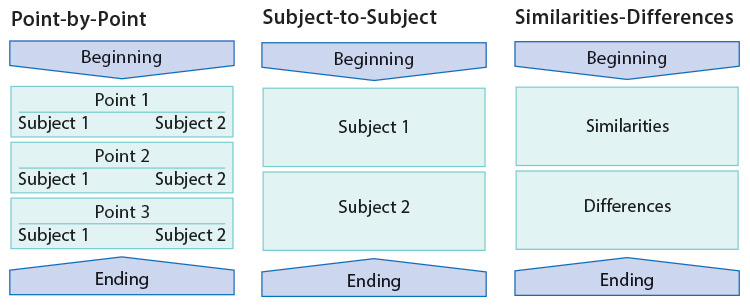
Pattern of Organization

Write topic sentences.

Write a topic sentence for each middle paragraph. Follow the directions for the type of essay you are writing—point-by-point, subject-to-subject, or similarities-differences.

Point-by-point: Write a topic sentence about the first point of comparison. OR Subject-to-subject: Write a topic sentence about the first subject. OR Similarities-differences: Write a topic sentence about a key similarity.

Dolphins and whales share some similar physical features.

Point-by-point: Write a topic sentence about a second point of comparison. OR Subject-to-subject: Write another topic sentence about the first subject. OR Similarities-differences: Write a topic sentence about a second key similarity.

Dolphins and whales share key behaviors, too.

Point-by-point: Write a topic sentence about a third point of comparison. OR Subject-to-subject: Write a topic sentence about the second subject. OR Similarities-differences: Write a topic sentence about a key difference.

The biggest difference between dolphins and whales is size.

Point-by-point: Write a topic sentence about a final point of comparison. OR Subject-to-subject: Write another topic sentence about the second subject. OR Similarities-differences: Write a topic sentence about a second key difference.

Another major difference is their habitat.

Teaching Tip

Students can create their topic sentences by using the same formula they used for creating a focus statement: the two subjects plus a comparison or contrast.

Write your middle paragraphs.

Write your topic sentences. Add detail sentences to support them. Use comparison-contrast transitions to connect your ideas.

Use a variety of details to compare and contrast: facts, examples, definitions, qualities, or details related to the senses­­—sights, sounds, smells, tastes, or textures.

Comparison-Contrast Transitions

Words used to compare:

Both

Like

Alike

In the same way

Similar to

Also

Words used to contrast:

Different

But

However

On the other hand

Instead of

In contrast to

Middle Paragraph 1

Middle Paragraph 2

Middle Paragraph 3

Middle Paragraph 4

Writing the Ending Paragraph

Write your ending paragraph.

Try these ending strategies. Then combine some into an ending paragraph.

  1. Restate your focus.

    Dolphins and whales are more alike than their size might suggest.

  2. Offer a final comparison or contrast:

    Two of the smartest ocean dwellers are dolphins and whales.

  3. Give a last thought.

    Cooperation makes dolphins and whales truly special.

Ending Paragraph

Reading a Comparison-Contrast Draft

Read a comparison-contrast draft.

Note how the writer put the parts together.

Dolphins Versus Whales

Lead

Did you know dolphins and whales come from the same biological family? It’s true. They’re both part of the “cetacean” order, aquatic mammals that evolved from hoofed land mammals. Focus statement Like many family members, dolphins and whales share some traits and features but also have key distinctions.

Dolphins and whales share some similar physical features. Both are long and slender, and they have fins on their back, sides, and ends of tails. Finally, both use a blowhole to breathe air. Breathing air is one reason why both are marine mammals, warm-blooded animals that live in the ocean.

Topic Sentences

Dolphins and whales share key social behaviors, too. Both are intelligent and cooperative. They travel in pods. That means they live, hunt, and raise their young in groups. Pod members use sounds to communicate and warn of danger. This type of communication is a form of echolocation, meaning they use sound waves and echoes to “see” objects and danger, even in dark or murky water.

Transitions

Of course, dolphins and whales have one very noticeable difference: size. Whales are much bigger than dolphins. Most dolphins are about 10 feet long and weigh 400 pounds. On the other hand, whales can grow up to 115 feet long and weigh up to 100 tons! Think of dolphins as the little cousins of whales.

Another major difference is their habitat. Whales are found in oceans all around the world no matter if the water is hot or cold. In contrast, dolphins live in ocean waters near the equator because they prefer warm water. And while many whale species take long migrations in search of food, dolphins don’t travel much outside their immediate habitat.

Ending Paragraph

Scientists say dolphins and whales are two of the smartest animals. You can see why by comparing the way they live and work together. Even though they are different sizes and live in different places, both value cooperation. This makes whales and dolphins special.

Teaching Tip

Students will recognize many parts of this essay, such as the lead, focus statement, and topic sentences. Help them see the choices the writer has made in drafting.

Templates
Template Name
Writing a Lead
Template Content

Student:

Date:

Write a lead.

Read each lead-writing strategy and example and write your own.

The first sentence in your essay should grab the reader's attention. It is called a "lead." The following activity will help you write an effective lead sentence.

1. Explain why the subject matters:

Dolphins and whales are among the most majestic creatures on earth.

2. Provide a surprising fact:

Two of the smartest animals on earth live in the ocean.

3. Ask a question:

Did you know dolphins and whales come from the same biological family?

Template Name
Writing Your Focus Statement
Template Content

Student:

Date:

Write your focus statement.

Read about focus statements. Then write your own focus statement.

Your beginning paragraph should end with a focus statement. The focus statement names the two subjects and starts to compare and contrast them.

Dolphins and whales share some traits and features but also have key distinctions.

Template Name
Writing Your Beginning Paragraph
Template Content

Student:

Date:

Write your beginning paragraph.

Write your lead sentence. Add detail sentences that build toward your focus statement.

Lead Sentence

Detail Sentences

Focus Statement

Template Name
Choose Your Pattern of Organization
Template Content

Student:

Date:

Choose a pattern of organization.

The following graphics show three common ways to organize the details in your middle paragraphs. Review the patterns, and pick the one that best fits your topics. Then follow that pattern as you begin writing your essay.

Template Name
Writing Topic Sentences
Template Content

Student:

Date:

Write topic sentences.

Write a topic sentence for each middle paragraph. Follow the directions for the type of essay you are writing—point-by-point, subject-to-subject, or similarities-differences.

Point-by-point: Write a topic sentence about the first point of comparison.

OR

Subject-to-subject: Write a topic sentence about the first subject.

OR

Similarities-differences: Write a topic sentence about a key similarity.

Topic sentence 1:

Point-by-point: Write a topic sentence about a second point of comparison.

OR

Subject-to-subject: Write another topic sentence about the first subject.

OR

Similarities-differences: Write a topic sentence about a second key similarity.

Topic sentence 2:

Point-by-point: Write a topic sentence about a third point of comparison.

OR

Subject-to-subject: Write a topic sentence about the second subject.

OR

Similarities-differences: Write a topic sentence about a key difference.

Topic sentence 3:

Point-by-point: Write a topic sentence about a final point of comparison.

OR

Subject-to-subject: Write another topic sentence about the second subject.

OR

Similarities-differences: Write a topic sentence about a second key difference.

Topic sentence 4:

Template Name
Writing Your Middle Paragraphs
Template Content

Student:

Date:

Write your middle paragraphs.

Write your topic sentences. Add detail sentences to support them. Use comparison-contrast transitions to connect your ideas.

 Use a variety of details to compare and contrast: facts, examples, definitions, qualities, or details related to the senses—see, hear, smell, taste, or touch.

Comparison-Contrast Transitions

Words used to compare:

Words used to contrast:

Both

Like

Alike

In the same way

Similar to

Also

Different

But

However

On the other hand

Instead of

In contrast to

Middle Paragraph 1

Middle Paragraph 2

Middle Paragraph 3

Middle Paragraph 4

Template Name
Writing Your Ending Paragraph
Template Content

Student:

Date:

Write your ending paragraph.

Try these ending strategies. Then combine some into an ending paragraph.

1. Restate your focus.

Dolphins and whales are more alike than their size might suggest.

2. Offer a final comparison or contrast:

Two of the smartest ocean dwellers are dolphins and whales.

3. Give a last thought.

Cooperation makes dolphins and whales truly special.

Template Name
Reading a Comparison-Contrast Draft
Template Content

Student:

Date:

Read the following draft.

Note how the writer put the parts together.

Dolphins Versus Whales

Did you know dolphins and whales come from the same biological family? It’s true. They’re both part of the “cetacean” order, aquatic mammals that evolved from hoofed land mammals. Focus statement Like many family members, dolphins and whales share some traits and features but also have key distinctions.

Dolphins and whales share some similar physical features. Both are long and slender, and they have fins on their back, sides, and ends of tails. Finally, both use a blowhole to breathe air. Breathing air is one reason why both are marine mammals, warm-blooded animals that live in the ocean.

Dolphins and whales share key social behaviors, too. Both are intelligent and cooperative. They travel in pods. That means they live, hunt, and raise their young in groups. Pod members use sounds to communicate and warn of danger. This type of communication is a form of echolocation, meaning they use sound waves and echoes to “see” objects and danger, even in dark or murky water.

Of course, dolphins and whales have one very noticeable difference: size. Whales are much bigger than dolphins. Most dolphins are about 10 feet long and weigh 400 pounds. On the other hand, whales can grow up to 115 feet long and weigh 100 tons! Think of dolphins as the little cousins of whales.

Another major difference is their habitat. Whales are found in oceans all around the world no matter if the water is hot or cold. In contrast, dolphins live in ocean waters near the equator because they prefer warm water. And while many whale species take long migrations in search of food, dolphins don’t travel much outside their immediate habitat.

Scientists say dolphins and whales are two of the smartest animals. You can see why by comparing the way they live and work together. Even though they are different sizes and live in different places, both value cooperation. This makes whales and dolphins special.

Unit Container Label
Unit Container D7 ID
Lesson Weight
4