Warm-Up for Phase Autobiographies
We all go through special phases that shape who are we and who we will become. This unit will show you how to write a compelling narrative about an important phase in your life.
Listen to "What Is a Phase Autobiography?"
Hide audio
What Is a Phase Autobiography?
A phase autobiography is a special form of narrative writing in which you write about a period in your life when you changed or grew in important ways. All people—especially young people like you—go through changes. A move to a new city may force one person to become more outgoing and personable in order to make new friends. The arrival of a baby brother or sister may cause another person to take on more responsibilities in the family. Learning how to play an instrument may show still another person the value of dedication and hard work.
You can write about a life-changing week, month, season, or year. Your biggest challenge may be choosing what to include in your writing and what to leave out. If you try to tell everything, your writing will go on and on, and may even become boring. Instead, plan to share just the key encounters, actions, and places as well as their effect on you. By doing so, you will create an effective narrative that readers can enjoy and learn from.
Thinking About Narrative Structure
The best narratives (stories) display a common structure characterized by rising action that builds interest to a peak before falling again toward a satisfying resolution. This structure mirrors the shape of the most rewarding experiences in life, so it is not surprising that phase autobiographies often follow this structure.
The following graphic shows how narratives build suspense through a series of actions that raise the stakes, leading to a critical moment or climax, when the main character confronts the central struggle.
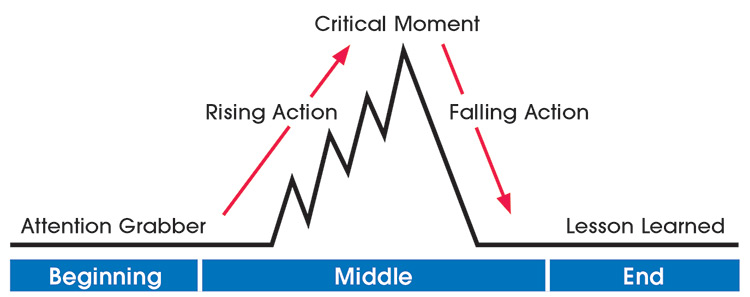
Read about how the main narrative elements in Harry Potter and the Sorcerer's Stone follow this pattern.
-
Attention Grabber
At midnight on Harry's 11th birthday, a gigantic stranger bursts into his room to deliver a letter that says Harry is actually a wizard and is to report to a magic school named Hogwarts.
-
Rising Action
Harry faces a series of obstacles adjusting to life at Hogwarts. He and his friends Ron and Hermione learn about a plot to steal the Sorcerer's Stone, which is hidden beneath a trap door at Hogwarts. The plot is being orchestrated by Lord Voldemort, an evil dark wizard.
-
Critical Moment
Hermione, Ron, and Harry descend the trapdoor in an attempt to foil Voldemort's plot. After overcoming many intense obstacles together, Harry enters the room with the stone. There, he encounters Quirrell, who is acting on behalf of Voldemort. While protecting the stone, Harry is struck by Quirrell. However, the contact is lethal to Quirrell.
-
Falling Action
-
Lesson Learned
Harry learns that evil forces are on the verge of returning to the wizarding world, and he will play a role in stopping them. More importantly, he realizes he can't tackle problems alone. He learns the value of friendship and cooperation.
Harry wakes up in the school hospital. The great wizard Dumbledore explains that Harry survived Quirrell's blow because of a charm passed onto him from his mother, who sacrificed her life to protect him from Voldemort when he was an infant. With the stone now destroyed, Harry finishes the school year and returns home.
Teaching Tip
Students should refer to the graphic for narrative structure as they plan their phase autobiographies.
Analyze narrative structure.
Think about the plot of one of your favorite books, television shows, or movies. Answer the questions about how the story is developed. Consider how closely the structure mirrors that of the graphic shown above.
- What is the title of the story?
- What happens at the beginning to grab your attention?
- What are some examples of rising action in the story?
- What would happen if the story exhibited falling action, but no rising action?
- What is the story's critical moment?
- How is the moment resolved?
- What main lesson or lessons does the main character learn?
Teaching Tip
Let your students know that rising action helps build suspense and keep the reader's attention. Encourage them to use rising action when they write their phase autobiographies.