Revising Comparison-Contrast Essays

By Anonymous (not verified), 12 March, 2026
Grade Level
Unit Lesson Body

Revising Comparison-Contrast Essays

After you've completed a first draft of your comparison-contrast essay, take a break before you begin revising. You need to see your work objectively, because when you revise, you make big improvements to your ideas, organization, and voice. These activities will help you revise.

Revising from General to Specific

Your writing will sound more knowledgeable and interesting if you replace general ideas with specific facts that your readers might not already know.

  • General idea: Whales are really long.

  • Specific fact: Whales can grow up to 115 feet long.

  • General idea: Dolphins and whales use sounds.

  • Specific fact: Dolphins and whales use echolocation sounds to communicate and warn of danger.

Choose interesting facts.

Read the following facts about penguins. Underline the three most specific facts that a writer could use to sound more knowledgeable.

  1. Penguins use their black and white color as camouflage. Penguins use their black and white color as camouflage.
  2. Penguins are great swimmers and can move quickly in the water. Penguins are great swimmers and can move quickly in the water.
  3. The Gentoo Penguin can swim at speeds of 22 miles per hour. The Gentoo Penguin can swim at speeds of 22 miles per hour.
  4. All penguins live in the Southern Hemisphere. All penguins live in the Southern Hemisphere.

Replace general ideas with interesting facts.

Replace at least two general ideas from your essay with specific facts. You may need to do new research to complete this activity. Check books and Web sites for new facts.

  1. Write a general idea from your essay.
  2. Write an interesting fact about the idea.
  3. Write another general idea from your essay.
  4. Write an interesting fact about the idea.

Teaching Tip

Use this lesson to help students deepen their explanations, adding new details with additional research.

Revising to Define Key Words

Define key words.

Follow these instructions to define key words. Then search for and define key words in your essay.

When your essay includes unfamiliar words about your subject, you should explain their meaning. Note the difference between undefined and defined words.

  • Key word not defined:

    Dolphins and whales live in pods. (What is a pod?)

  • Key word defined in a new sentence starting with “That means”:

    Dolphins and whales live in pods. That means they live in groups.

  • Key word not defined:

    They have dorsal fins. (What is a dorsal fin?)

  • Key word defined in the same sentence after a comma:

    They have a dorsal fin, a single fin located on their backs.

  1. Write down a key word about your subject or subjects.
  2. Define the key word in a new sentence starting with “That means.”
  3. Write down another key word about your subject or subjects.
  4. Define the key word in the same sentence after a comma.

Revising with a Peer Response

Share your writing.

Have a trusted classmate read your essay and complete the form.
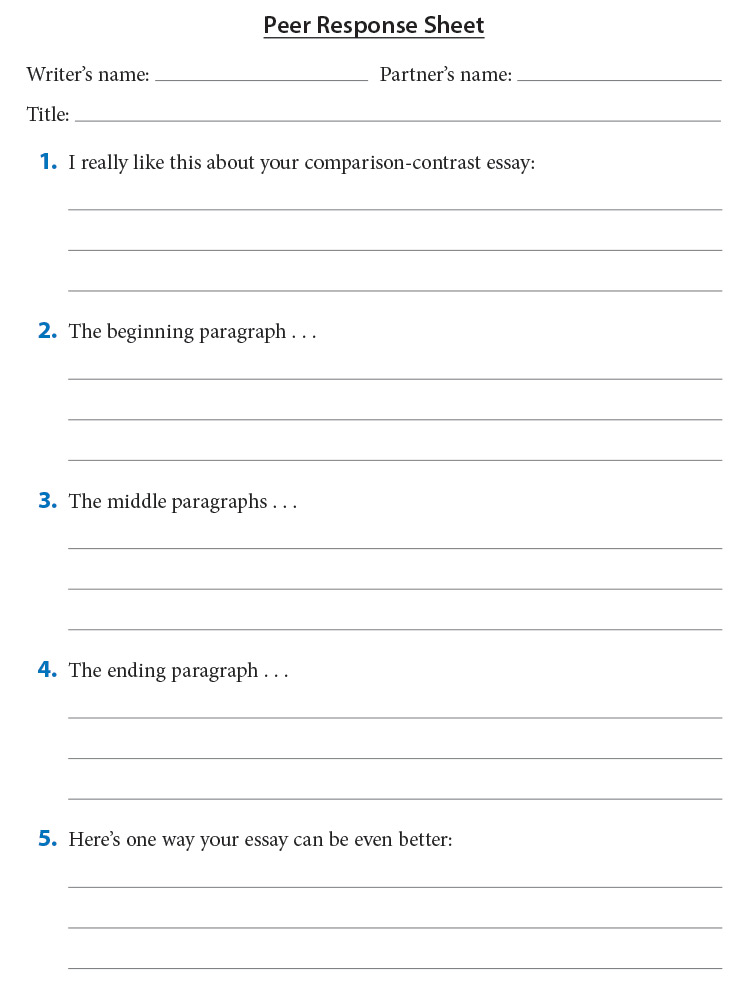
Peer Response Sheet

Revising in Action

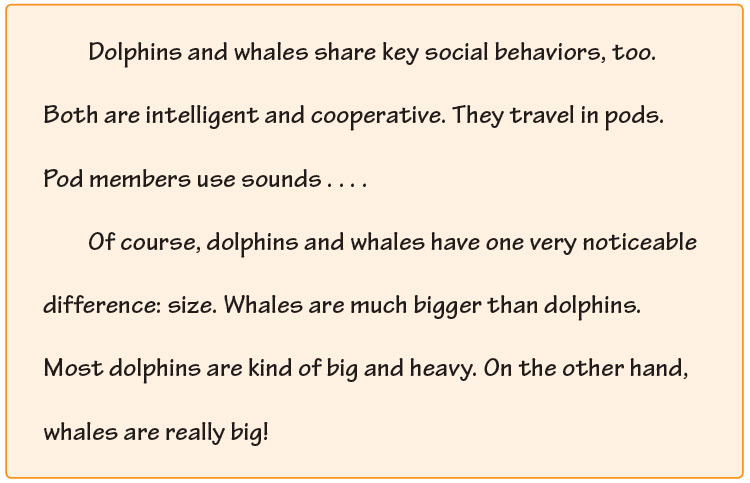
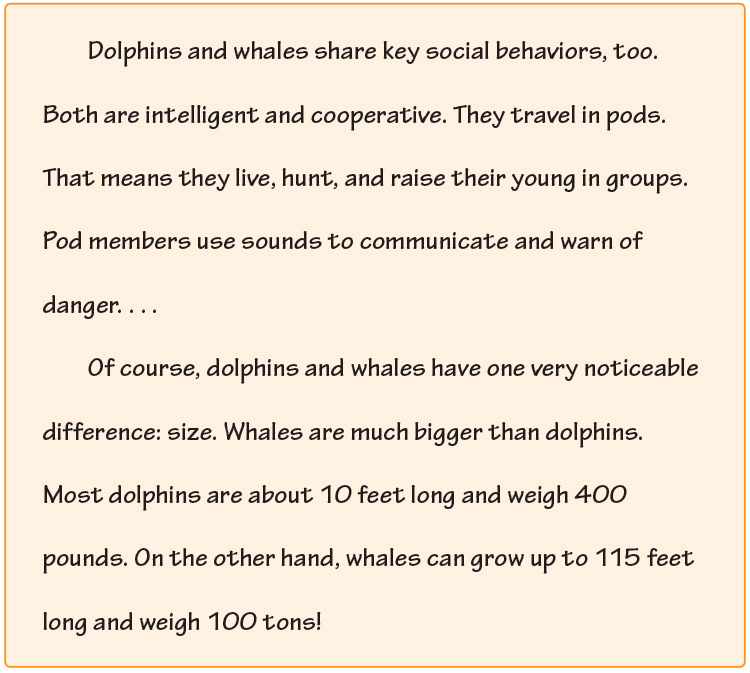
When you revise, you add, delete, rewrite, and rearrange your writing to make it clearer. Here are revisions to the "Dolphins Versus Whales" essay.

  • Paragraph Before Revising

    Revising
  • A definition is added and general ideas are replaced with specific facts.
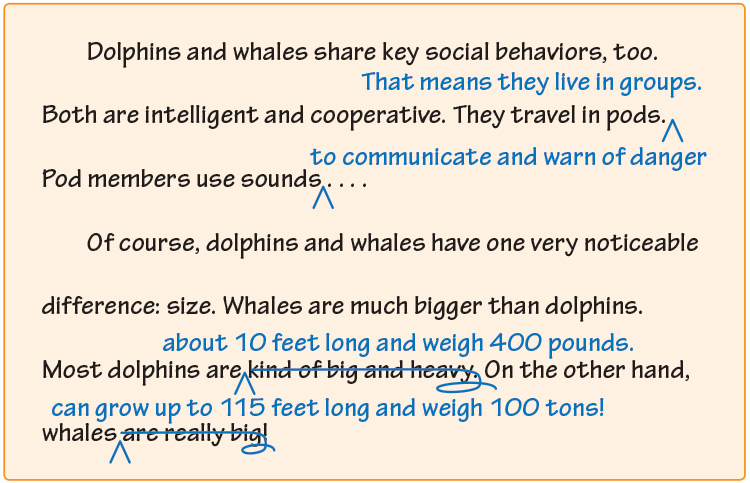
    Revising
  • Paragraph After Revising

    Revising

Revise with a checklist.

Read each line. When you can answer each question with a yes, check it off.

Ideas

  • Does the topic include two subjects?
  • Do I compare and contrast the subjects with specific facts and details?

Organization

  • Does the essay follow one of the organizational patterns?
  • Does a lead hook the reader at the beginning?
  • Does the beginning paragraph have a clear focus statement?
  • Do middle paragraphs focus on similarities and differences?
  • Do transition words connect ideas?

Voice

  • Does the voice effectively teach how the two subjects compare and contrast?

Word Choice

  • Do I use specific nouns and verbs?
  • Do I define any unknown words?

Sentence Fluency

  • Are my sentences clear and complete?
Templates
Template Name
Revising from General to Specific
Template Content

Student:

Date:

Choose interesting facts.

Read the following facts about penguins. Underline the three most specific facts that a writer could use to sound more knowledgeable.

1. Penguins use their black and white color as camouflage.

2. Penguins are great swimmers and can move quickly in the water.

3. The Gentoo Penguin can swim at speeds of 22 miles per hour.

4. All penguins live in the South Hemisphere.


© Thoughtful Learning                From Write on Course 20-20 and the unit Writing Comparison-Contrast Essays

Template Name
Revising to Replace General Ideas with Interesting Facts
Template Content

Student:

Date:

Replace general ideas with interesting facts.

Replace at least two general ideas from your essay with specific facts. You may need to do new research to complete this activity. Check books and Web sites for new facts.

1. Write a general idea from your essay.

2. Write an interesting fact about the idea.

3. Write another general idea from your essay.

4. Write an interesting fact about the idea.


© Thoughtful Learning                From Write on Course 20-20 and the unit Writing Comparison-Contrast Essays

Template Name
Revising to Define Key Words
Template Content

Student:

Date:

Define key words.

Follow these instructions to define key words. Then search for define key words in your essay.

        When your essay includes words about your subject that your readers might not understand, you should explain their meaning.

  • Key word not defined:

Dolphins and whales live in pods. (What is a pod?)

  • Key word defined in a new sentence starting with “That means”:

Dolphins and whales live in pods. That means they live in groups.

  • Key word not defined:

They have dorsal fins. (What is a dorsal fin?)

  • Key word defined in the same sentence after a comma:

                They have a dorsal fin, a single fin located on their backs.


1. Write down a key word about your subject or subjects.

2. Define the key word in a new sentence starting with “That means.”

3. Write down another key word about your subject or subjects.

4. Define the key word in the same sentence after a comma.

© Thoughtful Learning                From Write on Course 20-20 and the unit Writing Comparison-Contrast Essays

Template Name
Revising with a Peer Response
Template Content

Student:

Date:

Share your writing.

Have a trusted classmate read your essay and complete the form.

Peer Response Sheet

Writer's name:

Partner's name:

Title:

I really like this about your comparison-contrast essay:

The opening paragraph . . .

The body paragraphs . . .

The ending paragraph . . .

Here’s one way your essay can be even better:

© Thoughtful Learning                From Write on Course 20-20 and the unit Writing Comparison-Contrast Essays

Template Name
Revising in Action
Template Content

Student:

Date:

Revise with a checklist.

Read each line. When you can answer each question with a yes, check it off.

Ideas

Does the topic include two subjects?

Do I compare and contrast the subjects with specific facts and details?

Organization

Does the essay follow one of the organizational patterns?

Does a lead hook the reader at the beginning?

Does the beginning paragraph have a clear focus statement?

Do middle paragraphs focus on similarities and differences?

Do transition words connect ideas?

Voice

Does the voice effectively teach how the two subjects compare and contrast?

Word Choice

Do I use specific nouns and verbs?

Do I define any unknown words?

Sentence Fluency

Are my sentences clear and complete?

© Thoughtful Learning                From Write on Course 20-20 and the unit Writing Comparison-Contrast Essays

Unit Container Label
Unit Container D7 ID
Lesson Weight
5