Revising Promotion Essays
After you write a first draft, you'll be ready to start reviewing and revising. When you revise, you think about the "big picture," including your opinion, reasons, and details and the ways that you connect them into a beginning, middle, and ending. These activities will help you revise.
Revising to Answer Objections
Believe it or not, one of the most powerful ways to support your opinion is to consider the ideas of people who disagree. When you mention an opposing viewpoint, you show your reader that you have already thought about objections against your opinion. You also get the opportunity to handle the objection in one of three ways:
- Refuting the objection means showing how the opposing idea is incorrect.
Some people say that students who have to share instruments learn patience and cooperation. Unfortunately in the past, students who share instruments have only learned that band is not for them and have dropped out.
- Addressing the objection means recognizing it is valid but has some limitations.
Many people have suggested a fund-raiser to make money for new instruments. Though fund-raisers can be helpful, the cost of new instruments means a lot of effort to buy only a few instruments.
- Conceding the objection means saying it is a good point while at the same time stressing the importance of your position.
Yes, every student would prefer to play a new instrument. That's true. But a used instrument is better than nothing, which is what many students currently have.
Answer objections.
Think about three objections to your opinion and write them in the spaces provided. Then, under each objection, write a response that refutes, addresses, or concedes the objection.
Objection 1:
Answer 1 (Refute, Address, or Concede):
Objection 2:
Answer 2 (Refute, Address, or Concede):
Objection 3:
Answer 3 (Refute, Address, or Concede):
Revise to answer objections.
Reread your first draft. If adding an answer to an objection would strengthen your argument, consider including one of your answers to the objections above.
Revising for Logical Transitions
To convince your reader, you need to create a logical, coherent argument. Transition words and phrases can help connect your ideas, showing how they relate logically and how they hold together (cohere). Notice how choppy the following paragraph sounds without transitions, and how transitions greatly improve the coherence.
Revise for transitions.
Rewrite the choppy paragraphs that follow, adding transitions to improve the logic and coherence. You may need to adjust other words.
- Why should the city spend money to turn empty, overgrown lots into community gardens? The lots are really ugly. Turning them into beautiful gardens will make the neighborhood look better. A garden will bring neighbors together. Gardening makes people relaxed. People can eat what they grow and save money.
- The playground at the corner of Sixth Street and Rio Grande must be improved for many reasons. The neighborhood has only unsafe places for kids to play. Many kids play in lots where buildings have been torn down. These lots are littered with metal and broken glass. The playground is full of trash and dangerous objects. It has broken equipment. The playground is ugly. Neither parents nor children want to go there. By donating our time, tools, and gardening skills, we can turn the playground into a neighborhood treasure.
Add transitions.
Check your essay, watching for choppy sentences that lack coherence. If you find any, add transitions to improve the flow and create logical connections between ideas.
Revising with a Peer Response
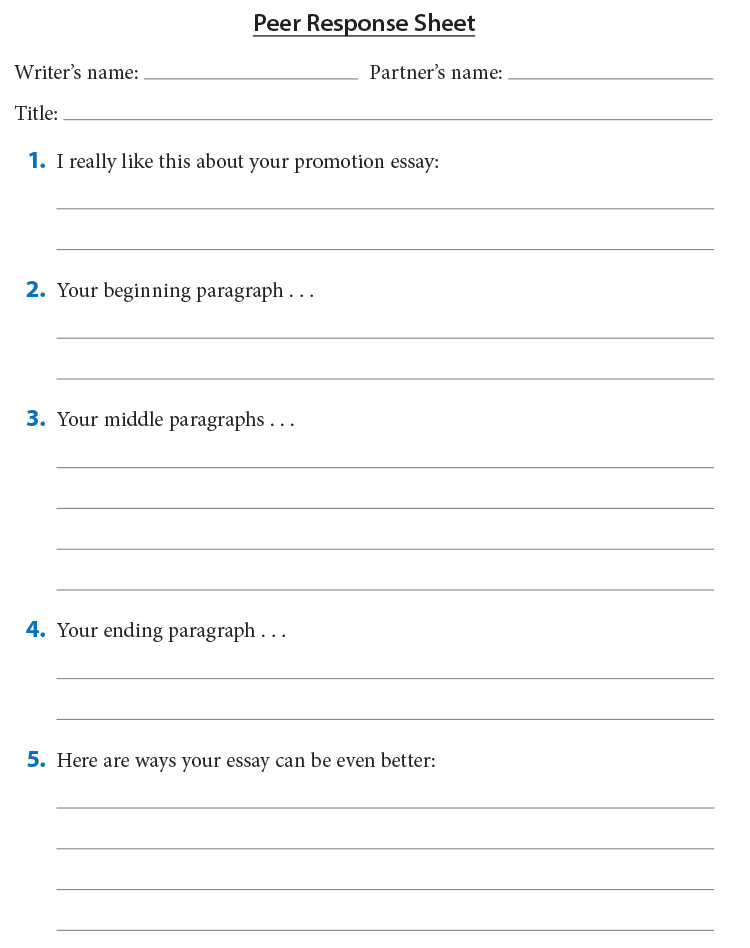
Share your writing.
Have a partner read your essay and then respond to it by completing this form. A responder should try to list at least one strong point for each part and, if at all possible, one thing to improve.
Revising in Action
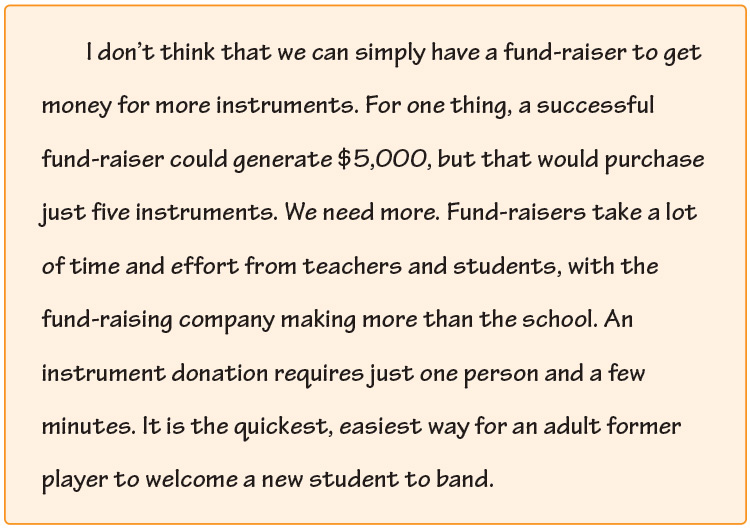
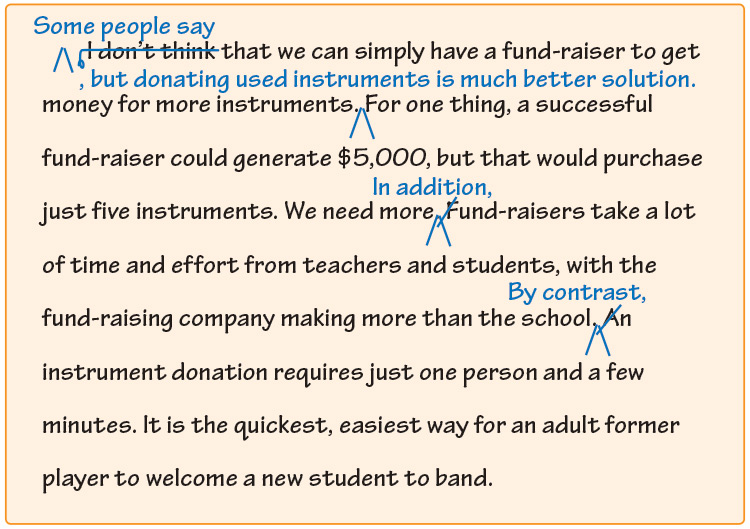
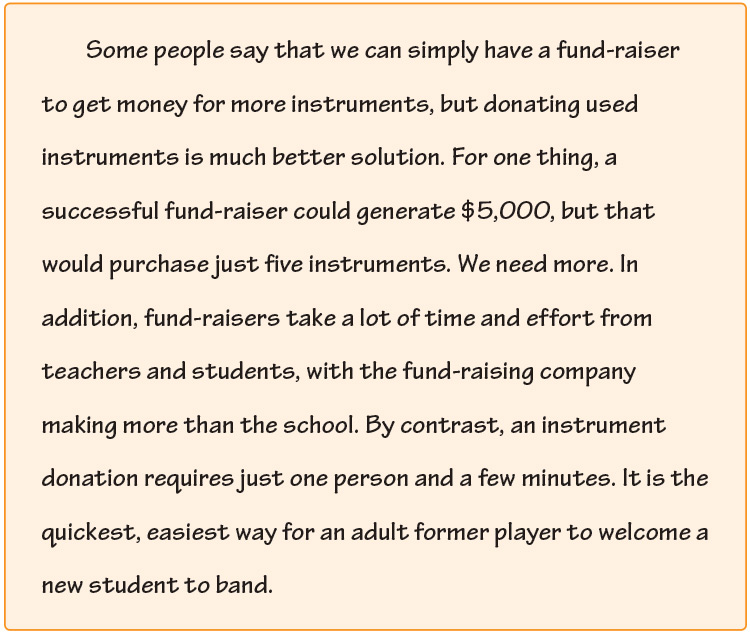
When you revise, you add, take out, rewrite, and rearrange your writing to make it clearer. Here are revisions to one student’s essay.
-
Paragraph Before Revising
-
Changes improve a response to an objection and paragraph coherence.
-
Paragraph After Revising
Revise with a checklist.
Read each line in the checklist. When you can answer each question with a yes, check it off.
Ideas
- Is my opinion statement clear?
- Is my opinion clearly developed with strong reasons?
- Do details (facts, examples, explanations, . . .) explain the reasons?
Organization
- Does the beginning paragraph state my opinion clearly?
- Do the middle paragraphs follow order of importance?
- Does the end paragraph wrap up the essay and give a call to action?
Voice
- Do I sound sincere and interested in the topic?
- Do I refute, answer, or concede objections in a fair and polite manner?
Word Choice
- Have I used specific nouns and active verbs?
Sentence Fluency
- Do my sentences flow smoothly from one to another?
- Do I use transitions to connect ideas?