Editing Literary Analyses
After revising your literary analysis, it is time to work on the finishing touches. Editing involves polishing your writing so that it has correct sentences, punctuation, capitalization, spelling, usage, and grammar. The following activities will help you edit your analysis.
Editing for Comma Usage
A comma creates a slight pause, gently separating the idea that comes before from the idea that comes after. This little separation help readers understand how words relate to each other. For example, a comma can show a reader how two or more adjectives work in front of a noun.
To Separate Equal Adjectives
Use a comma to separate two or more adjectives if they modify a noun in an equal way. Do not use a comma if the adjectives modify the noun in an unequal way.
I have a difficult, challenging job.
("Difficult" and "challenging" modify "job" in an equal way, so a comma is needed.)
Seasonal construction jobs are physically demanding.
("Seasonal" and "construction" do not modify "jobs" in an equal way. They need to be written in that exact order without a comma to make sense.)
How can you determine if adjectives are equal or unequal? Use one or both of these simple tests:
- If you can switch the order of the adjectives and they still sound right, they modify equally and need a comma.
I have a challenging, difficult job.
- If the word and works between the adjectives, they modify equally and need a comma.
I have a difficult and challenging job. I have a difficult, challenging job.
To Set Off Introductory Clauses and Phrases
Use a comma after an introductory clause or a long introductory phrase. The comma helps the reader know when the introduction is over and the main part of the sentence is beginning. If an introductory phrase is very short (three words or fewer), the comma is optional.
Because weather changes quickly in the mountains, we carried rain gear.
(an introductory clause)
Sore and tired from the climb, we stopped for a rest near a waterfall.
(an introductory phrase)
After lunch we continued our hike.
(a short introductory phrase)
Edit comma usage.
Place commas between equal adjectives and after introductory clauses and long introductory phrases. Then check your literary analysis for correct comma usage.
- In the middle of the summer, our youth group took a trip to the American West.
- The West's diverse topography features cold, snowy mountains; hot, arid deserts; warm, sunny beaches; and rainy, foggy coastlines.
- After a stop at Devils Tower Monument, we drove to Wyoming's Cloud Peak Wilderness and camped out in tents overnight.
- As the sun burned away the morning fog, we came out of our tents.
- We ate a quick, energy-packed breakfast and headed out for the trail.
- Winding in and out of the woods and crossing several streams, the trail slowly climbed to more than 10,000 feet.
- A small herd of graceful, regal elk grazed in a clearing far below.
- Although we had heard tales of a big black bear, we never saw it.
- We reached our destination at the beautiful, majestic mountaintop by midafternoon.
- Slipping on our hats and jackets, we sat down to drink water and admire the view.
Editing to Punctuate Quotations
When you use exact wording from literature, you need to enclose the words in quotation marks and provide a page reference. Follow these steps to make sure you correctly form text citations.
Mention the work and the author at least once in your paper before quoting evidence.
At the beginning of Roll of Thunder, Hear My Cry by Mildred D. Taylor, Cassie Logan recalls what . . .
Use double quotations before and after the quote. If quotation marks appear within, use single quotations for them.
He tells Cassie, “There’ll be a whole lot of things you ain’t gonna wanna do but you’ll have to do in this life just so you can survive” (175).
Showing her independent streak, Cassie explains her classroom behavior: “ ‘Yes'm Miz Crocker,’ the children chorused. But I remained silent. I never did approve of group responses” (107).
Indicate the source of the material by placing the page number in parentheses. The parentheses should appear after the end quotation marks but before the end punctuation.
The story ends with Cassie crying “for TJ. For TJ and the land” (276).
Edit to punctuate quotations.
In each sentence below, correct any errors in punctuating quotations. Then review your own writing to make sure you have correctly punctuated quotations.
- The boys tell the lady exactly what to think: " So we just flat out told the painter lady to quit messing with the wall" (328).
- The boy says, “Lou had to drag me away, I was so mad” ( 329).
- Then the boy complains, "Who did the lady think she was, coming into our neighborhood and taking over our wall" (332).
- The boy tries to describe what he sees: "Reds, greens, figures outlined in black. Swirls of purple and orange. Storms of blues and yellows. It was something" (333).
- Lou recalled, "When the lady commented, 'That's unique,' I don't think she mean it as a compliment" (12).
Editing in Action
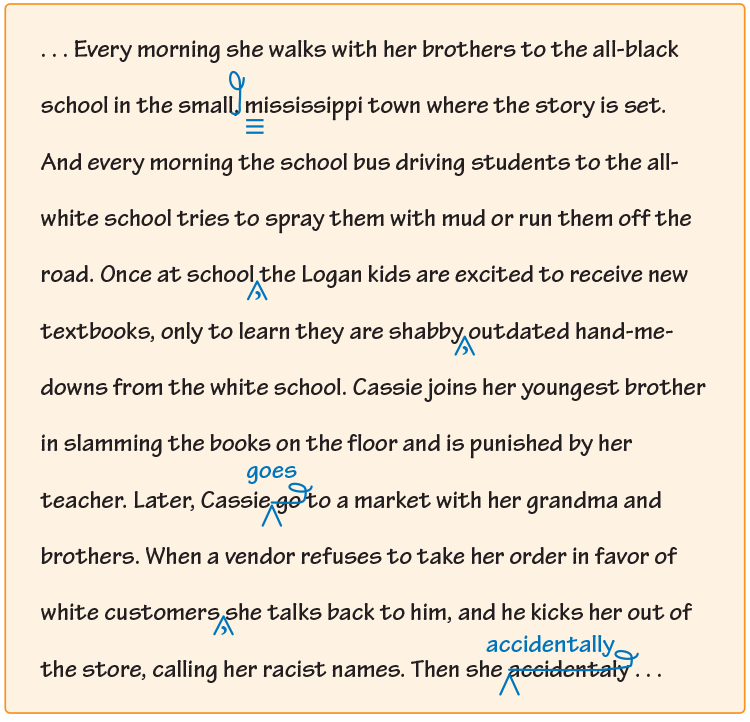
When you edit, you check sentences, punctuation, capitalization, spelling, usage, and grammar. You make corrections to ensure that your work is error free.
-
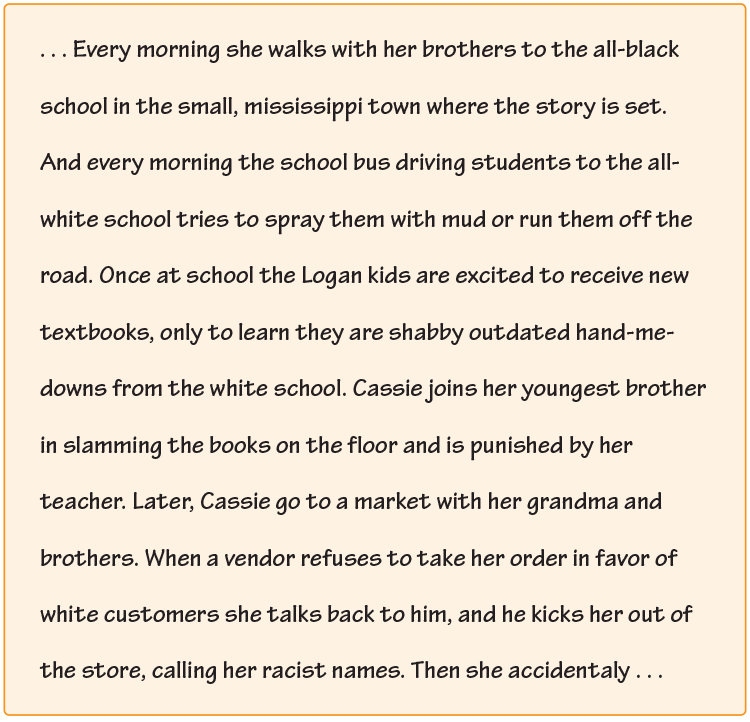
Paragraph Before Edits
-
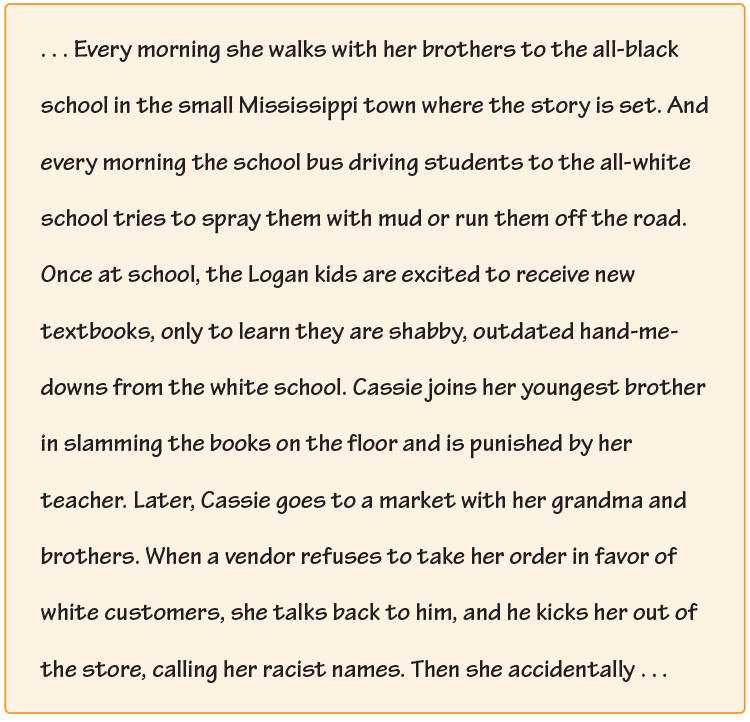
Errors in comma usage, subject-verb agreement, capitalization, and spelling are fixed.
-
Paragraph After Edits
Edit with a checklist.
Read each line. When you can answer each question with yes, check it off.
Punctuation
- Did I close each sentence with an end punctuation mark?
- Do I enclose dialogue in quotation marks?
- Do I place commas and end punctuation properly near quotation marks?
- Do I use commas to separate equal adjectives?
- Do I use commas after introductory clauses and long introductory phrases?
Capitalization
- Did I start all sentences with capital letters?
- Did I capitalize the names of people and places?
Grammar
- Are my sentences free of run-ons and comma splices?
- Do the subjects and verbs agree in number? (The van honks; the cars stop.)
Usage
- Did I correctly use commonly confused words (its/it's)?
Spelling
- Did I check for spelling errors?
- Did I use a dictionary or the spell checker on my computer?
Publishing Literary Analyses
Congratulations! Your hard work has paid off, and now your polished literary analysis is ready to share with others. Make a clean final copy of your analysis. Then find ways to share your writing with classmates, your teacher, your family, and your friends. You may also wish to submit your work to a literary contest or online publication.
Publishing a Final Copy
Create a final copy of your analysis.
Include your revising and editing changes and read over your work a final time, this time out loud. (If you are working on a computer, spell-check your work.)
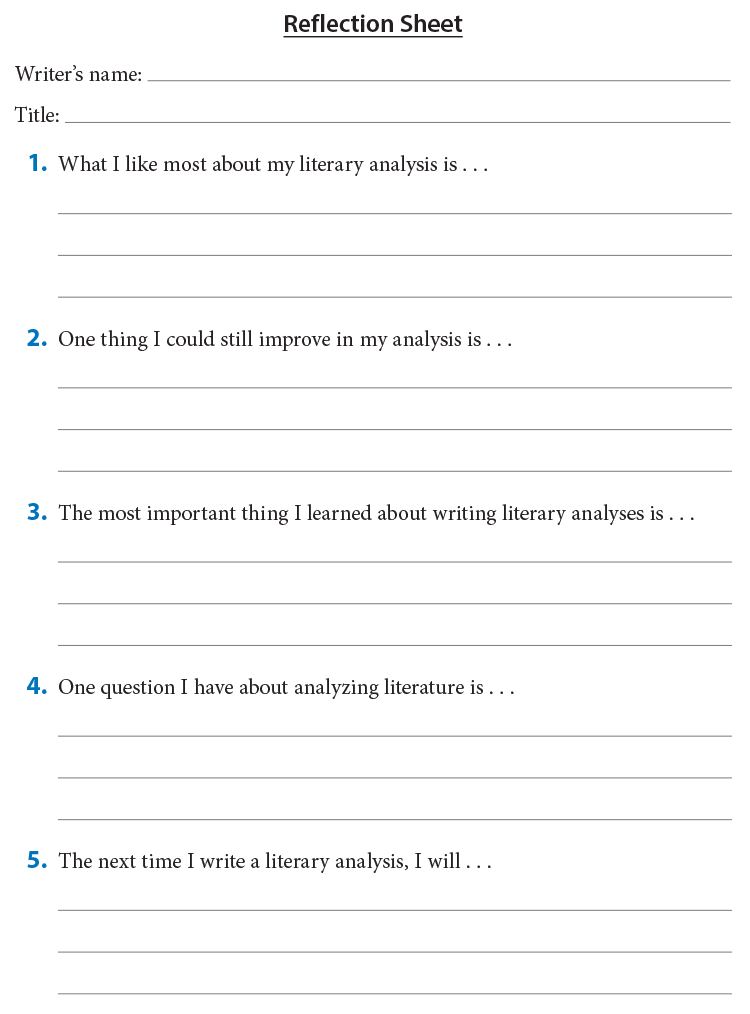
Reflecting on Your Writing
Reflect on your writing.
Complete the following sheet to reflect on analyzing literature.