Assembling Your Narrative Argument
By now you have completed drafts of an argument essay and a narrative. Great work! The two main components of your narrative argument are ready to go. Now comes the fun part—combining both forms into a single paper. Finding the right mix is not an exact science. You'll need to experiment with different arrangements to create your strongest argument. The activities in this lesson will help.
Combining Argument and Narrative
Follow these steps to blend your two separate essays into a narrative argument. As you work through the steps, remember that you can add, cut, rewrite, and rearrange parts of both original pieces as needed.
- Make your original argument essay the base of your paper.
- Read over both pieces one more time.
- Decide what portions of your narrative support your argument.
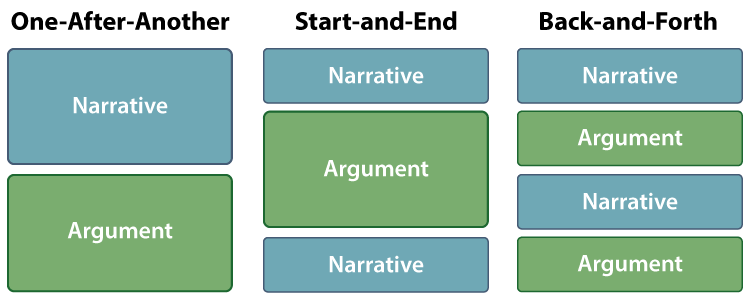
- Experiment with different combinations of narration and argumentation. Here are three common ways to organize a narrative argument:
- One-After-Another: Start with your full narrative and transition to your full argument or vice versa.
- Start-and-End: Start with a portion of your narrative, transition to your argument, and then return to your narrative.
- Back-and-Forth: Start with your narrative or argument and transition back and forth multiple times between both pieces.
- Evaluate the results. Which pattern most effectively strengthens the argument? Which pattern is easiest to follow? Which pattern will most likely get readers to empathize with your position?
- Choose a pattern.
- Add parts (or all) of your narrative to your argument essay. If you are working in a word-processing program, you can simply copy and paste the parts. Reword sections as needed to improve the flow.
Create your narrative argument.
Follow the steps to create a draft of your narrative argument.
Bridging the Genres
As you assemble your paper, you'll want to pay close attention to places where your narrative and argument meet. If the shifts seem unnatural, add a rhetorical bridge to connect your ideas. Consider the following transitional strategies:
Strategy 1: Insert linking words, phrases, sentences, or paragraphs.
I shared my concerns with my girlfriends, many of whom stopped playing sports after freshmen year. "You see the types of girls that still play. I’m not getting judged like that." In no uncertain terms they told me that boys’ teams deserve better resources because they are more popular.
The conversation made me wonder, with all the national momentum for women's empowerment issues, why does the push for gender equality seem to stall in high school?
Gender remains a taboo subject among high school students, and not just in athletics.
Can you follow the rhetorical thread? The narrative paragraph recounts a conversation. The transitional paragraph uses the conversation as its literal subject and proposes a rhetorical question to introduce the argument. The first argument paragraph starts with an answer to the rhetorical question and ends with a phrase that refers back to the subject of the conversation.
Strategy 2: Move from a general idea (main argument) to specific case (narrative example).
While the #MeToo movement empowered adult women to voice their experiences with sexual harassment and assault, high school girls do not feel the same empowerment. As one of my friends admitted, “I’d be too ashamed to say anything. Besides, who would believe me?” Some people will claim that the #MeToo movement deals with strictly adult problems.
The writer supports a general argument with a specific narrative example, and then moves back to her argument. Notice also the shifts in pronoun usage, which dovetail with Strategy 4.
Strategy 3: Connect a conflict, character, time, or setting.
I shared my concerns with my girlfriends, many of whom stopped playing sports after freshmen year. "You see the types of girls that still play. I’m not getting judged like that." In no uncertain terms, they told me boy’ sports deserve better resources because they are more popular.
Around the same time as this conversation, a movement for women’s empowerment was sweeping across the country. . . .
This example connects a narrative conflict with a historical moment related to the writer's argument.
Strategy 4: Use grammatical shifts in person. But be delicate about it. Avoid shifts within sentences, and make sure to include other transitional markers to help readers understand why the shift is occurring.
Boys who don't fit in stereotypical visions of masculinity get denigrated as well. Clearly, students need to be more aware and sensitive to their words and language.
Gender bias creeps into athletics, too. I would know. Despite my friends’ reservations, I decided to fight for better resources for female athletes at my school.
The sentence "I would know" signals a shift from third to first person.
Strategy 5: Utilize short paragraphs and white space for key transitions. This strategy draws readers' attention to the transition.
Critics may insist that schools should not get involved in social justice issues like gender equality because they drive a certain political agenda, and schools and politics should not mix.
Hold up. What?
Public education has always been partly political. Politicians control school funding, districting boundaries, and learning standards. And treating students fairly and equally in school regardless of gender is a civil right already guaranteed by Title IX. Schools enforce certain political agendas most obviously by not fully addressing gender equity.
The short narrative paragraph punctuates the ideas in the answer to a key objection.
Create bridges between genres.
Review your narrative argument, noting where the two genres meet. Insert transitional elements where needed using one or more of the strategies from above.
Reading a Narrative Argument
The student who wrote about gender equality in high school tried out different combinations of argumentation and narration but ultimately decided that a back-and-forth pattern produced her strongest argument. (The writer of the sample about Generation Z followed a one-after-another approach while also adding narrative connections to the main argument.)
Read a student's narrative argument.
As you read the draft, click on the side notes to see how she put the parts together. Notice too that the writer reworded, cut, and added parts of her original pieces to fit the two together.
Sample Narrative Argument
Listen to “Equity Matters”
Hide audio
Equity Matters
Lead I’m a sports fanatic. Football, basketball, soccer. I love it all.
I’m also a girl.
Narration I thought by now my gender wouldn't be an issue, but last school year showed it still is. That’s when I learned my passion for watching and playing sports wasn’t very “ladylike” and that I should shut up about gender inequality in high school.
Here’s how it all went down: At the start of junior year, I noticed some things. The football team received new equipment, while the girls’ volleyball team wore the same tattered jerseys as the previous year. The JV boys’ and varsity girls’ basketball teams practiced at the same time, but the girls’ team got bumped to the secondary gym. The baseball team played on a beautifully renovated field even though the previous version was newer than the divot-dotted softball diamond we girls played on.
I shared my concerns with my girlfriends, many of whom stopped playing sports after freshmen year. “You see the types of girls that still play. I’m not getting judged like that.” In no uncertain terms, they told me that boys’ teams deserve better resources because they are more popular.
Transition to Argument The conversation made me wonder, with all the national momentum for women’s empowerment issues, why does the push for gender equality seem to stall in high school?
Argument Gender remains a taboo subject among high school students, and not just in athletics. Many of us don’t realize the degree to which gender expectations impact our learning and well-being. Those of us who do speak out against sexism risk mockery. “There goes Drama Jess again, making something out of nothing!” It shouldn’t be that way. Position Statement High schools should challenge gender bias and create an equitable environment for all students.
So why and how should high schools promote gender equality? Reasons For starters, gender equality empowers all students, not just female ones. Too often equality measures get conflated with man-hating, when in fact they benefit guys as well as girls. Like female students, male students get tagged with gender stereotypes that affect everything from what classes they are expected to take to how comfortable they are expressing their feelings. In terms of class choices, certain subjects still get framed as stereotypically “masculine” (like science and math) or “feminine” (like English and choir). These long-standing stereotypes have negative consequences. A recent survey found that only 11 percent of high school girls were drawn to non-medical STEM careers versus 36 percent of males (Pittenger). Meanwhile, guys on average read less than their female classmates (Schwanenflugel and Knapp). High schools need to do a better job of addressing these issues. All students should feel comfortable pursuing academic and extracurricular interests free from the pressure of gender expectations.
Teachers can be a part of the solution by making their classes more gender equitable. STEM teachers can highlight female icons in those fields as well as male ones. English teachers can offer male (and female) students a wider choice in reading material and present works that challenge gender assumptions. Social studies teachers can delve into the history of gender roles. Teachers also need to rethink how they manage their classrooms. Did you know that female students are less likely to be called on in class than male peers? That teachers interrupt girls more often than guys? That guys are prompted to seek deeper answers to questions while girls are rewarded for keeping quiet (Chemaly)? These examples of gender bias are so socially ingrained that teachers may not even realize they are perpetuating them.
While teachers may sometimes unknowingly commit bias, students carry it out in more overt ways. Hallways and cafeterias overflow with gendered comments about actions, appearance, and clothing choices. High school girls often face double standards when it comes to dating, relationships, and even their manner of speech. For instance, girls who are assertive often get called “bossy” or “aggressive” while boys who speak and act in similar ways are called “bold” or “confident.” The “weakness” of girls gets reinforced with age-old pejoratives like “manning up” and “throwing like a girl.” Such rhetoric is harmful to both genders. Boys who don't fit in stereotypical visions of masculinity get denigrated as well. Clearly, students need to be more aware of and sensitive to their words and language.
Transition to Narrative Gender bias creeps into athletics, too. I would know. Despite my friends’ reservations, I decided to fight for better resources for female athletes at my school. I ran for student council president, making my athletics pitch my platform. During my campaign speech, I brought up how girls drop out of high school sports earlier than guys. I discussed the social pressures, body objectification, and poor playing conditions female athletes face. My platform alienated many of the guy athletes, which is ironic since I never would have noticed the inequality if I weren’t a crazy supporter of their teams to begin with. Meanwhile, I received just as much negative feedback from girls. One called me “abrasive.” Another asked, “What’s up with that outfit?” Hey, at least she was more opposed to my clothes than to my message. The entire experience made me feel almost as self-conscious about being a girl as going through puberty had. Transition to Argument Transition to Argument It also emboldened my resolve about high schools needing to change the way they approach gender issues.
Gender discrimination in high school affects the health and safety of students. While the #MeToo movement empowered adult women to voice their experiences with sexual harassment and assault, high school girls do not feel as empowered. As one of my friends admitted, “I’d be too ashamed to say anything. Besides, who would believe me?” Some people will claim that the #MeToo movement deals with strictly adult problems. Sadly, that’s not the case. According to the American Association of University Women, more than half of female students in grades 7–12 reported experiencing some form of sexual harassment during the 2010–11 school year (“Crossing the Line”). Furthermore, fewer than 1 in 10 sexually abused teens feel comfortable asking for help (“Children and Teens”). Also concerning are instances of school districts underreporting or covering up incidents of reported abuse. High schools need to promote a culture of openness and accountability. That begins by making sure counselors watch for signs of abuse and take abuse allegations seriously. It also means teaching students what constitutes sexual harassment. PSAs, posters, guest speakers—schools need to facilitate frank conversations about the matter. Answers to Objections Yes, such measures can make students uncomfortable, but that's a good thing! The whole point is to help students recognize and reduce gender bias.
At this point it may seem like many of these measures are tilted against guys. But here’s the thing: creating a school culture of openness supports the health and well-being of male students, too. From a young age, many guys are socially conditioned to hide their feelings. Challenging this gender expectation becomes crucial when you consider that one in five young people in America suffers from depression, anxiety, or other mental disorders. If males are taught that expressing their feelings is a sign of weakness, how will they ever feel empowered to admit they need help? In a recent survey, young men who believed manhood meant being tough and bottling emotions were twice as likely to have considered suicide than young men who did not frame masculinity in those terms (Baker). Challenging gender expectations for both sexes is as much a health imperative as it is a social one.
Critics may insist that schools should not get involved in social justice issues like gender equality because they drive a certain political agenda, and schools and politics should not mix.
Hold up. What?
Public education has always been partly political. Politicians control school funding, districting boundaries, and learning standards. And treating students fairly and equally in school regardless of gender is a civil right already guaranteed by Title IX. Schools enforce certain political agendas most obviously by not fully addressing gender equality.
Ultimately, striving for gender equality improves the culture of high school for all students. When we feel safe and respected regardless of gender, we are better prepared to learn. When we feel less pressured to look or dress a certain way, we feel more comfortable in our own skin. When we feel less inclined to conform to gender expectations, we are liberated to pursue new fields of study and extracurricular activities. One thing we can't afford to do is shut up. Students, teachers, and staff all need the courage and candor to speak up, speak out, and make our schools gender equitable.
Final Narrative-Argument Connection And while we’re at it, can we please fix the divots in our softball fields? Girls shouldn't have to catch anymore unnecessary shots to the chin.