CCSS.ELA-LITERACY.RL.7.1

By Anonymous (not verified), 12 March, 2026

Warm-Up for Analyzing a Character

Who is your favorite character from a story or novel? Someone with amazing abilities who does astounding things? Someone with major flaws who overcomes them in surprising ways? Is the person likable? Intelligent? Funny? Are other qualities more important? You could answer these questions in many ways because great characters, like real people, are multilayered and complex.

In this unit, you will peel back the layers of a character from a story or novel. In addition to the person's actions, you'll analyze the character's mind, body, and spirit to discover what makes the person tick. In the process, you may even get closer to understanding what really makes a great literary character.

What Is a Character Analysis?

Listen to "What Is a Character Analysis?"

Your browser does not support the audio tag.

Hide audio

Persuasive Essays
© Thoughtful Learning 2018

A character analysis is a response to literature that looks closely at one or more characters from a story or novel. A successful analysis considers different aspects of a character, provides textual evidence about the person, and explains what these details mean in the larger context of the work.

In this unit, you will pick a key character from a work of fiction that you know well. The lessons that follow will help you closely analyze the character, express an overarching idea about the person, and find evidence to support your position.

Thinking About Character Traits

One of the challenges of writing a character analysis is drawing conclusions about someone you have met only through words on a page. You have to rely on text evidence, things the character does and says in the story. Of course, we all make similar judgments about people we've met only in other media, for example favorite icons from music, sports, politics, or movies.

You can warm up your character-analysis muscles by answering interview questions from the perspective of a famous person. Create answers as best you can based on what you know about the person. Here's an example to get you started:
By Anonymous (not verified), 12 March, 2026

Writing an Essay for Assessment

Some tests ask you to write an essay response to short stories and poems you have closely read. The following activity will help you practice.

Analyze an essay prompt.

Read the following prompt, answer the PAST questions about it, write a focus statement, and list details.

Read the writing prompt.

The short story “Friend Beneath Your Feet” tells about a day that Jana spends with her shadow. The poem “Chicago Poet” tells about a poet seeing himself in a mirror. Both deal with reflections and shadows, which stay with us our whole lives. What theme is the same in this short story and this poem? How does the short story express this theme? How does the poem express it? Use evidence from the two sources.

Answer the PAST questions.

Purpose?

Audience?

Subject?

Type?

By Anonymous (not verified), 12 March, 2026

Responding to a Poem for Assessment

When you closely read a poem on an assessment, pay attention to the sounds of poetry, such as rhythm, alliteration, and repetition. Also note the meaning of poetry, focusing on features like imagery, metaphor, and symbolism.

Closely read a poem.

Read the following poem, paying attention to sound and meaning.

Source 2

Chicago Poet

Carl Sandburg

I saluted a nobody.

I saw him in a looking-glass.

He smiled—so did I.

He crumpled the skin on his forehead,

     frowning—so did I.

Everything I did he did.

I said, “Hello, I know you.”

And I was a liar to say so.

Ah, this looking-glass man!

Liar, fool, dreamer, play-actor,

Soldier, dusty drinker of dust—

Ah! he will go with me

Down the dark stairway

When nobody else is looking,

When everybody else is gone.

He locks his elbow in mine,

I lose all—but not him.

By Anonymous (not verified), 12 March, 2026

Warm-Up for Literature Assessment

Some major assessments test your ability to read and respond to literature.

How Can I Practice for Assessment?

Literature Assessment
© Thoughtful Learning 2016

The best way to practice for a reading and writing assessment is to take a practice test, like the one in this unit. You will closely read a story and a poem and write about them. You'll also write a story of your own.

You’ll find a playful story about a girl who tries to get away from her shadow. You’ll also read a poem about a man speaking to his reflection. Read them closely. You’ll be drawing evidence from them to build a response. You’ll also get to experiment with telling a story of your own.

If you would like more help with closely reading literature and responding in writing, see the unit “Reading and Writing Literature for Assessment.”

Responding to a Story for Assessment

When you closely read a story, pay attention to character, setting, conflict, and theme.

Closely read a short story.

Read the following story. You will need to answer questions afterward, but you can refer back as needed.

Source 1

Friend Beneath Your Feet

By Felice Williams

Jana stretched, yawned, and jumped out of bed.

“Ow! Hey! Get off me!”

Startled, Jana jumped back in bed. “Who said that?”

A muffled voice came underneath her. “Me!”

“Who are you?”

“Your shadow, that’s who,” the shadow replied. “I’m pinned underneath you!”

“Sorry!” Jana replied, scrambling off the bed.

“You’re stepping on my feet!” the shadow growled.

Jana lifted her feet, dancing to keep from stepping on the shadow, but every time her foot came down, the shadow was right under it. “Hey, you keep putting your feet under mine!”

“Of course I do. I’m your shadow!”

Jana shook her head. “Then I can’t help stepping on your feet or pinning you to the bed, can I?”

“No, you can’t help it,” her shadow replied, “but at least you could realize you’re doing it. Maybe you wouldn’t stomp around so much if you thought about how you’re always stepping on my feet!”

By Anonymous (not verified), 12 March, 2026

Writing On-Demand Essays

A writing assessment gives you a short time to write a paragraph or an essay. To do so, you should use a shortened form of the writing process.

Prewriting (5 Minutes)

Start by reading the writing prompt and analyzing it using the PAST questions.

Sample Writing Prompt

In “Finding Your Instrument” by Tom Diesel, Jamal and his friends are trying to decide what instrument they would like to play. Denny and the others choose saxophone, but Jamal decides on trombone. Why? What motivates Jamal's decision? Write an essay that explains Jamal's choice, using evidence from the source to support your explanation.

Answer the PAST questions.

Purpose? Explain Jamal’s choice

Audience? Tester

Subject? “Finding Your Instrument”

Type? Essay

Write a focus statement.

Jamal realizes he’s better off choosing his own way.

List supporting details.

--Denny is pressuring everyone to play saxophone.

--Denny makes fun of Jamal.

--Jamal tries trombone.

By Anonymous (not verified), 12 March, 2026

Using Evidence from Sources

Whenever you use ideas from a source, you need to name the source and the author. Usually, you put the ideas in your own words (paraphrase them).

Glenda of the Giraffe People

By Leslie Fields

Glenda liked to hang around. Literally. Every recess, she hung from the monkey bars until the line of kids barked her down. Then she would hang from the side braces of the swings. At home, she . . .

In the story “Glenda of the Giraffe People,” Leslie Fields (Title and Author) shows a student who hangs from monkey bars and trees to stretch. . . . (Paraphrase)

If you use the writer’s exact words, put the words in quotation marks. If the quotation is followed by a comma or period, put it inside the end quotation mark.

In the story “Glenda of the Giraffe People,” Leslie Fields (Title and Author) shows a student who “likes to hang around. Literally.” (Quotation) Glenda wants . . .

Paraphrase and quote.

Paraphrase and quote the selection. Credit the title and author.

By Anonymous (not verified), 12 March, 2026

Analyzing the Meaning of Poetry

Poetry uses different techniques to create different meanings. When you read a poem, watch for these kinds of techniques.

Connotation is the feeling that words create.

Grandma wore denim; mother wore silk.

(Denim has the connotation of being inexpensive, durable, and practical; silk has the connotation of being expensive, delicate, and dressy.)

Denotation refers to the literal meaning of words.

Grandma wore denim; mother wore silk.

(Denim is a cotton fabric; silk is a fabric made from the cocoons of silkworms.)

Imagery refers to what you see, hear, smell, taste, and touch.

In the trees, green leaves murmur.

In the grass dance sunlight stars.

(Imagery includes trees, green, murmur, grass, dance, sunlight stars.)

Metaphor is saying that one thing is another thing, without using like or as.

The speech was a lighthouse beacon,

Guiding me to shore.

(The speech is a beacon.)

Personification is giving human qualities to nonhuman things.

I wrestled the math problem all afternoon.

It pinned me to the mat.

(The math problem acts like a wrestler.)

Simile is comparing two things using like or as.

My dog is like Saturday,

Brimming with adventure and excitement.

(The dog is compared to Saturday, using like.)

Symbol is using one thing to stand for another.

She kept her heart in a safe

Where no one could ever break it.

(Her heart is a symbol of her inner self and her relationships.)

By Anonymous (not verified), 12 March, 2026

Analyzing the Sound of Poetry

As you know, a poem is not the same as a short story or a novel. One big difference is that poetry plays with the sounds of words. Different techniques create different sounds. When you read a poem, listen for these kinds of sounds.

Alliteration is using the same beginning consonant sound.

The burrow delves down dark and deep

Where slinking creatures go to sleep.

Assonance is repeating vowel sounds within words.

In a yellow casserole

A green bean makes a scene.

Onomatopoeia occurs when a word sounds like what it describes.

The ladle dripped atop my roll

And splashed the soup inside my bowl.

Repetition is using a word or phrase again to draw attention to it or to create rhythm.

The white dove in the white snow

Waits for the white-out winds to go.

Rhyme refers to repeating the end sounds of words, often at the end of lines.

If you would show some gratitude

Instead of so much attitude,

You wouldn’t hear a platitude

About your lack of manners, dude.

Rhythm refers to creating a pattern of stressed and unstressed sounds in a line of poetry.

If you would show some gratitude

Instead of so much attitude,

You wouldn’t hear a platitude

About your lack of manners, dude.

Closely read a poem.

Read the following wintry poem, focusing on the sounds it creates.

By Anonymous (not verified), 12 March, 2026

Analyzing Theme

The theme of a story is a lesson it teaches about life. The theme usually will not be stated outright. You have to infer it from the characters’ actions and words. Ask yourself questions like these.

  • What does the main character learn?

    Glenda learns that she should focus on what she can control (how high she climbs) rather than what she can’t (how tall she is).

  • How does the main character change?

    Glenda stops being a hanger and becomes a climber. She accepts her height and focuses on things she can do instead.

  • How are you changed by reading this story?

    I realize I should accept things I can’t change about myself and focus on what I can do.

  • What is the writer trying to say about life? (theme)

    Don’t focus on what you are given, but on what you do with it.

Read for theme.

Read the following story, watching for theme.

By Anonymous (not verified), 12 March, 2026

Analyzing Plot

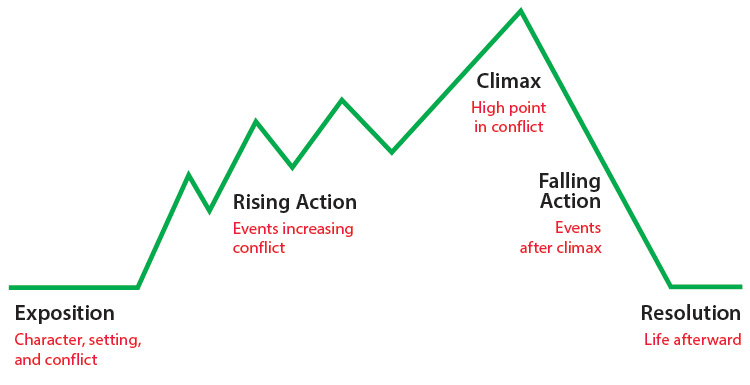
The plot of a story takes a standard shape. The beginning (exposition) introduces character, setting, and conflict. The middle (rising action) raises the level of conflict to a high point (climax). The ending tells what happens afterward (falling action and resolution).

Plot Diagram