Grade 11

By Anonymous (not verified), 12 March, 2026

Editing Résumés and Cover Letters

Often, a potential employer will "meet" your cover letter and résumé before actually meeting you. They are your first interview. Just as you wouldn't show up for a face-to-face interview with your hair a mess and a mustard stain on your shirt, you don't want to send out documents with errors. These activities will help you catch the most common (and costly) errors before employers can.

Editing to Check Facts

The quickest way to get rejected is to misspell the name of the reader, or botch the person's title, or mangle the company name. If you need to write to Ms. Leslie Wilcox, Editor in Chief of the Burlington Standard Bugle, but you instead write to Mr. Leslie Willcox, Editor of the Burlington Daily Bugle, you probably won't even get a reply, let alone a chance to interview.

You must fact-check every name, title, business, department, street address, email address, telephone number, job title, and job-specific term in your résumé and cover letter. Look up each one on the Internet, preferably using the employer's own Web site. Check off any detail you have fact-checked, and correct any that were incorrect.
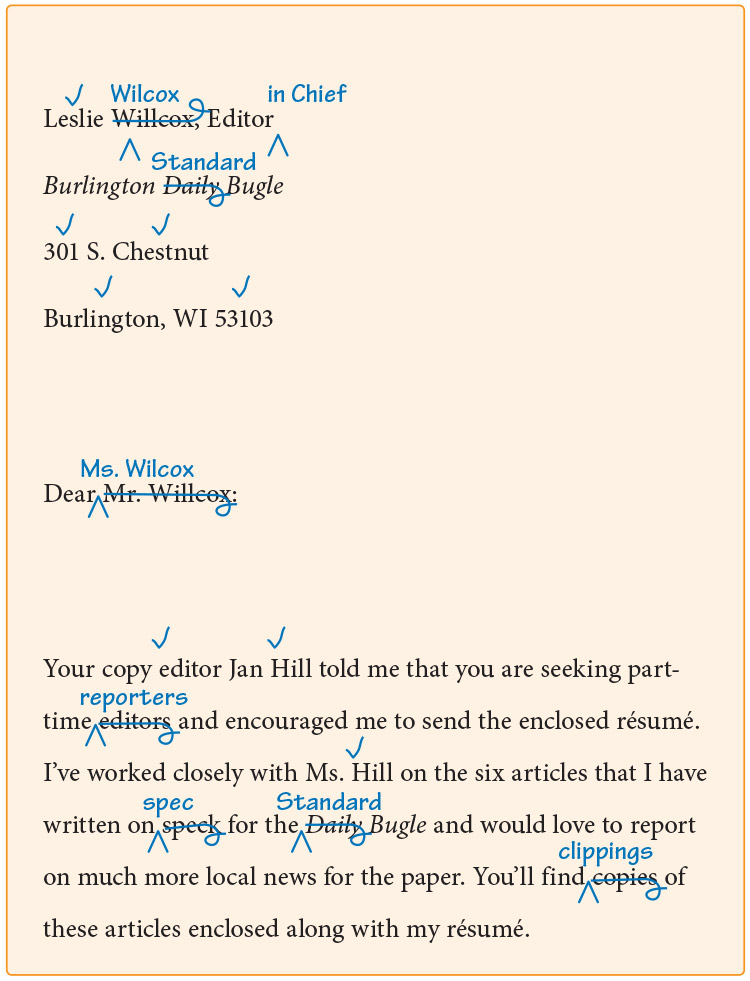

Fact Check
By Anonymous (not verified), 12 March, 2026

Revising Résumés and Cover Letters

So you've done the hard part, actually writing the résumé and cover letter. Take a little break if you can. Then come back to them. You want to make sure these two documents do the best job of representing you to a potential employer. Is there some critical piece of information that you forgot to include? Is there some extraneous piece of information that you don't need? In revision, you can make sure your documents have all the "right stuff."

Revising for Key Details

Remember that your cover letter and résumé are really meant for the employer, not for you. You already know who you are. The employer needs to know, so these documents should provide the key details without distraction. You can check for details by reviewing item 3 on the prewriting activity "Take the Employer's Perspective."

3. What kind of employee would make life better for this contact person?

A part-time reporter who can take any assignment, attend an event, interview those involved, take photos, research carefully, check facts, write a news article or feature article, create an effective headline, and digitally submit materials on or before deadline.

What employer needs did you fail to address in your cover letter and résumé? For example, Joyce realized that she forgot to mention that she is a skilled photographer, so she can provide images for her articles. She added a line to the "Skills and Qualifications" section of her résumé.

By Anonymous (not verified), 12 March, 2026

Writing Your Résumé

If you've done your prewriting work, creating a résumé should be fairly straightforward. Simply fill in each section with your information. The activities below will help you use parallel construction and telegraphic style.

Writing with Parallel Structure and Telegraphic Style

All similar elements in your résumé should use parallel structure, which means the same grammatical form. For example, each work experience item should list job title, employer, dates of employment, and duties—in that order, with the same punctuation and treatment for each element. By contrast, lists of skills and qualifications might all be adjectives:

WORK EXPERIENCE

  • Lifeguard—Campground Pool, Summers 2016 to present: Work closely with manager and liaison, guard Olympic-sized pool, . . .
  • Stocker/bagger—Rioldi's Market, Fall-Spring 2017 to present: Work closely with store manager, stock shelves, . . .
By Anonymous (not verified), 12 March, 2026

Prewriting for Résumés and Cover Letters

Though your reader begins with your cover letter and ends with your résumé, you need to work the other way around. Your first step is to create a general résumé that captures the most important details about your experience and education, for any job. Once you have a résumé, you can adjust it to fit a specific job opportunity. And then you can write a separate cover letter to apply for the job. Start by thinking about who you are.

Prewriting to Gather Details About Yourself

Before you write your résumé, you should think about your experiences and skills. At this point you don't need to worry about résumé sections or parallel structure or "telegraphic style." You just need to think about what you've learned, and what you have to offer employers. Answering questions can help.

  1. What three words would friends use to describe you and why?

    They would call me "funny and intense and weird." I like to make jokes to get friends to laugh, but when I'm serious about something, I'm super serious. Also, I'm serious about things most people aren't, like whether food can touch on a plate or whether your toothbrush can go in a cup with others (it shouldn't).

  2. What three words would teachers use to describe you and why?

    They would call me "hard-working, smart, and nice." I want to get good grades, so I work hard in class and on homework. That makes me come off as smart because I'm well prepared. But I'm also nice. I help other people who are having trouble.

  3. What would your dream job be?

    I'd like to be an air-traffic controller, preferably in the Navy on an aircraft carrier. I love everything about airplanes, especially military airplanes, but I get motion sick, so I'd rather be controlling them than piloting them. An aircraft carrier is probably big enough I wouldn't get motion sick.

  4. What job are you best suited for right now?

    I've been a lifeguard for two summers, so I know that job really well. I'd like to move up to be pool manager. It's a lot more hours but also a lot more pay. I could use the money for college.

  5. What experience do you have that suits you for the job?

    Guarding, cleaning up the pool, staffing the front desk, being in the locker-rooms, repairs, filter cleaning, working with everybody, you name it. Also, I've been a stocker and bagger at Rioldi's for two years, so I know about hard work and following directions.

  6. What education do you have that suits you for the job?

    I'm about to graduate high school. They want someone with at least a high school diploma. Also, I have Lifeguard Instructor certification. That's the latest one.

  7. Have you gotten any awards or honors?

    I'm in National Honor Society and I've got a letter for Swim Team.

By Anonymous (not verified), 12 March, 2026

Reading a Cover Letter and Résumé

The cover letter and résumé work hand in hand. The cover letter connects to a specific person at a specific company about a specific job. The résumé then provides detailed information showing how your experience, education, and skill line up with the job. You can review the following samples to get a sense of how these two documents work.

Reading a Cover Letter

Read the following cover letter, written by a student to apply for the position of pool manager where he had been working as a lifeguard. Note how the cover letter highlights details in the résumé that follows, which gives specifics. Click on the side notes to view the different parts of each document.

Listen to "Dear Mr. Carlson"

Your browser does not support the audio tag.

Hide audio

Sample Cover Letter

Heading Robert Schneider

714 N. Crenshaw St.

Griffith, IN 46319

rschneider315@ghs12.edu

Date 30 February 2018

Inside Address Mr. Carlson, Liaison

Methodist Campground Board

1250 Wesley Road

Des Plaines, IL 60018

Salutation Dear Mr. Carlson:

Opening I'm writing to express my strong interest in the position of Pool Manager for the Campground Pool for this summer's season. To prepare for this role, I have taken the latest Lifeguard Instructor course through the American Red Cross, as you will see on the enclosed rĂ©sumĂ©. You will also see that I graduate in May from high school and so can work the usual season from Memorial Day to Labor Day this year. Please review the rĂ©sumĂ© for my other qualifications.

Middle Of course, my greatest store of experience comes from my previous two summers as a lifeguard at the Campground Pool. I understand pool policies and procedures for guarding, locker-rooms, front-desk, chemistry, cleaning, and maintenance. I've worked closely with previous staff and board members, including yourself. You know my work ethic, punctuality, and ability to work well with others to solve problems. I very much appreciate the opportunities and trust you have given me in the past and hope to take on more responsibility at the pool this summer.

The Campground Pool has been a big part of my childhood and an even bigger part of my early work history. I would love the opportunity to lead the staff in making this a great place for families into the future.

Closing If you have any questions or would like to set up an interview, please contact me at rschneider315@ghs12.edu or call me at (219) 555-9242. I look forward to hearing from you!

Complimentary Closing Sincerely,

Robert Schneider

Signature Block Robert Schneider

Lifeguard Instructor

Enclosure Note Enclosure: Résumé

Respond to the cover letter.

Answer these questions about the reading.

By Anonymous (not verified), 12 March, 2026

Warm-Up for Résumé Writing

In tribal societies, pretty much everybody has to do everything: hunting, gathering, making tools, building shelters, fetching water, hauling goods, fighting predators, bartering, teaching, learning, and so on. In modern societies, people specialize. Most people don't grow their own wheat or make their own circular saws or build their own houses. Instead, they pay experts who can do these tasks much more effectively and efficiently while meanwhile making money doing something they are experts in.

Your schooling is starting you on the road to becoming an expert in something. Your first few jobs will continue that journey. Just as you've learned a great deal in school, you will learn even more as you work and develop expertise. But how do you build a bridge from the classroom to the workplace? You start by writing an effective résumé.

What Is a Résumé?

Listen to "What Is a Résumé?"

Your browser does not support the audio tag.

Hide audio

Writing Literary Analysis
© Thoughtful Learning 2018

A résumé is a document that helps potential employers understand who you are: your objectives, experience, skills, education, and awards. The word résumé comes from the French "resume," meaning to "take back, assume again, or regain." In other words, when you are writing a résumé, you are regaining all of the experiences you've had that can prepare you to succeed in a new opportunity. Some people also use the term c.v. or curriculum vitae, which means "course of one's life."

Thinking About the Course of Your Life

You began life as a single cell. You now have a trillion of them. That's a lot of change to go through. You can reflect over the long course of your life by completing a time line. For each period, list key experiences, educational influences, and who you became. Here's the course of one student's life.

By Anonymous (not verified), 12 March, 2026

Writing for Literature Assessment

When you respond to a writing prompt, you should start by carefully reading and analyzing the prompt using the PAST questions. Then you should jot down a quick outline of your response. Do these activities in the first five minutes or so of the time you have. (If the prompt includes a reading, take more time with this step.) You'll spend the bulk of your time creating a beginning, a middle, and an ending. Afterward, you'll want to review your answers to the PAST questions and read your response, making sure it is on target. In the last five minutes or so, revise and edit your work. This abbreviated version of the writing process needs to fit into the total time you are given (often between 30 and 90 minutes).

Viewing a Sample Prompt and Response

Read the following prompt, and view one student's PAST analysis, outline, and beginning, middle, and ending. Then you'll get a chance to read and respond to a prompt of your own.

Sample Writing Prompt

"Romance Sonambulo" by Federico Garcia Lorca focuses on the color green. What does it mean in this poem? How does the poet use it to construct images and tell a story? Write an essay that analyzes the use of green in "Romance Sonambulo" and cites evidence from the poem.

By Anonymous (not verified), 12 March, 2026

Responding to Literary Writing Prompts

Often tests contain writing prompts that ask you to respond to literature. A writing prompt is a specific set of instructions that you must follow to write a well-targeted essay. If you write an excellent response that does not answer the prompt, you will score poorly.

Analyzing Writing Prompts

Some prompts may provide you a short reading and ask for a written response. Others may present a quotation or thesis and ask you to argue for or against it using evidence from literature that you have read.

To succeed on writing assessments, you must start by analyzing the writing prompt. You can use the PAST questions:

  • Purpose? Why am I writing? (To analyze a character? To demonstrate a theme? To evaluate a work?)
  • Audience? Who is my reader? (Tester? Classmates? Other readers?)
  • Subject? What topic should I write about? (A central conflict? A key setting? Literary/poetic devices?)
  • Type? What type of writing should I create? (Analysis essay? Character sketch? Review?)

Sample Writing Prompt

Often, a person's greatest strength can also be his or her greatest weakness. For example, Albert Einstein's phenomenal intellect made him a genius but also a social misfit. Wealth and fame make actors and destroy them. Argue for or against the idea that great strengths are also great weaknesses. Support your position using evidence from the lives of characters you have read about in literature. Convince other readers of your position.

Answers to PAST Questions

  • Purpose?

    To argue for or against the idea that "a person's greatest strength can also be his or her greatest weakness"

  • Audience?

    Other readers

  • Subject?

    Lives of characters in literature

  • Type?

    Position/argument essay

By Anonymous (not verified), 12 March, 2026

Answering Multiple-Choice Questions

High-stakes assessments often include multiple-choice questions, which can be graded by machine. Questions may ask about character and conflict, symbol and theme, literary and poetic devices, or anything in between. Follow these guidelines to score your best on multiple-choice questions:

  • Read questions first. Then you know what to watch for.
  • Note question order. Often the first question asks about the first part of the reading. Usually questions follow the order of the passage.
  • Treat each passage separately. You usually answer a bank of multiple-choice questions for each passage before being prompted to write about a set of passages together.
  • Analyze characters and conflict. For literature, questions often focus on what characters desire and fear, which creates conflict that drives plot.
  • Analyze narration, descriptions, action, and dialogue. Questions may also ask about how the writer creates a piece of literature, focusing on one or more of these components.
  • Be patient with poems. They may take as long or longer to analyze than pieces of literature.
  • Analyze words, sounds, images, thoughts, and emotions. For poetry, questions may ask you to focus on devices the poet has used to achieve a given effect.
  • Answer easy questions first. Eliminate obviously wrong answers.

Answering Multiple-Choice Questions About a Text

Often, high-stakes assessments will present you with a text, asking you to read it and analyze it by responding to multiple-choice questions.

By Anonymous (not verified), 12 March, 2026

Understanding Vocabulary

When you read an unfamiliar word, you need to figure out its meaning based on how it is used. You can use the following context clues to guess a meaning.

Word parts let you assemble meaning from prefixes, suffixes, and roots.

Joshua tended to isolate himself, a habit strongly correlated with his bouts of paranoia.

(The prefix co means “together,” the prefix re means “again,” the root late means "bring," or "bear," and the suffix ed indicates past tense, so correlated must mean “having brought two things together again.")

Cause-and-effect clues let you infer meaning.

Gabrielle kept her nose buried in the novel, her mind wandering the lush lowlands of Scotland beside burly Haemish, claymore at his back, ready for brigands.

(If the burly Scotsman Haemish carries a claymore on his back to deal with brigands, a claymore must be a large weapon—perhaps a sword.)

Definitions embedded within the text spell out the meaning.

Jon was born on a military base and would die on one, a lifer, but for me, the Army was a means to a much bigger end.

(Since "Jon was born on a military base and would die on one," a lifer must be "a person who spends a lifetime in a given activity.")

A series includes an unknown word with known words of the same type.

He bore himself with the condescending, self-righteous, and supercilious air of a child who has willfully abandoned belief in the Easter Bunny.

(Since supercilious is in a series with condescending and self-righteous, it must mean believing oneself to be superior to others.)

Examples provide specific instances of general ideas.

Doctor Grant pointed to a chart of theropods, ranging from T-rexes to sparrows.

(T-rexes were large, carnivorous dinosaurs on two legs, and sparrows are small birds on two legs, so theropods must be a wide classification of two-legged animals that spans dinosaurs and modern birds.)

Synonyms have the same meaning as the unfamiliar word.

Rudy knew his opinions often caused his friends offense or even umbrage, but he voiced them anyway.

(Umbrage must mean "strong offense.")

Antonyms have the opposite meaning as an unfamiliar word.

This would not be conventional war, with two well-trained armies on a gridiron approved by the Geneva Convention; this would be asymmetric war between an army and secret foes with improvised explosives on city streets.

(As the opposite of "conventional war," asymmetric war must mean "a regular army fighting guerillas.")

Tone reveals the writer’s thoughts about a word.

As much as his dinners delighted him, he savored even more his routine repose on the couch afterward.

(The words delighted and savored show pleasure, so repose on the couch must mean a "pleasurable rest.")