Research Writing

By Anonymous (not verified), 12 March, 2026

Writing a Research Paper

After fully engaging your sources, you have plenty of remarkable information to convey to your reader. The problem may be figuring out where to begin. What do you share first?

The following activities will suggest many starting points and ending points and other points in between. The strategies below will prime the pump of your ideas, getting them to flow easily into your first draft.

Writing the Beginning Paragraph

Your first job in writing a research paper is to catch your reader's interest. You can experiment with a number of strategies to form an interesting lead sentence.

Write a lead sentence.

Try out some of these strategies for introducing your research paper. Read the examples for ideas.

  1. Start with a fascinating quotation.

    "Do things. Be sane. Don't fritter away your time; create, act, take a place wherever you are, and be somebody; get action.”
    —Theodore Roosevelt, Sr.

  2. Express what is most interesting about the subject.

    Teddy Roosevelt transformed himself from an asthmatic weakling to a brawler who won in Cuba and Panama, in Washington and on Mount Rushmore.

  3. Provide an anecdote.

    As they charged up San Juan Hill into the teeth of machine-gun fire, Teddy Roosevelt turned to a fellow soldier and shouted, "Holy Godfrey, what fun!"

  4. Ask an engaging question.

    Are heroes born, or are they made?

By Anonymous (not verified), 12 March, 2026

Prewriting for Research Papers

When something fascinates you, studying it is simple. You naturally train all your attention on it and try to figure it out. Learning is easy because all the doors and windows of your mind are flung wide open. When something bores you, studying it is a chore. You can't stay focused. No one could pay you enough to care.

Since you need to closely study whatever topic you choose for your research paper, you should strive up front to find a topic that fascinates you. The next activity will help you find a strong topic, and the activities afterward will help you launch your research.

Prewriting to Select a Topic

The following "Basics of Life" list includes broad subject areas that are critical to life. You can click on any entry to find more resources about it. You can also apply these general subjects to a specific class in order to find a unique topic. For example, applying "Personality" to the Spanish-American War unit in AP U.S. History would suggest studying the irrepressible Teddy Roosevelt and his Rough Riders.

By Anonymous (not verified), 12 March, 2026

Reading a Research Paper

Before you start work on your own research paper, you should read a paper created by another student. As you read, note how the writer gathers interesting details from a variety of sources, both online and in print. Click on the side notes to study the different parts of the research paper.

Reading a Student Model

This research paper details what scientists know about Sagittarius A*, the supermassive black hole at the center of our galaxy. The overall structure of the paper includes a beginning paragraph, multiple body paragraphs, an ending paragraph, and a works-cited page. The writer uses in-text citations to credit sources.

By Anonymous (not verified), 12 March, 2026

Warm-Up for Research Writing

You live at a fortunate time. Before the Internet, people had no easy way to find out what they wanted to know. Friends had heated arguments about which actor played a part or when Czechoslovakia broke up or why there are 360 degrees in a circle. To find answers, people had to go to a library, search through thousands of cards in a big set of drawers, search through hundreds of shelves to find the right book, and search through hundreds of pages to find the right information. That's a lot of work. Not surprisingly, many people just chose to remain ignorant.

These days, you say, "Hey, Alexa, when did Czechoslovakia break up?" In seconds, she tells you that the former nation dissolved into the Czech Republic and Slovakia on January 1, 1993.

Still, many people choose to remain ignorant. One fifth of millennials know little of the Holocaust. (If you are one of them, ask Alexa about it.)

So, research in the Information Age is more important than ever. And rigorous research reaches beyond the free Internet to scholarly publications that only your library makes available. In this unit, you will conduct research about a topic that you care about, uncovering reliable and surprising information that you'll want to share with others. That's the key to an effective research paper.

What Is Rigorous Research?

Listen to "What Is Rigorous Reseach?"

Your browser does not support the audio tag.

Hide audio

Writing Literary Analysis
© Thoughtful Learning 2018

Rigorous research digs deeply into a topic, discovering many surprising answers but also new, challenging questions. Rigorous research can start with Alexa and Wikipedia, but it certainly doesn't end with them. It can start with the top Google search result, but it must go much further than that.

Basic research finds reliable answers to who, what, where, and when:

  • What was the Holocaust? The Holocaust was the state-sponsored persecution and murder of people deemed inferior by the Nazi regime in Germany.
  • Who was targeted in the Holocaust? Six million Jews (two thirds of the European population) were murdered along with millions more Roma, Slavs, and Russians as well as homosexuals and those with disabilities.
  • When did the Holocaust occur? The Holocaust occurred from the rise of Nazis in Germany in 1933 through the conclusion of World War II in 1945.
  • Where did the Holocaust occur? The Holocaust occurred throughout Nazi-controlled territories in Europe, with numerous concentration camps in Germany and Poland.
By Anonymous (not verified), 12 March, 2026

Editing Research Reports

After revising your report, you need to edit it to correct any remaining errors. You'll look closely at sentences, punctuation, capitalization, grammar, usage, and spelling. The following activities will help you edit your research report.

Editing In-Text Citations

Always place in-text citations in parenthesis at the end of a sentence but before the end punctuation. In a direct quote, citations come after the closing quotation mark but before the end punctuation.

  • Correct: Ride wished the science part of her mission got more attention (Hurwitz 28).

  • Incorrect: Ride wished the science part of her mission got more attention. (Hurwitz 28)

  • Correct: “She inspired generations of young girls to reach for the stars” (Macy 5).

  • Incorrect: “She inspired generations of young girls to reach for the stars (Macy 5).”

Cite sources correctly.

Insert the citations in the correct places in each sentence. One example is provided.

  1. Thurgood Marshall changed the course of the Civil Rights Movement. (Smith 18)
  2. Thurgood Marshall changed the course of the Civil Rights Movement (Smith 18).

  3. Marshall believed in justice for all people. (Smith 24)
  4. “Every day we live with the legacy of Justice Thurgood Marshall.” (Feldman 45)
  5. In grade school, he had to memorize the Constitution as a punishment for goofing around. (“Biography”)
By Anonymous (not verified), 12 March, 2026

Revising Research Reports

After you write a first draft, you can improve your writing through a series of revisions. When you revise, you think about the “big picture,” including the overall structure of your writing (beginning, middle, and ending) and the focus, main ideas, and supporting details you use. These activities will help you revise.

Revising to Cite Evidence

As you revise your first draft, search for and replace general ideas and unsupported opinions with factual evidence from your sources.

  • General Idea: Sally Ride did some important things in space.

  • Factual Evidence: Sally Ride spent six days in space, where she helped place satellites in orbit.

  • Opinion: I bet Ride was surprised to see an advertisement from NASA.

  • Factual evidence: It was the first time that women were invited to apply to astronaut program (Smith).

Replace general ideas and unsupported opinions.

Find three general ideas or unsupported opinions from your report. Then find evidence from one of your sources to support each idea. Add the revisions to your report.

  1. General idea/opinion:
  2. Specific evidence:

  3. General idea/opinion:
  4. Specific evidence:

  5. General idea/opinion:
  6. Specific evidence:

By Anonymous (not verified), 12 March, 2026

Writing a Research Report

Once you finish your planning and research, you are ready to write your first draft. These activities will help you hook the reader's interest at the beginning, explain important information in the middle, and end with a strong final point.

Writing the Beginning Paragraph

Write a lead.

Read each lead-writing strategy and example and write your own.

  1. Ask a question about the topic.
  2. Did you know women couldn’t become astronauts for almost the first three decades of the space program?

  3. Start with a surprising fact or detail about the topic.
  4. Before Sally Ride, space travel was mostly a club for men.

  5. Tell a little story about the person.
  6. Sally Ride didn’t always want to be an astronaut. When she was young, going to space was not a realistic aspiration for girls.

Write your beginning paragraph.

Write your lead and then give details that lead up to your focus statement. End the paragraph with your focus statement.

By Anonymous (not verified), 12 March, 2026

Prewriting for Research Reports

Of all the forms of academic writing, research reports require the most planning. The good news is that the extra attention you give to prewriting will make it easier for you to draft your report.

Prewriting to Select a Topic

For your report, you will research an important person from the past or present. As you consider topic choices, note people who truly interest you, because you will be spending a lot of time learning about them.

Create a cluster.

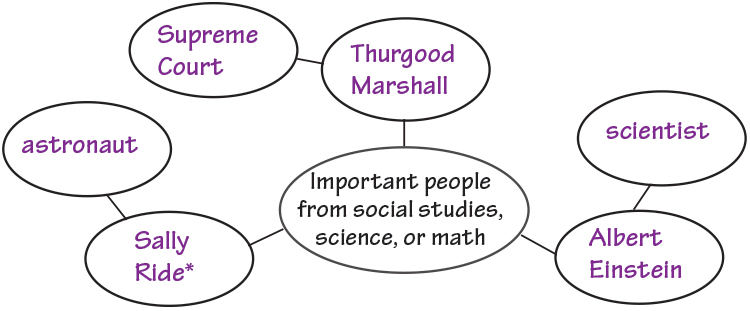
Create a cluster about historical figures from social studies, science, or math. Add names in the first branch of circles. Write a detail about the person in the second branch. Finally, put a star by the person you want to write about.

Cluster
  • Cluster
  • Cluster

Other Ways to Discover Topic Ideas

Search online or scan your school books for influential figures. Also try freewriting for topics.

Prewriting for Research Questions

Now that you have decided on a topic for your report, you need to find out what you already know about the person and what you want to learn.

Record what you know.

List all the things that you definitely know to be true about your topic. Then list any information you are not completely sure of.

By Anonymous (not verified), 12 March, 2026

Reading a Research Report

Before you begin the process of writing a research report, you'll want to see how others did so. This lesson shows you a sample research report, explaining each of its main parts. As you read the sample, think about how the writer integrated information from different sources to explain the topic in an informative manner.

Reading a Sample Research Report

A research report has some special features, but the actual report has three main parts, just like an essay. The beginning paragraph introduces the topic and leads to a focus statement. The body paragraphs support the focus statement by citing evidence from sources. The ending paragraph revisits the main idea.

Research reports end with a works-cited page, which lists the sources used in the writing. Source material is cited within the report using in-text citations.

Sample Research Paper

Gutierrez 1

Header

Maria Gutierrez

Mr. Meddaugh

Social Studies

11 February 2016

The Legacy of Sally Ride

Beginning Paragraph Before Sally Ride, space travel was mostly a club for men. Even though studies showed women had the stamina and fortitude to thrive in space, NASA excluded them from its first space missions based on a rule that astronauts had to also be fighter pilots, a profession deemed "too dangerous" for women at that time (Gannon). By 1983 only two women had ever been in space, and they were both from Russia. Ride would change that. Focus statement Sally Ride’s trailblazing journey to outer space opened doors for women interested in science and space.

Despite growing up in a time when science was considered a mostly male interest, the subject fascinated Ride early on in life. Born in 1951 in Los Angeles, California, her favorite subjects in school were math and science. She especially liked the scientific method of asking questions and testing answers (Macy 42). “For whatever reason, I didn't succumb to the stereotype that science wasn't for girls. I got encouragement from my parents. I never ran into a teacher or a counselor who told me that science was for boys. A lot of my friends did,” said Ride (Smith). Her passion helped her get accepted into Stanford University, where she studied physics. She was one of few women in the physics department but received great grades (Macy 45).

By Anonymous (not verified), 12 March, 2026

Warm-Up for Research Reports

In this unit, you will research a variety of sources to write a report about an important person.