Research Writing

By Anonymous (not verified), 16 March, 2026
This good research paper focuses on the history of Hmong immigration and assimilation in the United States.
By Anonymous (not verified), 16 March, 2026
In this fair research paper, a student outlines the migration and settlement patterns of a group of American immigrants.
By Anonymous (not verified), 12 March, 2026

Editing Literary Research Papers

Once you complete major improvements to your research paper, you can focus on every word, letter, and punctuation mark. Editing helps you correct errors in punctuation, mechanics, spelling, grammar, and usage. You'll also want to make sure that you have correctly used Modern Language Association (MLA) style. The following activities will help you.

Editing In-Text Citations for MLA Style

Whenever you use ideas or direct quotations from others, you need to credit the source. You do so to show who originated an idea, to avoid plagiarism, and to allow readers to explore the same materials in their own research.

All credits begin with an in-text citation that names the source and page number (if there is one) and refers to a complete entry on the works-cited page. The simplest citation names the title and author in the text and provides the page number in parentheses after the borrowed material, before the period.

In "On Faerie Stories," Tolkien argues that Alice's Adventures in Wonderland and Through the Looking Glass are not actually fantasy because they are framed by a dream. Everything in Wonderland is unreal, and the reader knows that it is. Also, Gulliver's Travels is not fantasy because the tiny people and giants Gulliver encounters are in the Primary World, simply removed by distance (5).

By Anonymous (not verified), 12 March, 2026

Revising Literary Research Papers

After you complete the first draft of your research paper, take a break. Then you'll be able to return to it and see it with fresh eyes. That's what the word revision means—seeing your work anew. When you revise, you check the "big picture," looking at the ideas, organization, and voice of your writing. The following activities will help you.

Revising to Elaborate Details

Your research paper should be more than just a list of details: First of all . . . Second of all . . . Thirdly . . . Fourthly . . . . Instead, you should elaborate ideas. You can do so by introducing a concept, looking more carefully at it, defining the terms you are using, giving examples, telling an anecdote, providing historical context, and so on. Note how each of these types of details further "unpacks" the concept, allowing readers to understand it more fully.

In the following paragraph from "The Mind Behind Middle-earth," note how the topic sentences introduce two main points, and the writer explores each point separately, using a variety of details to unfold the picture for the reader. Click on the callouts to view each part.

By Anonymous (not verified), 12 March, 2026

Writing a Literary Research Paper

If you have thoroughly researched your topic, you should have plenty of information to share in your first draft. Relax. Your job at this point is just to get your ideas down on the page. You don't have to get everything perfect right from the start. Instead, write freely, exploring ideas, relating concepts, quoting sources, paraphrasing, making connections. Once you get your ideas on the page, you'll have time to work with them and shape them. Right now, you should just focus on expressing what you've learned about your topic and doing so in a way that makes your curiosity infectious.

Writing the Beginning Paragraph

If you're having trouble deciding how to start, you can experiment with different strategies for catching your reader's interest. (If you'd rather just plunge in to writing your middle paragraphs, go ahead, and circle back to this step later.) Your lead sentence will begin your first paragraph and help to introduce your thesis statement.

Write a lead sentence.

Try out some of these strategies for introducing your research paper. Read the examples for ideas.

By Anonymous (not verified), 12 March, 2026

Prewriting for Literary Research Papers

American novelist Zora Neale Hurston once wrote, "Research is formalized curiosity. It is poking and prying with a purpose." So, the start of a successful literary research paper is choosing a topic that really sparks your curiosity. If you want to find out about a specific book or author or genre or movement, your curiosity will make it easy to gather sources and discover what they have to offer.

By Anonymous (not verified), 12 March, 2026

Reading a Literary Research Paper

Before you start work on your own literary research paper, you should read a paper created by another student. As you read, note how the writer analyzes his topic with a breadth of ideas and a depth of details. He draws evidence from multiple sources, including the fiction and nonfiction of the author as well as historical references. He also connects the literature to larger thematic questions about life itself. Click on the side notes to study these features.

Reading a Student Model

This research paper explores the meaning of the term fantasy, specifically in the works of J. R. R. Tolkien. The overall structure includes a beginning paragraph, multiple body paragraphs, an ending paragraph, and a works-cited page. The writer uses source citations as well as historical context and discussions of theme in the analysis.

By Anonymous (not verified), 12 March, 2026

Warm-Up for Literary Research

Imagine that you needed to find out about the homework assignment for a class you missed. Where would you go for the information? Would you trust what you overheard from two strangers in the hall? Would you trust what a friend says who also missed the class? Would you trust the word of an A-student that you don't like? How about your teacher's class page (if it is regularly updated)?

Obviously, information is only as good as its source. Every day, you sift through dozens of sources: You remember what you heard from your instructors in different classes, what you saw on SnapChat, what you read on Google News, what you heard at the lunch table. You draw all of those different pieces of information together to make a single, mostly consistent "story" for your day.

A literary research paper does the same thing, drawing information from a variety of sources about one or more pieces of literature. By assembling the information and tracking the sources, you create a consistent story to help your reader understand the literature.

What Is a Literary Research Paper?

Listen to "What Is a Literary Reseach Paper?"

Your browser does not support the audio tag.

Hide audio

Writing Literary Analysis
© Thoughtful Learning 2018

A literary research paper is a response to literature that analyzes one or more literary works by drawing on a variety of sources. An effective research paper uses evidence to create new insights about the literature. It also cites sources so that interested readers can explore the same ideas and make up their own minds.

Every reliable article on the Internet and in the news is a thoroughly researched, correct, accurate, and up-to-date account of some event or topic. We rely on research to sift real news from fake news, fact from fiction. Indeed, our very concept of reality is only as good as the information we choose to accept. That's why research is now more important than ever. This unit will help you create effective research about literature, and you can start by thinking about reliable and unreliable sources.

Thinking About Sources of Information

Some people are trustworthy sources of information, and others are not. You can trust a friend more than an enemy. You can trust a well-informed person more than an ignorant one. You can trust someone who is involved in a situation more than someone who is not involved. Trustworthiness comes in many forms. A chart like the one that follows can help you rate the trustworthiness of a specific person about a specific topic.

By Anonymous (not verified), 12 March, 2026

Editing Research Papers

You're almost there! You've conducted research, drafted your paper, and made major improvements. Now you're ready for editing, focusing on every word, letter, and punctuation mark. You can start by making sure you have correctly used Modern Language Association (MLA) style. You'll also want to correct errors in punctuation, mechanics, spelling, grammar, and usage. The following activities will help you.

By Anonymous (not verified), 12 March, 2026

Revising Research Papers

Congratulations! You've completed a first draft of your research paper, pouring your ideas out onto the pages. Take a short break, or at least a long breath. Now that you have a first draft, you have something to work with. Some parts may be great just as they are. Some parts may need more details, or better wording, or rearranging, or rewriting. That's okay! Revision helps you improve your first draft in major ways. The following activities will guide you.

Revising to Elaborate Details

In the warm-up to this unit, you discovered that basic research answers questions like who, what, where, and when, but rigorous research moves on to deeper questions like why, how, could, would, and should. You can answer basic questions with facts. To answer deeper questions, you'll need many other types of details: explanations, statistics, anecdotes, quotations, reflections, and even visuals. You need to elaborate your ideas.

In the following paragraphs from "The Man Writ Large," note how the topic sentence introduces the key event. Afterward, the writer uses a variety of details to fully elaborate the event, helping readers understand the why, how, could, and should of the situation. Click on the callouts to view each part.

Topic Sentence That indomitable spirit would have its greatest test a week later on July 1. Explanation While most of the regular army troops focused on a siege at Santiago, the Rough Riders, the Buffalo Soldiers, and a few regular army regiments sought to dislodge Spanish control at El Canarey. Doing so would prevent attacks on the American flanks during the siege ("Spanish"). Roosevelt would once again lead his troops uphill into the face of an entrenched foe with superior weaponry. Statistic Roosevelt, however, had a 10 to 1 advantage of soldiers against the 500 Spanish defenders. Just as he had done at the docks at Tampa Bay, Roosevelt jostled his Rough Riders forward to bypass the regular-army regiments and begin the assault on Kettle Hill. Anecdote A Buffalo Soldier asked, "Who do you think you are?" and was told, "Rough Riders going to take that hill. Get out of the way or fall in with us." The Buffalo Soldier replied, "I'll be damned if those Rough Riders will get ahead of me!" Roosevelt thus ended up effectively commanding his own men and that of the separate regiment. Quotation A Rough Rider said of that sudden battlefield brotherhood, "I most positively assert that every face I looked into, both white and black, had a broad grin upon it"(Gardner 161).

The regiments ground forward, eventually taking Kettle Hill, but gunfire still rained down on them from San Juan Hill. Amid the withering fire, Roosevelt raised his pistol and shouted, "Now by God, men! Let's charge 'em!" He jumped a fence and ran down Kettle Hill toward San Juan Hill, but in the noise and confusion, only five of his own men followed. He had to retreat to gather the others, as Roosevelt remembered it: "Even while I taunted them bitterly for not having followed me, it was all I could do not to smile at the look of injury and surprise that came over their faces" (Gardner 167-169). Mounting his horse Little Texas, Roosevelt led his soldiers in the charge up San Juan Hill, and to victory. Diary Entry In his July 1 diary entry, Roosevelt scribbled in pencil, "Rose at 4. Big battle. Commanded regiment. Helped extreme front of firing line. Under shell and rifle fire."Reflection Later, he would dub the charge up San Juan Hill "the great day of my life" ("T.R."). A battle that had been expected to take two hours stretched to twelve, with 300 Spanish casualties to the 500 U.S. casualties ("Spanish").
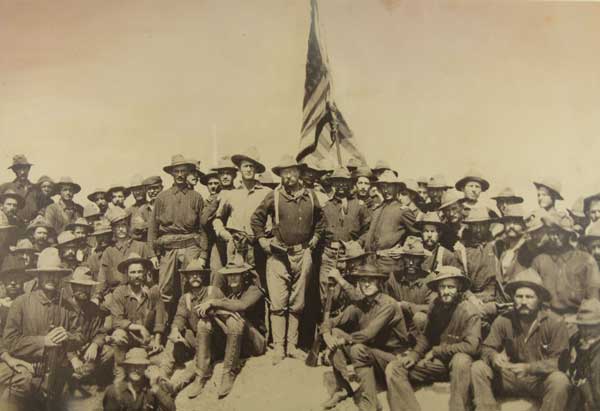
Roosevelt and the Rough Riders atop San Juan Hill. Theodore Roosevelt Birthplace National Historic Site.

Photo and Caption Roosevelt and the Rough Riders atop San Juan Hill. Theodore Roosevelt Birthplace National Historic Site.