Revising Research Papers
Congratulations! You've completed a first draft of your research paper, pouring your ideas out onto the pages. Take a short break, or at least a long breath. Now that you have a first draft, you have something to work with. Some parts may be great just as they are. Some parts may need more details, or better wording, or rearranging, or rewriting. That's okay! Revision helps you improve your first draft in major ways. The following activities will guide you.
Revising to Elaborate Details
In the warm-up to this unit, you discovered that basic research answers questions like who, what, where, and when, but rigorous research moves on to deeper questions like why, how, could, would, and should. You can answer basic questions with facts. To answer deeper questions, you'll need many other types of details: explanations, statistics, anecdotes, quotations, reflections, and even visuals. You need to elaborate your ideas.
In the following paragraphs from "The Man Writ Large," note how the topic sentence introduces the key event. Afterward, the writer uses a variety of details to fully elaborate the event, helping readers understand the why, how, could, and should of the situation. Click on the callouts to view each part.
Topic Sentence That indomitable spirit would have its greatest test a week later on July 1. Explanation While most of the regular army troops focused on a siege at Santiago, the Rough Riders, the Buffalo Soldiers, and a few regular army regiments sought to dislodge Spanish control at El Canarey. Doing so would prevent attacks on the American flanks during the siege ("Spanish"). Roosevelt would once again lead his troops uphill into the face of an entrenched foe with superior weaponry. Statistic Roosevelt, however, had a 10 to 1 advantage of soldiers against the 500 Spanish defenders. Just as he had done at the docks at Tampa Bay, Roosevelt jostled his Rough Riders forward to bypass the regular-army regiments and begin the assault on Kettle Hill. Anecdote A Buffalo Soldier asked, "Who do you think you are?" and was told, "Rough Riders going to take that hill. Get out of the way or fall in with us." The Buffalo Soldier replied, "I'll be damned if those Rough Riders will get ahead of me!" Roosevelt thus ended up effectively commanding his own men and that of the separate regiment. Quotation A Rough Rider said of that sudden battlefield brotherhood, "I most positively assert that every face I looked into, both white and black, had a broad grin upon it"(Gardner 161).
The regiments ground forward, eventually taking Kettle Hill, but gunfire still rained down on them from San Juan Hill. Amid the withering fire, Roosevelt raised his pistol and shouted, "Now by God, men! Let's charge 'em!" He jumped a fence and ran down Kettle Hill toward San Juan Hill, but in the noise and confusion, only five of his own men followed. He had to retreat to gather the others, as Roosevelt remembered it: "Even while I taunted them bitterly for not having followed me, it was all I could do not to smile at the look of injury and surprise that came over their faces" (Gardner 167-169). Mounting his horse Little Texas, Roosevelt led his soldiers in the charge up San Juan Hill, and to victory. Diary Entry In his July 1 diary entry, Roosevelt scribbled in pencil, "Rose at 4. Big battle. Commanded regiment. Helped extreme front of firing line. Under shell and rifle fire."Reflection Later, he would dub the charge up San Juan Hill "the great day of my life" ("T.R."). A battle that had been expected to take two hours stretched to twelve, with 300 Spanish casualties to the 500 U.S. casualties ("Spanish").
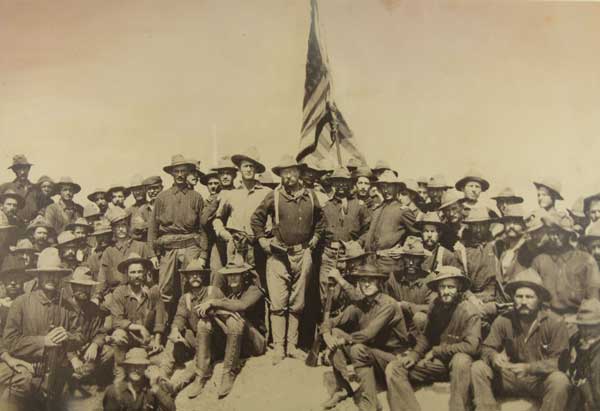
Photo and Caption Roosevelt and the Rough Riders atop San Juan Hill. Theodore Roosevelt Birthplace National Historic Site.
Revise to elaborate details.
Review your research paper, looking for parts that are underdeveloped. Rework them, elaborating with a variety of details that answer the reader's many questions. Consider facts, statistics, explanations, examples, quotations, anecdotes, definitions, reflections, and visuals. Remember to cite sources.
Revising to Improve Sentence Variety
In the previous activity, you made sure to use a variety of details to elaborate your topic. You should also use a variety of sentences to express those details. Too many short sentences in a row sound choppy. Too many long sentences in a row drone on and on. Too many sentences of the same kind or type become monotonous. You can vary sentences in a number of ways.
Vary sentence lengths. Use medium-length sentences to convey most ideas, long sentences to explore complex concepts, and short sentences to punctuate your thinking.
Vary sentence beginnings. Start most sentences with the subject, but avoid using the same subject repetitively. Start some sentences with introductory words.
Vary sentence types. Use simple sentences to express simple ideas. Use compound sentences (two simple sentences join with a comma and and, but, or, nor, for, so, or yet) to closely connect two ideas. Use complex sentences (a simple sentence and a clause that starts with a subordinating conjunction such as if, though, after or a relative pronoun such as who, which, or that) to show complex relationships.
Vary sentence kinds. Use statements to provide facts and questions to create space for answers. Use commands to energize language and exclamations to show excitement.
Improve sentence variety.
Revise the following paragraph to improve sentence flow. Vary lengths, beginnings, types, and kinds. Then reread your research paper and revise any sentences that sound repetitive.
Teaching Tip
Point out to students how difficult these sentences are to read. Instead of focusing on the writer's ideas, the reader keeps getting stopped short by choppiness and repetition. The paragraph is like a road with pot-holes. By smoothing the sentences, the writer can speed the reader along to the destination rather than noticing each jolt and bump along the way.
Revising with a Peer Response
Share your writing.
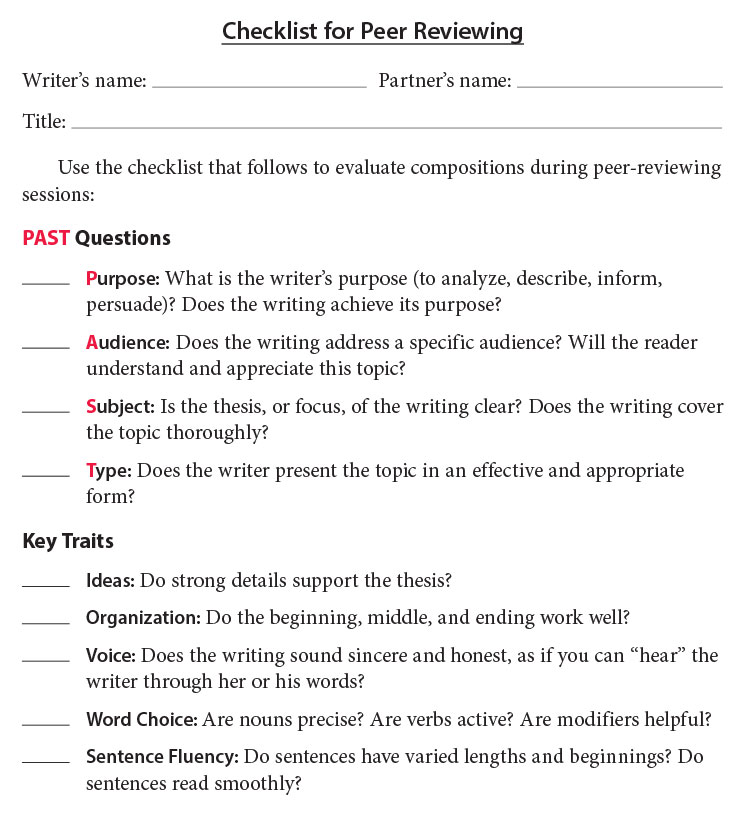
Have a trusted classmate read your research paper and complete the form.
Revising in Action
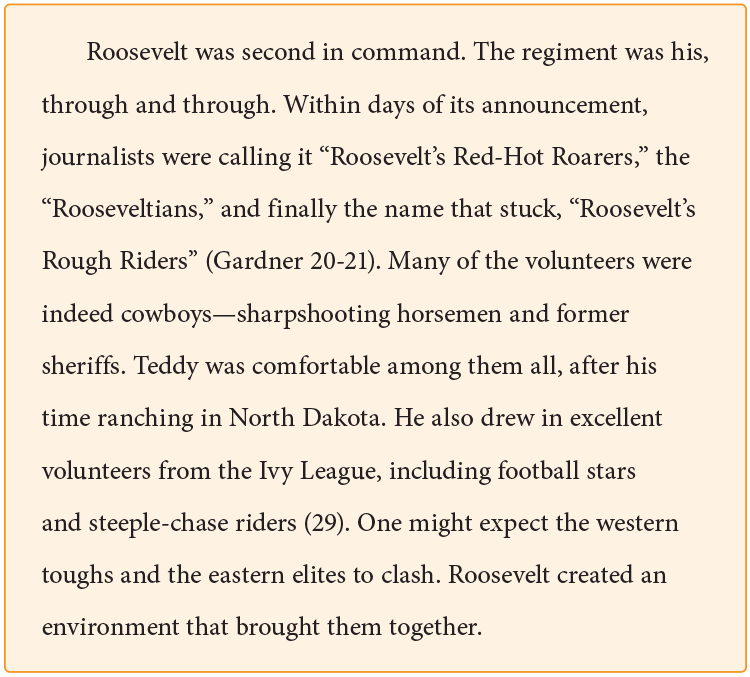
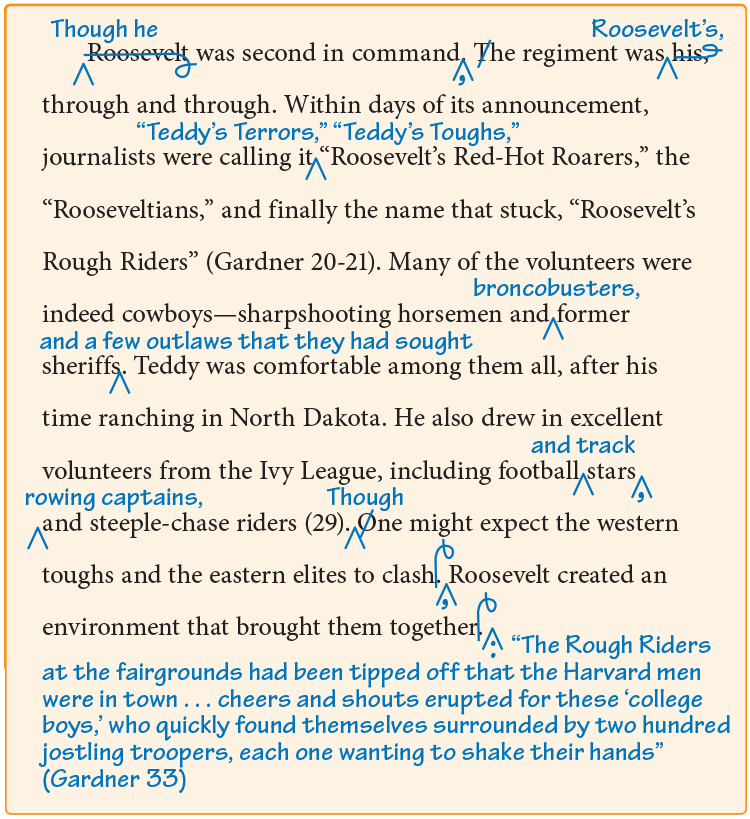
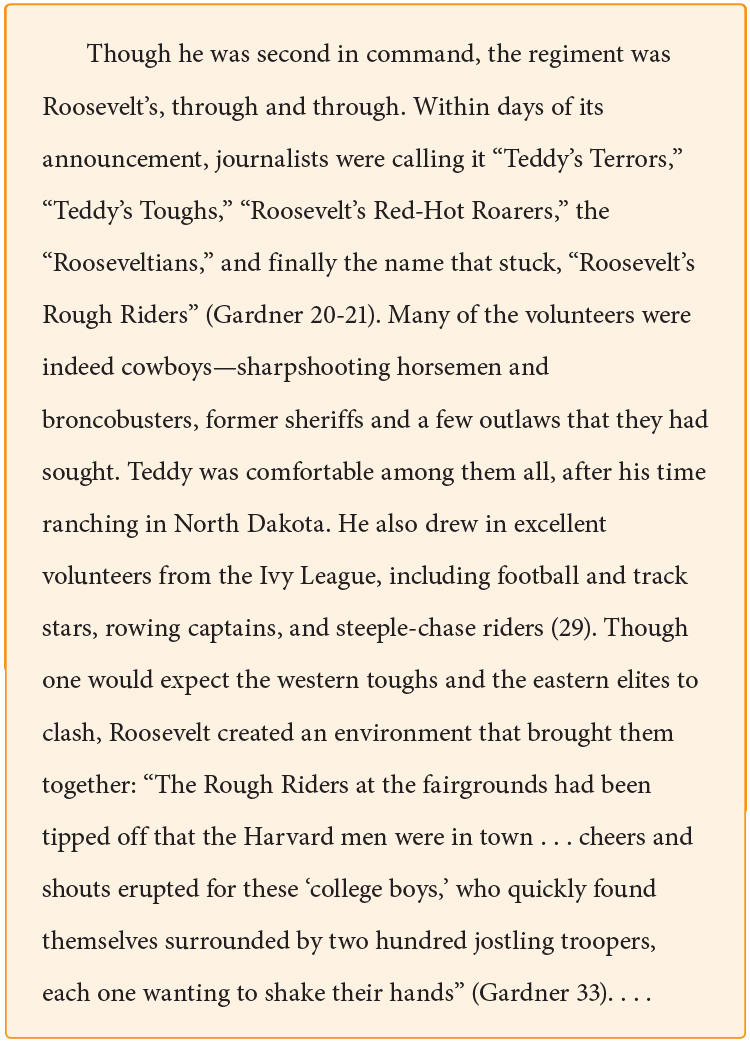
When you revise, you add, delete, rewrite, and rearrange your writing to make it clearer. Here are some revisions to the research paper about Teddy Roosevelt and the Rough Riders.
-
Paragraph Before Revisions
-
Facts, examples, and quotations elaborate ideas, and sentence variety is improved..
-
Paragraph After Revisions
Revise with a checklist.
As you revise your research paper, ask yourself the questions on this checklist. When you can answer a question yes, check it off. Continue revising until all questions are checked off.
Developing Your Ideas
- Does the research paper have a strong lead that catches the reader's interest?
- Does the thesis statement clearly focus the paper?
- Does each body paragraph begin with a topic sentence that names a main point in support of the thesis statement?
- Does evidence from a variety of sources support each topic sentence?
- Are concepts fully elaborated with quotations, anecdotes, examples, explanations, reflections, and other details?
- Does the voice sound enthusiastic, with active sentences, precise nouns and verbs, modifiers that clarify, and evidence that shows interest?
- Do I effectively use a variety of sentence lengths, beginnings, types, and kinds?