CCSS.ELA-LITERACY.L.11-12.2.A

By Anonymous (not verified), 12 March, 2026

Editing Résumés and Cover Letters

Often, a potential employer will "meet" your cover letter and résumé before actually meeting you. They are your first interview. Just as you wouldn't show up for a face-to-face interview with your hair a mess and a mustard stain on your shirt, you don't want to send out documents with errors. These activities will help you catch the most common (and costly) errors before employers can.

Editing to Check Facts

The quickest way to get rejected is to misspell the name of the reader, or botch the person's title, or mangle the company name. If you need to write to Ms. Leslie Wilcox, Editor in Chief of the Burlington Standard Bugle, but you instead write to Mr. Leslie Willcox, Editor of the Burlington Daily Bugle, you probably won't even get a reply, let alone a chance to interview.

You must fact-check every name, title, business, department, street address, email address, telephone number, job title, and job-specific term in your résumé and cover letter. Look up each one on the Internet, preferably using the employer's own Web site. Check off any detail you have fact-checked, and correct any that were incorrect.
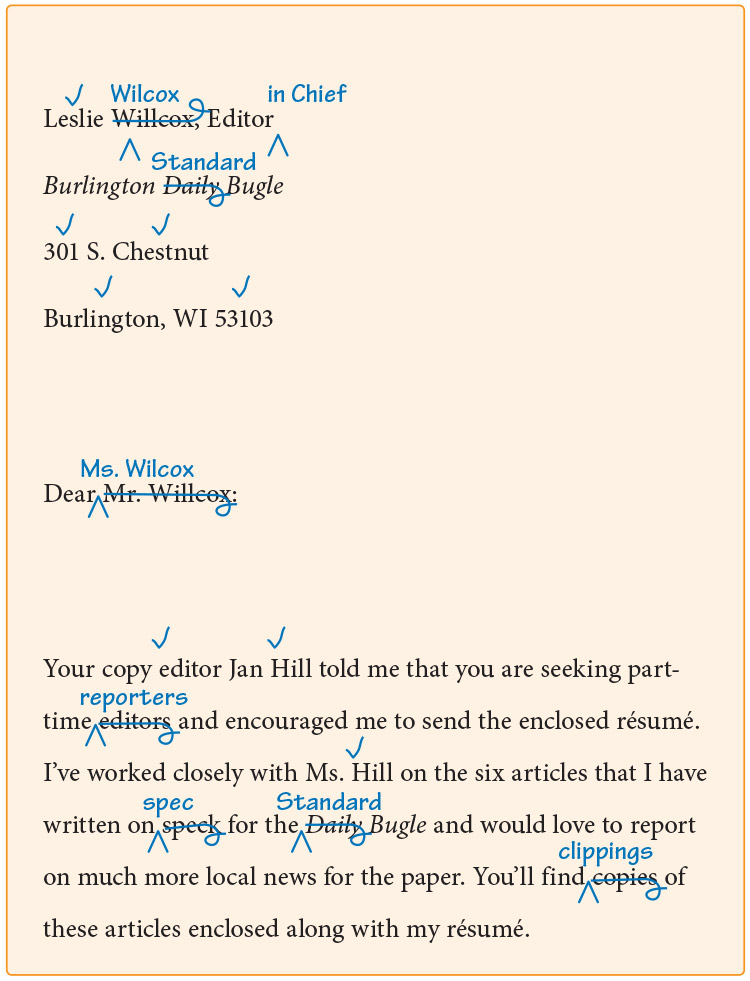
Fact Check
By Anonymous (not verified), 12 March, 2026

Answering Multiple-Choice Questions

High-stakes assessments often include multiple-choice questions, which can be graded by machine. Questions may ask about character and conflict, symbol and theme, literary and poetic devices, or anything in between. Follow these guidelines to score your best on multiple-choice questions:

  • Read questions first. Then you know what to watch for.
  • Note question order. Often the first question asks about the first part of the reading. Usually questions follow the order of the passage.
  • Treat each passage separately. You usually answer a bank of multiple-choice questions for each passage before being prompted to write about a set of passages together.
  • Analyze characters and conflict. For literature, questions often focus on what characters desire and fear, which creates conflict that drives plot.
  • Analyze narration, descriptions, action, and dialogue. Questions may also ask about how the writer creates a piece of literature, focusing on one or more of these components.
  • Be patient with poems. They may take as long or longer to analyze than pieces of literature.
  • Analyze words, sounds, images, thoughts, and emotions. For poetry, questions may ask you to focus on devices the poet has used to achieve a given effect.
  • Answer easy questions first. Eliminate obviously wrong answers.

Answering Multiple-Choice Questions About a Text

Often, high-stakes assessments will present you with a text, asking you to read it and analyze it by responding to multiple-choice questions.