CCSS.ELA-LITERACY.W.11-12.4

By Anonymous (not verified), 16 March, 2026
In this strong research report, a high school student thoroughly details a recent wave of American immigration.
By Anonymous (not verified), 16 March, 2026
This good research paper focuses on the history of Hmong immigration and assimilation in the United States.
By Anonymous (not verified), 16 March, 2026
In this fair research paper, a student outlines the migration and settlement patterns of a group of American immigrants.
By Anonymous (not verified), 16 March, 2026
This poor research report about the Hmong needs more development and more sources.
By Anonymous (not verified), 12 March, 2026

Warm-Up for Literary Research

Imagine that you needed to find out about the homework assignment for a class you missed. Where would you go for the information? Would you trust what you overheard from two strangers in the hall? Would you trust what a friend says who also missed the class? Would you trust the word of an A-student that you don't like? How about your teacher's class page (if it is regularly updated)?

Obviously, information is only as good as its source. Every day, you sift through dozens of sources: You remember what you heard from your instructors in different classes, what you saw on SnapChat, what you read on Google News, what you heard at the lunch table. You draw all of those different pieces of information together to make a single, mostly consistent "story" for your day.

A literary research paper does the same thing, drawing information from a variety of sources about one or more pieces of literature. By assembling the information and tracking the sources, you create a consistent story to help your reader understand the literature.

What Is a Literary Research Paper?

Listen to "What Is a Literary Reseach Paper?"

Your browser does not support the audio tag.

Hide audio

Writing Literary Analysis
© Thoughtful Learning 2018

A literary research paper is a response to literature that analyzes one or more literary works by drawing on a variety of sources. An effective research paper uses evidence to create new insights about the literature. It also cites sources so that interested readers can explore the same ideas and make up their own minds.

Every reliable article on the Internet and in the news is a thoroughly researched, correct, accurate, and up-to-date account of some event or topic. We rely on research to sift real news from fake news, fact from fiction. Indeed, our very concept of reality is only as good as the information we choose to accept. That's why research is now more important than ever. This unit will help you create effective research about literature, and you can start by thinking about reliable and unreliable sources.

Thinking About Sources of Information

Some people are trustworthy sources of information, and others are not. You can trust a friend more than an enemy. You can trust a well-informed person more than an ignorant one. You can trust someone who is involved in a situation more than someone who is not involved. Trustworthiness comes in many forms. A chart like the one that follows can help you rate the trustworthiness of a specific person about a specific topic.
By Anonymous (not verified), 12 March, 2026

Editing Narrative Arguments

After you complete major revisions to your narrative argument, you should edit it to make sure every word and punctuation mark is correct. Among other issues, you'll want to look closely at pronoun agreement and punctuation of dialogue. The activities that follow will help. You'll also use a checklist to finalize your editing.

Editing for Pronoun Agreement

A pronoun is a word that stands in the place of a noun or another pronoun (its antecedent). The most familiar pronouns are I, me, my; we, us, our, ours; you, your, yours; he, she, it, they, their, theirs. A pronoun needs to agree with its antecedent. That means both need to have the same person (first, second, or third), the same number (singular or plural), and the same gender (masculine, feminine, neuter, or indeterminate).

Agreement

Merida drove her car. (Merida and her are both third person, singular, and feminine: they agree.)

I rode my bike. (I and my are both first person, singular, and indeterminate.)

Other friends relied on ride-share apps using their phones. (Other friends and their are both third-person, plural, and indeterminate.)

By Anonymous (not verified), 12 March, 2026

Revising Narrative Arguments

Now that you have combined the argument and narrative portions of your work into one essay, you can take a look at the whole document. Some ideas may be stretched thin, needing more elaboration. Others may be redundant, needing cuts and better pacing. The two activities that follow will help you revise your combined draft.

Revising to Elaborate Ideas

When ideas feel thin, you can elaborate by imagining what questions a reader would ask. Then you can answer the reader’s main questions using a variety of details at a variety of levels. The writer of “Equity Matters” imagined the following interview, answering the reader’s questions in a number of different ways.

Writer: Like female students, male students get tagged with gender stereotypes that affect everything from what classes they are expected to take to how comfortable they are expressing their feelings.

Reader: Aren’t gender stereotypes based on actual differences between males and females?

Writer: Standard IQ tests as well as tests of mathematical aptitude show no significant difference between female and male students.

Reader: But aren’t women more social than men, and aren't men more aggressive than women?

Writer: Studies have a difficult time determining whether differences in sociability and aggression have more to do with biology (X and Y chromosomes and hormonal differences) or with cultural expectations. But scientists can definitively say that gender stereotypes strongly impact the behavior of males and females.

Reader: And what are the effects of these gender stereotypes?

Writer: The stereotype that men are more aggressive excuses some forms of harassment as "boys will be boys" and discourages women from taking dominant roles. Stereotypes also stigmatize social men and solitary women.

Reader: What can be done to challenge these stereotypes?

Writer: We can begin by recognizing that gender roles are culturally dependent, differing around the world and throughout time. Then we can examine the gender roles prevalent in our own culture and work to reduce stereotypes and improve openness.

By Anonymous (not verified), 12 March, 2026

Assembling Your Narrative Argument

By now you have completed drafts of an argument essay and a narrative. Great work! The two main components of your narrative argument are ready to go. Now comes the fun part—combining both forms into a single paper. Finding the right mix is not an exact science. You'll need to experiment with different arrangements to create your strongest argument. The activities in this lesson will help.

Combining Argument and Narrative

Follow these steps to blend your two separate essays into a narrative argument. As you work through the steps, remember that you can add, cut, rewrite, and rearrange parts of both original pieces as needed.

  1. Make your original argument essay the base of your paper.
  2. Read over both pieces one more time.
  3. Decide what portions of your narrative support your argument.
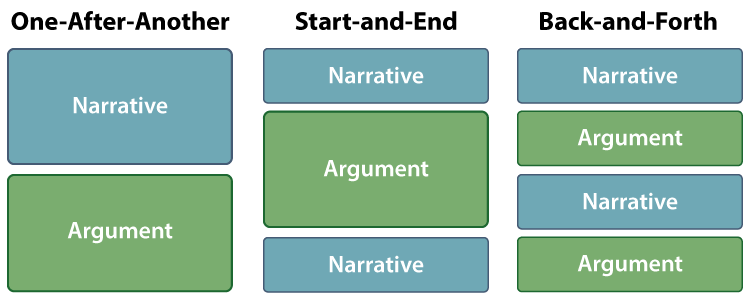
  4. Experiment with different combinations of narration and argumentation. Here are three common ways to organize a narrative argument:
    • One-After-Another: Start with your full narrative and transition to your full argument or vice versa.
    • Start-and-End: Start with a portion of your narrative, transition to your argument, and then return to your narrative.
    • Back-and-Forth: Start with your narrative or argument and transition back and forth multiple times between both pieces.

Narrative Argument Organizer

  1. Evaluate the results. Which pattern most effectively strengthens the argument? Which pattern is easiest to follow? Which pattern will most likely get readers to empathize with your position?
  2. Choose a pattern.
  3. Add parts (or all) of your narrative to your argument essay. If you are working in a word-processing program, you can simply copy and paste the parts. Reword sections as needed to improve the flow.
By Anonymous (not verified), 12 March, 2026

Writing a Narrative

After identifying your focus and gathering details about it, you are ready to write your narrative. Remember that a narrative is more than a chronological list of events. It is a true-life story with characters and conflict, so you need to build it like a story. The activities on this page will help.

Writing the Narrative Beginning

The beginning of your narrative has a number of jobs:

  • Catch the reader's attention.
  • Introduce the main character (person of focus).
  • Describe the setting (time and place).
  • Create conflict.

Write the beginning.

Experiment with strategies for capturing the reader's interest. Use the examples below for inspiration. Then develop a beginning that introduces the main character, describes the setting, and sets up the conflict.

  1. Start in the middle of the action.

    Flush with determination, I stepped up to the podium. I had a strong speech. I had a strong message. I was ready to fight for equal rights. So how did I know it was all doomed?

  2. Use interesting dialogue.

    "There goes Drama Jess again. Making something out of nothing." Girls with an opinion get that a lot in high school.

  3. Pose a fascinating question.

    What does justice mean to you?

  4. Set up the conflict.

    I’m a sports fanatic. I’m also a girl. I thought by now my gender wouldn't be an issue, but last school year showed it still is.

By Anonymous (not verified), 12 March, 2026

Writing an Argument Essay

You've researched controversial topics in your school, community, nation, and world. You've stated a position and explored reasons for and against it. You've even outlined your argument and responded to objections. Now it's time to write your first draft. The following activities will guide you.

Writing the Argument Beginning

The beginning first needs to grab the reader's attention. Then it should introduce your topic and provide background leading up to your position statement. To get started with your beginning paragraph, you can experiment with different lead-writing strategies.

Write a lead sentence.

Write a different lead sentence(s) for each strategy to capture the reader's attention. Use the examples as inspiration.

  1. Ask a provocative question.

    Why is gender such a taboo subject in high school?

  2. Provide a fascinating quotation.

    "True equality means holding everyone accountable in the same way, regardless of race, gender, faith, ethnicity, or political ideology."
    ― Monica Crowley

  3. Provide a surprising fact.

    Did you know more than half of female students in grades 7-12 report experiencing some form of sexual harassment?

  4. Directly address the issue.

    Recently a wave of women's empowerment has swept across the country, but it hasn't seemed to reach high schools.

Write your beginning paragraph.

Start with your lead, and then provide background and develop a paragraph leading to your position statement.

Writing the Middle Paragraphs

Develop a middle paragraph for each reason that supports your position statement. Organize these paragraphs using your outline (for a receptive audience) or follow a pattern for a resistant audience.