CCSS.ELA-LITERACY.W.9-10.10

By Anonymous (not verified), 16 March, 2026
This thank you letter expresses appreciation for a community partner of a school club.
By Anonymous (not verified), 12 March, 2026

Assembling Your Narrative Argument

By now you have completed drafts of an argument essay and a narrative. Great work! The two main components of your narrative argument are ready to go. Now comes the fun part—combining both forms into a single paper. Finding the right mix is not an exact science. You'll need to experiment with different arrangements to create your strongest argument. The activities in this lesson will help.

Combining Argument and Narrative

Follow these steps to blend your two separate essays into a narrative argument. As you work through the steps, remember that you can add, cut, rewrite, and rearrange parts of both original pieces as needed.

  1. Make your original argument essay the base of your paper.
  2. Read over both pieces one more time.
  3. Decide what portions of your narrative support your argument.
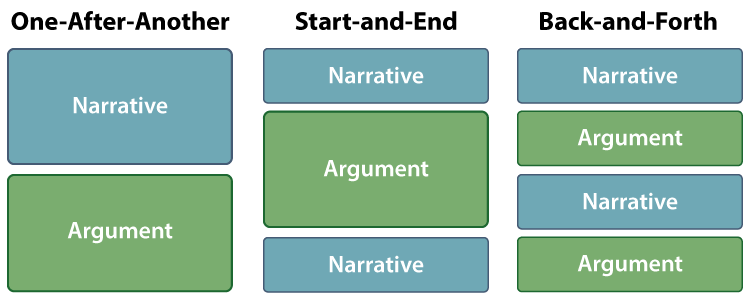
  4. Experiment with different combinations of narration and argumentation. Here are three common ways to organize a narrative argument:
    • One-After-Another: Start with your full narrative and transition to your full argument or vice versa.
    • Start-and-End: Start with a portion of your narrative, transition to your argument, and then return to your narrative.
    • Back-and-Forth: Start with your narrative or argument and transition back and forth multiple times between both pieces.

Narrative Argument Organizer

  1. Evaluate the results. Which pattern most effectively strengthens the argument? Which pattern is easiest to follow? Which pattern will most likely get readers to empathize with your position?
  2. Choose a pattern.
  3. Add parts (or all) of your narrative to your argument essay. If you are working in a word-processing program, you can simply copy and paste the parts. Reword sections as needed to improve the flow.
By Anonymous (not verified), 12 March, 2026

Writing an Argument Essay

You've researched controversial topics in your school, community, nation, and world. You've stated a position and explored reasons for and against it. You've even outlined your argument and responded to objections. Now it's time to write your first draft. The following activities will guide you.

Writing the Argument Beginning

The beginning first needs to grab the reader's attention. Then it should introduce your topic and provide background leading up to your position statement. To get started with your beginning paragraph, you can experiment with different lead-writing strategies.

Write a lead sentence.

Write a different lead sentence(s) for each strategy to capture the reader's attention. Use the examples as inspiration.

  1. Ask a provocative question.

    Why is gender such a taboo subject in high school?

  2. Provide a fascinating quotation.

    "True equality means holding everyone accountable in the same way, regardless of race, gender, faith, ethnicity, or political ideology."
    ― Monica Crowley

  3. Provide a surprising fact.

    Did you know more than half of female students in grades 7-12 report experiencing some form of sexual harassment?

  4. Directly address the issue.

    Recently a wave of women's empowerment has swept across the country, but it hasn't seemed to reach high schools.

Write your beginning paragraph.

Start with your lead, and then provide background and develop a paragraph leading to your position statement.

Writing the Middle Paragraphs

Develop a middle paragraph for each reason that supports your position statement. Organize these paragraphs using your outline (for a receptive audience) or follow a pattern for a resistant audience.