Template Content
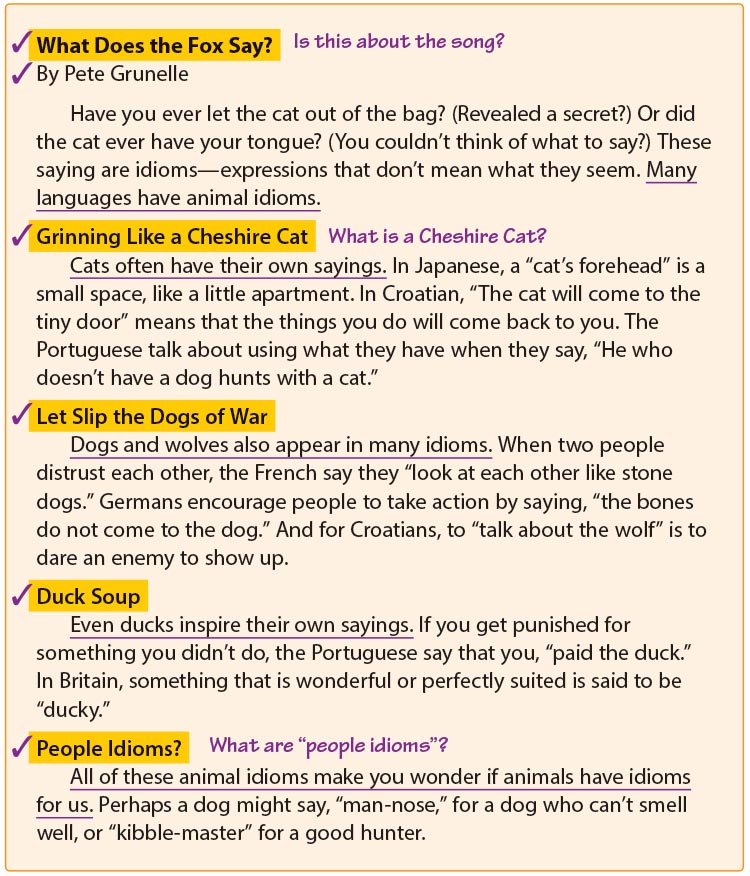
Survey, question, and read.
Use these instructions to closely read the following essay.
- Survey the text: Highlight the title, author, and headings.
- Question the topic and purpose: Write comments on the document.
- Read the text: Underline the focus statement and topic sentences.
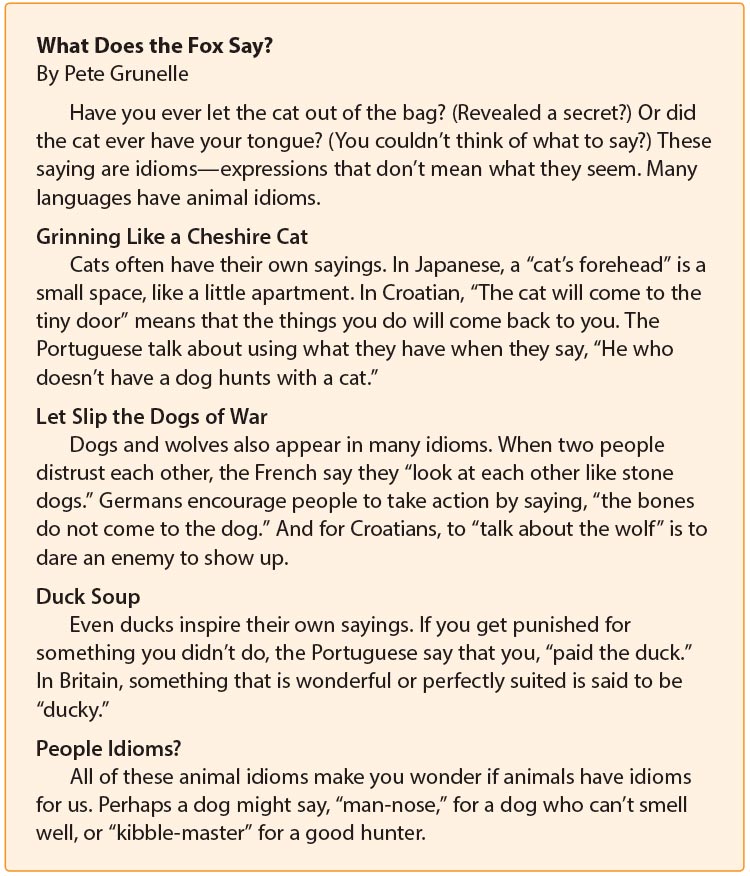
What Does the Fox Say?
By Pete Grunelle
Have you ever let the cat out of the bag? (Revealed a secret?) Or did the cat ever have your tongue? (You couldn’t think of what to say?) These saying are idioms—expressions that don’t mean what they seem. Many languages have animal idioms.
Grinning Like a Cheshire Cat
Cats often have their own sayings. In Japanese, a “cat’s forehead” is a small space, like a little apartment. In Croatian, “The cat will come to the tiny door” means that the things you do will come back to you. The Portuguese talk about using what they have when they say, “He who doesn’t have a dog hunts with a cat.”
Let Slip the Dogs of War
Dogs and wolves also appear in many idioms. When two people distrust each other, the French say they “look at each other like stone dogs.” Germans encourage people to take action by saying, “the bones do not come to the dog.” And for Croatians, to “talk about the wolf” is to dare an enemy to show up.
Duck Soup
Even ducks inspire their own sayings. If you get punished for something you didn’t do, the Portuguese say that you, “paid the duck.” In Britain, something that is wonderful or perfectly suited is said to be “ducky.”
People Idioms?
All of these animal idioms make you wonder if animals have idioms for us. Perhaps a dog might say, “man-nose,” for a dog who can’t smell well, or “kibble-master” for a good hunter.
Recite and review.
Answer the following questions about the essay on animal idioms.
- What topic does the essay describe?
- Write down the focus statement (the sentence that names the topic).
- Write down the topic sentence about cat idioms.
- Write your favorite cat idiom (a detail that supports this topic sentence).
- What is the duck idiom from Britain? What does it mean?
- Use your imagination to come up with a “people idiom” that animals could say about us. Think from the point of view of an animal and come up with a clever saying. Explain what your idiom means