Editing Comparison-Contrast Essays
After revising your essay, you need to edit it to correct any remaining errors. You'll look closely at sentences, punctuation, capitalization, grammar, usage, and spelling. The following activities will help you edit your comparison-contrast essay.
Editing Compound Sentences
Simple sentences have just one complete thought.
Dolphins are playful. They often perform tricks.
Whales can live in cold water. Dolphins prefer warm water.
What if you combined them? A compound sentence joins simple sentences using a comma and and, or, but, for, nor, or so.
Dolphins are playful, and they often perform tricks.
Whales live in warm and cold water, but dolphins prefer warm water.
Combine to create compound sentences.
Combine the pairs of sentences using a comma and the word given in parentheses.
- I like helping my mom cook. It's fun to taste our creations. (and)
- We were going to go sledding. There was not enough snow. (but)
- Special Challenge: Find two simple sentences from your essay. Add a comma and the word and, but, or or to combine the two sentences.
Insert commas where needed.
For each sentence, insert the missing comma before the connecting word to create a compound sentence.
-
My mom taught me how to play chess and we played for two hours. My mom taught me how to play chess, and we played for two hours.
-
My dog might be playful or he might want a nap. My dog might be playful, or he might want a nap.
-
The water is as clear as glass but it is too cold to swim in. The water is as clear as glass, but it is too cold to swim in.
-
Today is my birthday and I want ice cream. Today is my birthday, and I want ice cream.
Teaching Tip
When students use too many short, simple sentences in a row, their writing can sound choppy. Combining simple sentences to create compound sentences is one way to improve the flow.
Editing Verb Agreement with Two Subjects
Subjects and verbs need to agree in number. When subjects include just one subject, agreement rules are straightforward. If you use a singular subject, use a singular verb. If you use a plural subject, use a plural verb. But when sentences include two subjects, pay close attention to the word that connects both subjects.
- In sentences with two subjects connected by and, the verb should be plural.
Both a dolphin and a whale use sound to communicate.
- In sentences with two subjects connected by or or nor, the verb must agree with the subject that is nearer the verb.
Neither a dolphin nor a whale is a fish.
(Use a singular verb because the subject nearer the verb—whale—is singular.
Neither dolphins nor whales are fish.
(Use a plural verb because the subject nearer the verb—whales—is plural.
Choose the correct verb.
Highlight or underline the correct verb for sentences with two subjects. The first one has been done for you.
- The brother and sister (walk / walks) to the store.
- In the valley, trees or prairie grass ( covers / cover ) the landscape. In the valley, trees or prairie grass ( covers / cover) the landscape.
- Diet and exercise ( is / are ) keys to good health. Diet and exercise ( is / are ) keys to good health.
- Neither my hamster nor bunnies ( lives / live ) in separate cages. Neither my hamster nor bunnies ( lives / live ) in separate cages.
- Spaghetti or tacos ( are / is ) my favorite foods. Spaghetti or tacos ( are / is ) my favorite foods.
- A dog and a cat ( is / are ) living in the shed. A dog and a cat ( is / are ) living in the shed.
- Either Rosa or Pasha ( kicks / kick ) the soccer ball. Either Rosa or Pasha ( kicks / kick ) the soccer ball.
- Where ( is / are ) Patrick and Keshawn? Where ( is / are ) Patrick and Keshawn?
- A mouse and a rat ( has / have ) similar features. A mouse and a rat ( has / have ) similar features.
- After Mel and Jessica ( go / goes ) horseback riding, they ( has / have ) to groom the horses. After Mel and Jessica ( go / goes ) horseback riding, they ( has / have ) to groom the horses.
Edit for agreement.
Read your essay, paying careful attention to verb agreement in sentences with two or more subjects.
Editing in Action
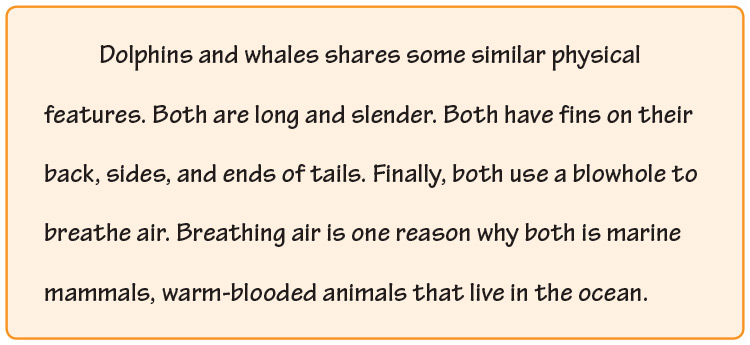
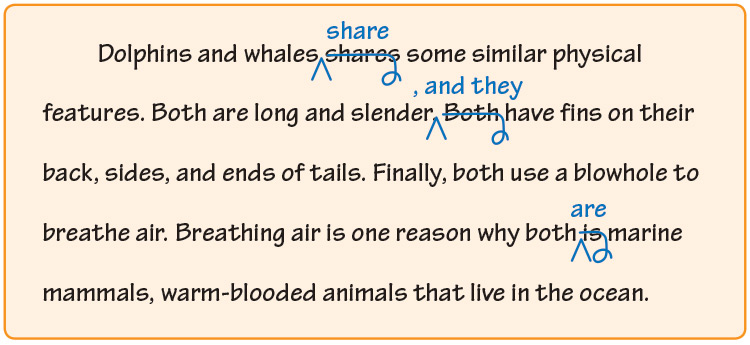
When you edit, you check to make sure your essay is correct.
-
Paragraph Before Edits
-
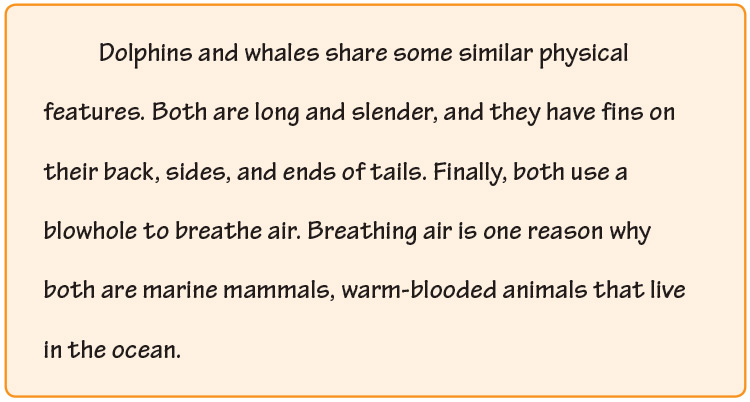
Agreement errors are fixed and a compound sentence is created.
-
Paragraph After Edits
Edit with a checklist.
Read each line. When you can answer each question with a yes, check it off.
Punctuation
- Did I close each sentence with an end punctuation mark?
- Do compound sentences have commas before and, but, or or?
Capitalization
- Did I start all sentences with capital letters?
- Did I capitalize the names of people and places?
Grammar
- Did I use the correct form of verbs (give, gave, given)?
- Do my compound subjects agree with their verbs?
Usage
- Did I use an appropriate level of language?
- Did I correctly use commonly confused words (affect/effect)?
Spelling
- Did I check for spelling errors?
- Did I use a dictionary or the spell checker on my computer?
Publishing Comparison-Contrast Essays
When you publish your writing, you make it public. First, you need to make a clean final copy of your work. Then you should find ways to share what you have written with classmates, your teacher, your family, and your friends.
Publishing a Final Copy
Create a final copy of your writing.
Include your editing changes and read over your work a final time. (If you are working on a computer, spell check your work.)
Reflecting on Your Writing
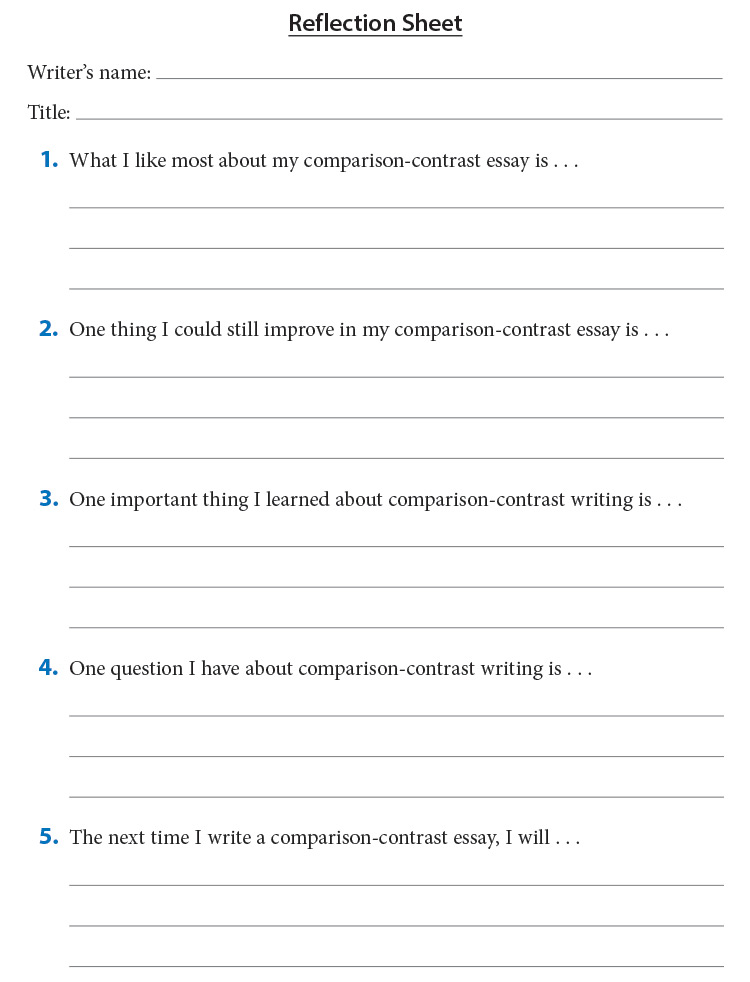
Reflect on your writing.
Complete the following form to think about what you learned.