Editing Personal Narratives
After making big changes to improve your personal narrative, you need to make little changes (editing) to correct any remaining errors. You'll look for problems with sentences, punctuation, capitalization, grammar, usage, and spelling. The following activities will help you edit your narrative.
Editing to Punctuate Dialogue
Dialogue, or written conversation, works only when it is punctuated correctly. Use the examples that follow as a guide to punctuating dialogue.
Put quotation marks around spoken words.
Martha whispered, “What page are we on?”
Use a comma to separate the speaker from the spoken words.
Martha whispered, “What page are we on?”
If the comma comes after the quotation, put the comma inside the quotation marks.
“Pay attention,” Lupe said.
If a period comes after a quotation, put the period inside the quotation marks.
Martha insisted, “Just tell me.”
If the speaker interrupts a spoken sentence, use two commas to show the interruption.
“Lupe,” Martha pressed, “I thought we were friends.”
If the speaker comes between two sentences, use a period to end one sentence before beginning another.
“We are friends,” said Lupe. “I just don't want to get in trouble for whispering.”
OR
“We are friends.” Lupe added, “I just don't want to get in trouble for whispering.”
If the spoken words are a question or an exclamation, place the question mark or exclamation point inside the quotation marks.
“Are we on page 33?” asked Martha.
OR
Martha asked, “Are we on page 33?”
If the sentence is a question or exclamation but the spoken words are not, place the question mark or exclamation point outside of the quotation marks.
Did you hear Mrs. Williams say, ”Turn to page 33”?
Teaching Tip
Students should use just one punctuation point at the end of a sentence. In other words, the last example should not be punctuated this way: Did you hear Mrs. Williams say, ”Turn to page 33.”?
Punctuate dialogue.
Punctuate the following sentences with quotation marks, commas, and end marks. The first one has been done for you.
- “Where are we going on the field trip?” LaShawn wanted to know.
-
Well said Mrs. Miller we’ll go wherever there are a lot of animals “Well,” said Mrs. Miller, “we’ll go wherever there are a lot of animals.”
-
Daniel blurted out I know where Daniel blurted out, “I know where!”
-
Do you asked Mrs. Miller Please tell us “Do you?” asked Mrs. Miller. “Please tell us.”
-
To my house said Daniel Do you know why “To my house,” said Daniel. “Do you know why?”
-
Mrs. Miller said I have no idea Mrs. Miller said, “ I have no idea.”
-
Well said Daniel my mother says our house is like a zoo “Well,” said Daniel, “my mother says our house is like a zoo.”
-
LaShawn said What are you talking about LaShawn said, “What are you talking about?”
-
It’s a joke said Daniel Lighten up, LaShawn “It’s a joke.” said Daniel. “Lighten up, LaShawn.”
-
Mrs. Miller said Daniel is just having a little fun Mrs. Miller said, “Daniel is just having a little fun.”
Editing Comma Splices and Run-Ons
A comma splice is an error made when a writer connects two simple sentences with only a comma. A run-on sentence occurs when two simple sentences run together without any punctuation marks and/or connecting words.
Comma Splice
The day is going to be very hot, I like hot weather.
(Two complete thoughts are incorrectly “spliced” together with only a comma.)
Corrected Sentence
The day is going to be very hot, but I like hot weather.
(Adding the coordinating conjunction but after the comma turns this into a compound sentence. The other coordinating conjunctions are and, or, nor, for, so, and yet.)
Run-on Sentence
The day was to be the hottest of the summer we decided to get up early.
(Two complete thoughts are incorrectly run together.)
Corrected Sentence
The day was to be the hottest of the summer; we decided to get up early.
(Adding a semicolon corrects the run-on error. Using a period between the two sentences would also correct the run-on.)
Fix comma splices and run-ons.
Fix the comma splices and run-ons in the following items by creating two sentences, using a comma and a coordinating conjunction, or using a semicolon. The first one has been done for you.
- It looked like a great day for swimming, so we headed for the beach.
-
By noon the heat was intense we needed to come in out of the sun. By noon the heat was intense; we needed to come in out of the sun.
-
It was the perfect time to go for a ride in our air-conditioned car, we decided to look for an ice-cream stand. It was the perfect time to go for a ride in our air-conditioned car. We decided to look for an ice-cream stand.
-
The searing afternoon sun seemed ready to scorch everything in sight, we had come prepared with three bottles of sunscreen. The searing afternoon sun seemed ready to scorch everything in sight, but we had come prepared with three bottles of sunscreen.
-
I didn’t want to get a sunburn I remembered the pain that I had experienced the last time it happened. I didn’t want to get a sunburn. I remembered the pain that I had experienced the last time it happened.
-
We all brought along our beach hats the cool breeze from the water also kept us from overheating. We all brought along our beach hats. The cool breeze from the water also kept us from overheating.
-
When it’s hot, all I think about is swimming that’s how much I like it. When it’s hot, all I think about is swimming; that’s how much I like it.
-
I like the community pool, the beach is more fun. I like the community pool, but the beach is more fun.
-
I’d spend every day at the beach, imagine how great that would be. I’d spend every day at the beach. Imagine how great that would be.
-
I love the sound of the waves, there's nothing like it. I love the sound of the waves, for there's nothing like it.
Editing in Action
When you edit, you check to make sure your essay is correct.
-
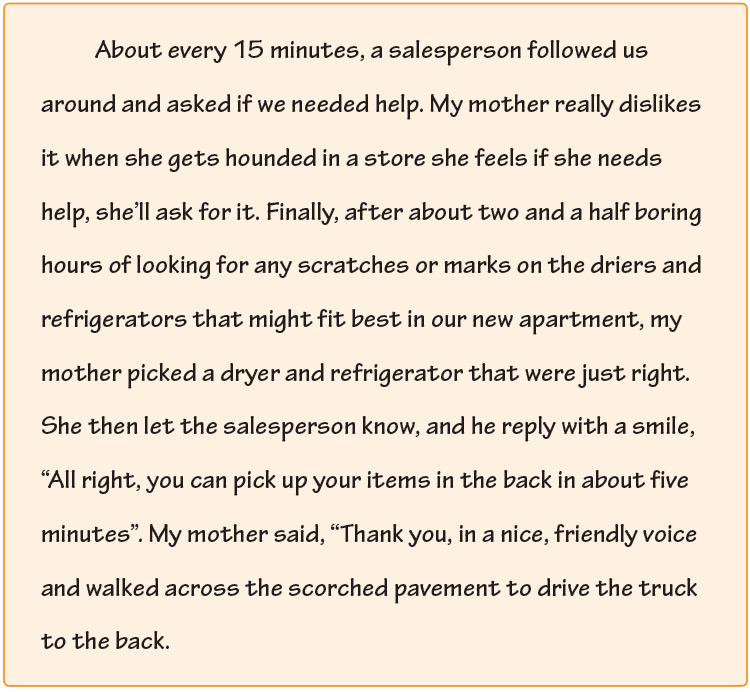
Paragraph Before Edits
-
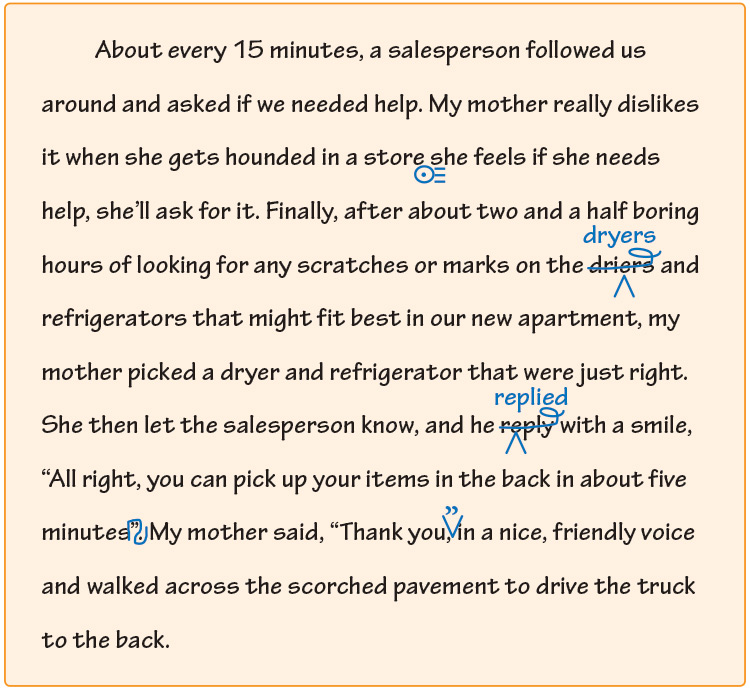
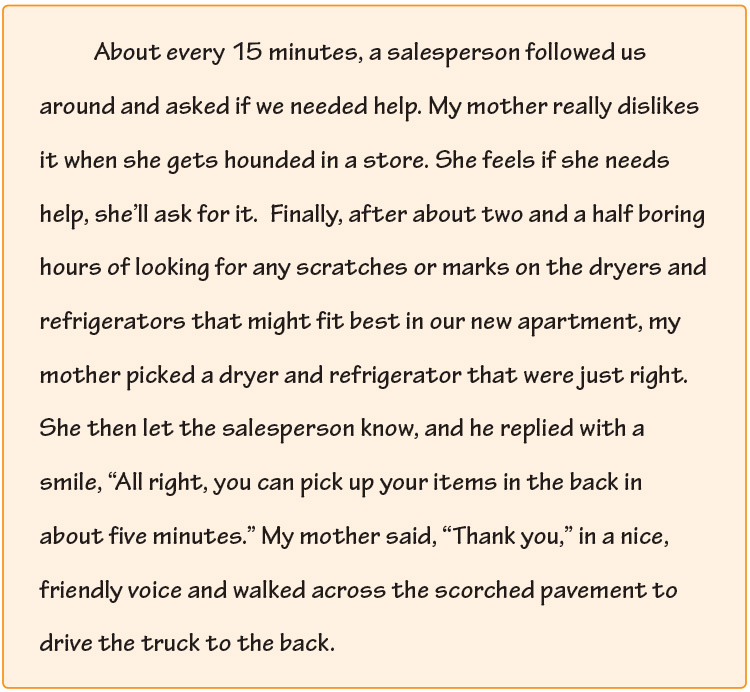
A run-on sentence, spelling error, and improper shift in tense are corrected, as is the punctuation of dialogue.
-
Paragraph After Edits
Edit with a checklist.
Read each line. When you can answer each question with a yes, check it off.
Punctuation
- Did I close each sentence with an end punctuation mark?
- Do I enclose dialogue in quotation marks?
- Do I place commas and end punctuation properly near quotation marks?
Capitalization
- Did I start all sentences with capital letters?
- Did I capitalize the names of people and places?
Grammar
- Are my sentences free of run-ons and comma splices?
- Do the subjects and verbs agree in number? (The van honks; the cars stop.)
Usage
- Did I correctly use commonly confused words (affect/effect)?
Spelling
- Did I check for spelling errors?
- Did I use a dictionary or the spell checker on my computer?
Publishing Personal Narratives
When you publish your personal narrative, you make it public, sharing it with others. First, you need to make a clean final copy of your work. Then you should find ways to share what you have written with classmates, your teacher, your family, and your friends.
Publishing a Final Copy
Create a final copy of your writing.
Include your editing changes and read over your work a final time. (If you are working on a computer, spell check your work.)
Reflecting on Your Writing
Reflect on your writing.
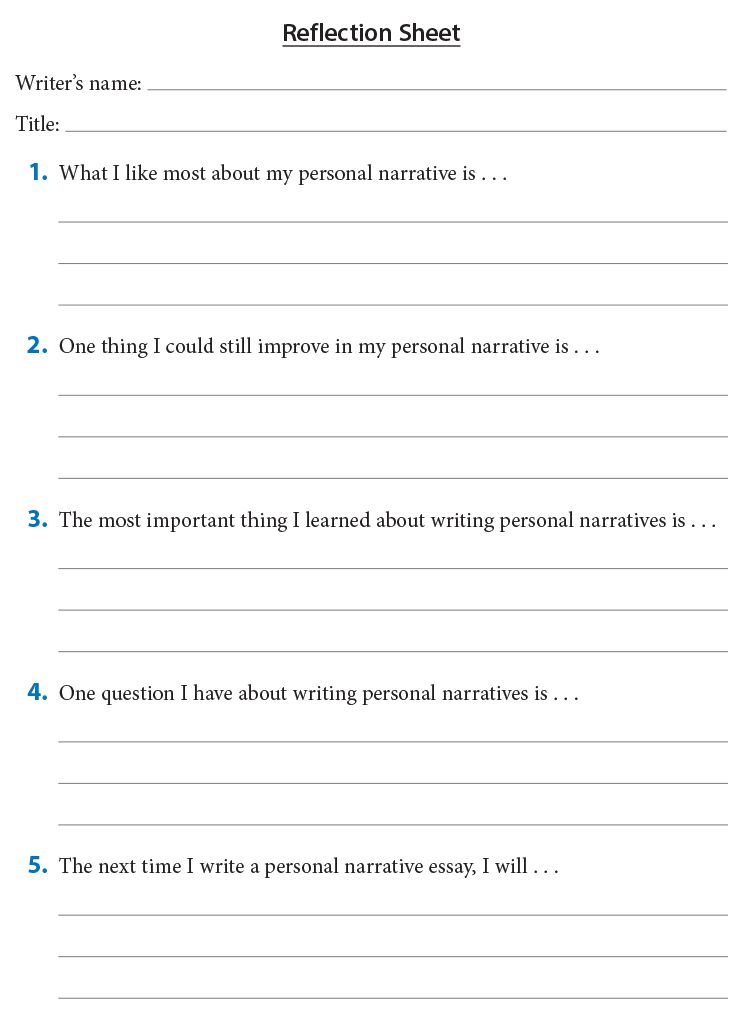
Complete the following form to think about what you learned.