Reading and Writing Nonfiction Assessment III
Closely read the following articles and answer the questions afterward. Then you will need to analyze a prompt about these models and respond by writing an insightful essay.
Closely read and respond to source 1.
Read and/or listen to the following text, focusing on the topic, purpose, and main points. Answer the questions afterward.
Listen to "Excerpt from "The Power of Thankfulness"
Hide audio
Source 1
The Power of Thankfulness

Traditional Thanksgiving with family (Shutterstock)
1 In July of 1863, the three-day Battle of Gettysburg killed or wounded more American soldiers than the Revolutionary War and the Mexican-American War combined. Lincoln's Gettysburg Address dedicated a portion of the battlefield "as a final resting place" for "these honored dead." And the war was only intensifying. How strange, then, that three months later, that same embattled president declared a national day of Thanksgiving for the third Thursday of every November. Though some would consider such a declaration at least odd if not entirely inappropriate, Lincoln deemed it, "fit and proper that [our blessings] should be solemnly, reverently and gratefully acknowledged as with one heart and one voice by the whole American People." What did Lincoln know that we do not? The power of thankfulness.
2 Recent studies have demonstrated the power of gratitude. Amit Kumar of MIT and Nicolas Epley of University of Chicago asked test subjects to write thank-you notes to people and estimate the positive impact of the notes. The researchers found that participants greatly undervalued how happy others would be to receive their thanks. Put simply, when people say, "You have no idea how much your note meant to me," they are probably speaking the truth. A similar study by Steven Toepfer and Patti Peters of Kent State asked 219 participants to write three thank-you letters over a three-week period. The letter writing improved participants' sense of happiness, life-satisfaction, and gratitude and decreased their depression. These studies go beyond simply asking people to "look on the bright side." Participants focused not just on counting blessings but on expressing thanks to another person for those blessings. Gratitude isn't just an attitude but an action. It is not just an internal state but an external, social interaction.
3 In "The Lifesaving Power of Gratitude," Richard Gunderman of Indiana University explains the power of thankfulness. He says gratitude begins by reorienting the individual's mind from negatives to positives, from inward thoughts of regret to outward expressions of appreciation. In so doing, thankfulness interrupts a downward spiral of negativity and replaces it with an upward feedback loop of positivity. It uplifts the psychology of the thanks-giver and the thanks-receiver. As a social act, thankfulness also connects the thankful person to others. Positive interactions with family members, friends, and even strangers are among the strongest remedies for depression. Thankfulness also strengthens those relationships, thereby reinforcing the social safety network that surrounds a person. And thankfulness creates an environment in which positivity becomes reciprocated. The age-old adage about karma applies: "What goes around comes around." Expressing thankfulness to others increases one's own likelihood of receiving expressions of thankfulness. Giving and receiving thanks can be "more helpful than you know."
4 Of course, expressions of thanks are not always well received. Sometimes people are embarrassed by the overture, anxious because they feel unworthy of such praise. People blush and squirm, unsure what to say. They don't like getting presents on their birthday and certainly don't want a party and wish people wouldn't make a fuss over them. The fault there does not lie with the thankful person but with the low self-esteem of the person who is thanked. Gentle, repeated overtures of genuine appreciation can help improve the person's self-esteem. Others who rebuff thankfulness do so because of too much self-esteem. They feel they deserve even more praise than they receive and sneer at the inadequate offerings presented to them. In such cases, continued thankfulness only stokes the person's sense of entitlement, and thankful people would be best counseled to direct their positivity elsewhere while the person's ego deflates. Others still might distrust the motives of the thankful person, fearing they are being manipulated somehow or put into the other's debt. In this case, the thankful person should make sure he or she is truly offering the appreciation with "no strings attached." Once the recipient realizes as much, the frigid demeanor likely will melt.
5 So, next time you crowd around the Thanksgiving table, elbow-to-elbow with squabbling siblings and uncles determined to argue over politics, remember the power of thankfulness. And when your grandmother requires each participant to name a thing he or she is thankful for, muster up your courage and blurt out something. Be thankful for turkey and stuffing. Better yet, be thankful to the people who bought and prepared the turkey and stuffing. And remember how, in the midst of the bloodiest war our nation had ever seen, a gawky failed lawyer from Illinois called on his countryfolk to give thanks for all that they had and all that they hoped to preserve. He sought to use the power of thankfulness "to heal the wounds of the nation and to restore it as soon as may be consistent with the Divine purposes to the full enjoyment of peace, harmony, tranquility and Union."
Rob King is a staff writer for Thoughtful Learning, an educational publishing house.
-
Which statement best describes the article's thesis?
A. Thanksgiving elevated the American mood during our darkest hour.
B. Thanking others provides powerful health benefits.
B. Thanking others provides powerful health benefits.
C. Thankfulness is the act of showing gratitude.
D. Some people dislike receiving gratitude for a variety of reasons.
-
Infer why the author would begin with an anecdote about Lincoln and Thanksgiving.
A. Most readers like Lincoln and don't realize he declared Thanksgiving a national holiday.
B. The anecdote introduces the power of giving thanks even in dark times.
B. The anecdote introduces the power of giving thanks even in dark times.
C. The writer wants to whet the reader's appetite for the subject.
D. The Gettysburg Address established Thanksgiving as a holiday.
-
Infer the best topic sentence for the first paragraph.
A. Abraham Lincoln showed that he understood the power of gratitude when he established the holiday of Thanksgiving during the darkest days of the Civil War.
A. Abraham Lincoln showed that he understood the power of gratitude when he established the holiday of Thanksgiving during the darkest days of the Civil War.
B. In July of 1863, the three-day Battle of Gettysburg killed or wounded more American soldiers than the Revolutionary War and the Mexican-American War combined.
C. Most people associate Thanksgiving with pilgrims, but they really should credit Abraham Lincoln, instead.
D. The purpose of Thanksgiving was not to celebrate the harvest but rather to help the nation survive the Civil War.
-
In the studies referenced in the second paragraph, infer why researchers asked participants to write thank-you notes and letters instead of simply thinking thankful thoughts.
A. Writing notes and letters is an active and social process rather than a passive and solitary one.
B. Notes and letters involve both a thanks-giver and a thanks-receiver.
C. Notes and letters allowed researchers to measure psychological effects on both senders and receivers.
D. All of these were reasons for notes and letters.
D. All of these were reasons for notes and letters.
-
In the third paragraph, what does the writer mean by "an upward feedback loop of positivity"?
A. Gratitude requires the thanks-receiver to be grateful in return.
B. People are happiest in a "mutual admiration society."
C. Thankfulness inspires more thankfulness.
C. Thankfulness inspires more thankfulness.
D. People who give thanks are expecting positive feedback.
-
In the third paragraph, why is the social aspect of thankfulness crucial?
A. Social media allows people to share thankfulness.
B. Positive social interactions are a strong remedy for depression.
C. Thankfulness to others strengthens the social safety net around a person.
D. Both B and C are correct.
D. Both B and C are correct.
-
In the fourth paragraph, what type of thanks-receiver does the writer say should receive less thankfulness?
A. Those with low self-esteem
B. Those with a sense of entitlement
B. Those with a sense of entitlement
C. Those who distrust the motives of the thankful person
D. All of the above
-
In the fourth paragraph, infer the best definition of "no strings attached."
A. Severing ties with the recipient
B. Offered freely, without expectation of repayment
B. Offered freely, without expectation of repayment
C. Done to create a sense of social indebtedness
D. Like a liberated marionette
-
What best describes the purpose of this article?
A. To explain the positive psychological effects of thankfulness
A. To explain the positive psychological effects of thankfulness
B. To convince clinicians to prescribe thank-you notes as a therapeutic intervention for depression
C. To encourage thanks-receivers to gratefully receive positive feedback
D. To introduce anecdotes that should be part of Thanksgiving celebrations
-
Which quotation would be the best alternate title for this selection?
A. "Fit and Proper"
B. "What Goes Around Comes Around"
C. "Look on the Bright Side"
D. "More Helpful Than You Know"
D. "More Helpful Than You Know"
Closely read and respond to source 2.
Read and/or listen to the following text, focusing on the topic, purpose, and main points. Answer the questions afterward.
Listen to "Musick Has Charms to Soothe"
Hide audio
Source 2
Musick Has Charms to Soothe
by Brooke Cavanaugh
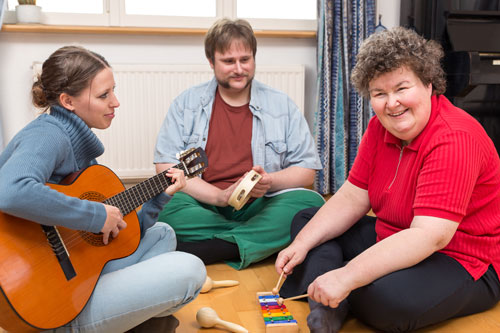
Music therapy lifts mood, improves communication, and helps self-esteem. (Shutterstock)
1 Imagine being born blind but forced to work at an early age, dragging lumber through dense jungles. That was the life of Lam Duan, a female elephant who worked for 20 years in the lumber trade in Koh Samui, Thailand. When the government outlawed use of elephants in logging, Lam began 10 years of work giving rides to tourists. The aging elephant then was donated to ElephantsWorld, a mountainous reserve for rescue elephants. She was restless, but her handler, Nasuyo, soon discovered that music calmed her. Now Nasuyo sings to Lam every day and has even placed a piano in the habitat so that she and other volunteers can play music. Lam stands beside the piano, ears wide, swaying with the sound, her anxiety slowly melting away. As William Congreve noted long ago, "Musick has charms to soothe a savage breast."
2 Yes, the word is "breast" instead of "beast," which is good news for the troubled hearts not just of animals but also of humans. For millennia, people have known that music can soothe and console, can inspire and entertain, can make us march or dance. But a growing body of research shows that music can also heal. Across the country, music therapists use melodies and harmonies to break through the fog of Alzheimer's, to help Parkinson's patients be "big and loud," and to help alleviate depression and anxiety. They use music scientifically and systematically to reduce asthma episodes in young children, to help those with autism improve communication skills, and to help premature babies sleep and gain weight. Music therapists even helped Arizona Congresswoman Gabrielle Giffords regain her ability to speak after being shot in the head.
3 The American Music Therapy Association provides a stringent set of standards for accreditation: a bachelor's degree or higher in music therapy, 1,200 hours of clinical training, and credentials from the Certification Board for Music Therapists. Practitioners must also engage in continuing education that melds musical instruction with the latest developments in neurology, psychology, and anatomy. Music therapists work scientifically, establishing therapeutic goals and tracking patient improvement in response to music. They not only perform for patients but also invite them to participate in music making, whether by singing along, sharing a piano, using percussion, or moving to music. As music therapists work, they add to the growing body of research about using music to achieve medical and psychological outcomes.
4 "I regard music therapy as a tool of great power in many neurological disorders—Parkinson's and Alzheimer's—because of its unique capacity to organize or reorganize cerebral function when it has been damaged," said neurologist Oliver Sacks, author of Awakenings. The scientific application of music to improve cerebral function may be relatively new, but humans have known of music's positive effect on the brain for at least 2,000 years. Plato said, "I would teach children music, physics, and philosophy; but most importantly music, for the patterns in music and all the arts are the keys to learning."
5 Though music therapy specifically targets patient improvement, it also has an uplifting effect on families and staff. Jefri Franks, mother of a child battling non-Hodgkin's lymphoma, said, "When [our music therapist] Allison would peek through the window of our hospital room door, guitar in hand, we would heave a sigh of relief and wave her in. . . . Music has the power to transport the listener." Music therapy helped Jefri, her daughter, and her whole family navigate their "harrowing journey." Melissa Wenszell, head of music therapy at the MacPhail Center for Music in Minneapolis, said, "Sometimes our job is for the family or staff of a care facility." Effective therapy eases stress, provides emotional release, and rejuvenates exhausted caregivers. Also the frequent breakthroughs during music-therapy sessions re-energize family and medical professionals alike, rekindling hope.
6 Kayla Shafer, who runs a counseling service that offers music therapy, says, "I'm looking for excellent communication skills and people who are likable, relatable—someone I can trust and who has fantastic music skills." She also seeks therapists who can creatively apply music to the needs of individual patients, adjusting rapidly to accommodate changes in health, mood, or environment.
7 Shafer and others like her are gearing up for the huge wave of Baby Boomers who will soon need help with Alzheimer's, Parkinson's, stroke, cancer, and other geriatric diseases. Luckily, these therapists have an arsenal of fantastic music to reach this generation, everything from big band to Elvis to folk songs to classic rock. "This is the soundtrack of their lives," said Clay Taylor, a newly accredited therapist who gets whole rooms of Parkinson's patients to loudly sing along with the rock anthems he plays on his Fender electric guitar. "The music that wired their adolescent brains is incredibly powerful to rewire and rejuvenate their aging neurons."
-
Which best sums up the thesis of this speech?
A. Music has charms to soothe the savage beast.
B. Anyone who plays music for a sick person is a music therapist.
C. Music therapists scientifically use music to promote healing.
C. Music therapists scientifically use music to promote healing.
D. Music is the best medicine.
-
Infer why the writer began this article with the anecdote about the blind elephant Lam.
A. The writer wanted to show a music therapist at work.
B. Readers are more interested in elephants than in music therapists.
C. The anecdote introduces the idea of using music to produce strong psychological benefits.
C. The anecdote introduces the idea of using music to produce strong psychological benefits.
D. The writer wants to advocate for fair treatment of elephants.
-
In the second paragraph, how does the writer contrast music therapy to more traditional uses of music?
A. Music therapists are more highly trained than other musicians.
B. Music therapy does not just aim at entertainment or inspiration but healing.
C. Music therapy is scientific and measurable in its approach.
D. Both B and C are correct.
D. Both B and C are correct.
-
Which of the following statements best sums up the examples of music therapy in the second paragraph?
A. Music therapy targets only psychological healing.
B. Music therapy works only for elderly patients.
C. Music therapy targets psychological and physical healing for old and young patients.
C. Music therapy targets psychological and physical healing for old and young patients.
D. Music therapy requires concert-quality performers.
-
In the third paragraph, infer why music therapists must engage in continuing education.
A. To add to the growing body of music therapy research
B. To stay up-to-date with the latest developments in music and medicine
B. To stay up-to-date with the latest developments in music and medicine
C. To prevent regular musicians from claiming to be music therapists
D. To provide ongoing funding for the Certification Board for Music Therapists
-
How do the two quotations work together in the fourth paragraph?
A. The first quotation contrasts modern music therapy to the outdated concept in the second quotation.
B. The first quotation shows how modern music therapy improves neural function in the elderly while the second quotation shows how music improved childhood education in the ancient world.
B. The first quotation shows how modern music therapy improves neural function in the elderly while the second quotation shows how music improved childhood education in the ancient world.
C. The quotations show that Oliver Sacks and Plato were both music therapists separated by two millennia.
D. The quotations show how music therapy has evolved over two thousand years.
-
In the fifth paragraph, why is it important that "music has the power to transport the listener"?
A. Music lifts the spirits of patient, family, and staff alike.
A. Music lifts the spirits of patient, family, and staff alike.
B. Patients and families want to leave the hospital but cannot.
C. Medical transportation is expensive, but musical transportation is free.
D. Music therapists can't perform for patients stuck in one location.
-
In the fifth paragraph, how does music help those around the patient?
A. It transports the listener.
B. It eases stress and provides emotional release.
C. It rejuvenates exhausted caregivers and re-ignites hope.
D. Music does all of these.
D. Music does all of these.
-
In the sixth paragraph, infer why music therapists need to be likable and relatable.
A. They need to work well with other music therapists.
B. They need to make a personal connection with patients, families, and caregivers.
B. They need to make a personal connection with patients, families, and caregivers.
C. They need to be charismatic.
D. They are seeking popularity for repeat customers.
-
In paragraph 7, why does drawing from "the soundtrack of their lives" help Clay Taylor promote healing among geriatric patients?
A. They like the songs he is performing.
B. They can sing along with the songs.
C. Familiar songs from youth help reawaken neural function in brains damaged by disease.
D. All of these are reasons.
D. All of these are reasons.
Writing an Essay for Assessment III
Some tests ask you to write an essay response to articles you have closely read. The following activity will help you practice.
Analyze and respond to an essay prompt.
Read the following prompt, analyze it using the PAST questions, and write an essay response.
Source 1 claims that simple thankfulness can combat depression, and Source 2 claims that music can ease conditions ranging from Parkinson's to asthma. How is it possible that these simple, free, everyday things could promote mental and physical healing? Write an essay that states your position about thankfulness, music, and other everyday curatives. Support your position with evidence from the two sources and from your own personal experience. Help convince other students of your position.