Reading Personal Narratives
Before you write about your own experience, you'll want to see how other students created personal narratives. This lesson shows you a narrative paragraph and a narrative essay, explaining each part. As you read them, think about how the writers made the people, places, and events come to life through description, action, and dialogue.
Reading a Narrative Paragraph
A personal narrative paragraph has three main parts. The topic sentence introduces your story. The body sentences describe what happened to you. The ending sentence tells why the experience was important. This paragraph shares one writer’s story about a school play.
Sample Paragraph
Listen to "Frozen on Stage."
Hide audio
Frozen on Stage
Topic SentenceMy first school play is something I’ll never forget. I was playing Mary Todd Lincoln, the wife of Abraham Lincoln. The whole auditorium was packed with people. Body SentencesIt was hot inside, even though it was the middle of the winter. Ms. Valentine gave me the cue, so I walked on stage toward Chad, who was playing Abraham Lincoln. When I looked at the audience, I froze and forgot my line. Now I was really sweating. I looked at Chad, and he pointed to his hat. That helped me remember the line. I said, “Geez, Abe, your hat is on crooked again.” The crowd laughed, and I relaxed. We got a standing ovation when the show ended. Chad was a great teammate. Ending SentenceI knew from then on that I would be a good teammate, too.
Respond to the paragraph.
Answer the following questions about the paragraph.
- What is the topic of this paragraph?
- What details stand out? Name two.
Reading a Narrative Essay
A personal narrative essay has three main parts. The beginning paragraph hooks the reader’s interest and introduces the experience. The middle paragraphs tell what happened by describing actions in time order. The ending paragraph sums up the experience and shares a final thought about it.
In this personal narrative essay, the writer adds dialogue, thought details, and sensory details to expand her paragraph topic into an essay.
Listen to "Topping Stage Fright."
Hide audio
Sample Essay
Topping Stage Fright
Beginning ParagraphI thought I was ready when I arrived at our school’s auditorium. Last winter my class put on a play called “Gettysburg” for a real audience. I had practiced hard, and I had all my lines memorized. During the dress rehearsal, everything went smoothly. But my first real show did not go as planned.
Middle ParagraphsI started to get nervous backstage. “I can’t believe all these people are here to see us,” I told Sofia. “And why is it so hot?” Even in the middle of the winter, the auditorium felt steamy. It didn’t help that I was wearing a big poofy gray dress in my role as Mary Todd Lincoln, the wife of Abraham Lincoln.
DialogueI wasn’t in the first scene, so I kept my eyes on Ms. Valentine. She was the director of the play and would give me a cue when it was my turn to go on stage. “You’re going to do great,” said Sofia. Before I had time to thank her, Ms. Valentine gave me two thumbs up.
Sensory DetailsStepping on stage for the first time felt like slow motion. Each step was more difficult than the last. When I caught a glimpse of the crowd, I froze. Every seat seemed like it was filled. Then a bright light hit my face, and I realized everyone could see me.
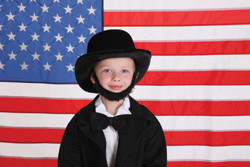
TransitionsAfter that I slowly walked toward Chad. He was playing Abraham Lincoln and was wearing a full black suit and a top hat that leaned off the side of his head. I knew it was time for my first line, but when I looked again at the crowd, my mouth got dry and my mind went blank.
Now I was really sweating, because I forgot my line. I started to feel embarrassed, but then I looked at Chad. He pointed to his hat. That’s it! I remembered what I was supposed to say.
I turned to the crowd and said, “Geez, Abe, your hat is on crooked again.” The audience laughed. I smiled and relaxed as Chad said the next line, “I was worried about my speech, Mary. Now I’m worried about my hat!”
Ending ParagraphThe rest of the play went great. My lines came out just like I practiced them. I was no longer nervous, and I even felt a surge of excitement. At the end, the crowd gave us a standing ovation. I thanked Chad backstage. “It was nothing,” he said. Reflective DetailsBut I won’t forget what he did. He acted like a good teammate. Whenever the chance comes, I’ll do the same thing for someone else.
Teaching Tip
Show students how an essay is an expanded paragraph: the topic sentence becomes the beginning paragraph, the body sentences become middle paragraphs, and the ending sentence becomes an ending paragraph.
Respond to the essay.
Work with a partner to answer these questions.
- How does the essay get your attention in the lead sentence?
- Does the essay answer the 5 W’s questions? If so, answer these questions: Who is involved? Where does it happen? When does it happen?
- What unexpected things happen?
- What details most make you feel like you are a part of the experience?
- What does the writer learn? Where does she share this reflection?
Teaching Tip
Help students realize that the key features in the model essay can inspire them as they create their own essays.