Revising Definition Essays
Congratulations! You have an essay: You no longer have to worry about the blank page. Instead, you have words, sentences, ideas—all your best initial thinking about the topic. But a great first draft can still be a lackluster final draft. Revising lets you work with those ideas, adding new details, deleting unnecessary stuff, rewriting thoughts that didn't come out just right, and reorganizing material into the best order. The following activities can guide you.
Revising for Order of Details
When you wrote your first draft, you may have been tempted to write one paragraph about denotations, a second about connotations, a third about synonyms and antonyms, and so on. The result might feel a bit formulaic, marching doggedly through the list of details that you found. An effective essay is more than a list of details. It organizes the details with the reader's questions in mind.
In the first sample essay, "Right to the Heart," the first middle paragraph begins with the dictionary definition and then combines quotations and logical arguments to unpack the meaning of the definition. This organization works because readers know the word courage but need to analyze what it means and doesn't mean.
Dictionary Definition Merriam-Webster defines courage as the "mental or moral strength to venture, persevere, and withstand danger, fear, or difficulty," Quotations or, in the words of Ernest Hemingway, "courage is grace under pressure." Logical Arguments Danger, fear, difficulty, pressure—these make courage not only necessary but possible. Courage cannot exist without opposition. One must feel fear before one can courageously persevere in the face of it. As Mark Twain puts it, "Courage is resistance to fear, mastery of fear, not absence of fear." The famous World War II general George S. Patton makes the connection even clearer: "Courage is fear holding on a minute longer." So, courage does not remove fear but rather persists in the face of it.
In the second sample essay, "Get Your Nerd On," the first middle paragraph begins with etymology and then uses a quotation and a dictionary definition to explain the meaning. This organization works because readers need to understand the origin and evolution of the terms geek and nerd.
Etymology While geek began its career as a name for an outcast sideshow carney, nerd got its start in Dr. Seuss's 1950 book If I Ran a Zoo:
And then, just to show them, I'll sail to Ka-Troo
And bring back an It-Kutch, a Preep, and a Proo,
A Nerkle, a Nerd, and a Seersucker too.
The nerd in the zoo was just like the geek in the carnival—an oddity that people would pay money to gawk at. Quotation In 1951, Newsweek gave the first definition of nerd for people: "In Detroit, someone who once would be called a drip or a square is now, regrettably, a nerd." Dictionary Definitions This sense of being a social outcast persists in the modern definition of each term. Merriam-Webster defines a nerd as "an unstylish, unattractive, or socially inept person; especially one slavishly devoted to intellectual or academic pursuits," and defines a geek as "a person often of an intellectual bent who is disliked." The nerd is a socially awkward bookworm. The geek is a know-it-all.
Review order of details.
Ask yourself, "What does my reader already know about this term? What do I want the reader to know about it?" Then reread your essay and consider ways to combine different types of details to fully unpack the meaning for your reader. Rearrange as needed.
Revising for Voice
A definition essay, of course, defines a term, but it better not sound like a dictionary. No one reads a dictionary for fun (well, nerds and geeks might). And dictionaries don't care.
You need to care, and you want your reader to care. Your voice should invite the reader to discover the term along with you, sharing fascinating details about it and using words that show your interest. Use these tips to create a welcoming voice:
- Use questions to engage the reader.
. . . Muhammad Ali says that nothing in life can be accomplished without courage. But what is courage? How is it different from foolhardiness? Is it the opposite of fear, or is it somehow a kind of negotiation with fear? Where can one find it, and how can one regain it when it is lost? . . .
- Use precise words with emotional impact.
. . . "Being deeply loved by someone gives you strength, while loving someone deeply gives you courage." By that definition, courage belongs to mothers even more powerfully than to soldiers. Women who fight for their children are often called mother bears or tiger mothers, named for animals that are especially dangerous when guarding their young. People overcome fear by loving someone or something powerfully enough to risk what needs to be done. So, just as courage cannot exist without fear, it also requires "skin in the game.". . . .
- Use we and you to connect to the reader.
. . . We live at a time when sports fans proudly call themselves "baseball nerds" and geek out over the World Cup and organize fantasy football leagues. In addition to wine connoisseurs, we have beer nerds; in addition to gourmands, we have food geeks. We have election nerds and gardening geeks. . . .
- Use short, punchy sentences to punctuate complex ideas.
. . . Merriam-Webster defines a nerd as "an unstylish, unattractive, or socially inept person; especially one slavishly devoted to intellectual or academic pursuits," and defines a geek as "a person often of an intellectual bent who is disliked." The nerd is a socially awkward bookworm. The geek is a know-it-all. . . .
. . . Merriam-Webster offers them as synonyms for each other, but each has a slightly different focus. A nerd is "slavishly devoted to intellectual or academic pursuits," which connotes a serious, laborious, scholarly interest. A geek is "an enthusiast or expert especially in a technological field or activity," which connotes a joyful, active, techie interest. Nerds are obsessed introverts. Geeks are obsessed extroverts. . . .
Revise for voice.
Reread your definition essay. In places that sound too dry, improve voice by engaging readers with questions, using words with emotional impact, connecting to readers with we or you, and punctuating complex ideas with short, punchy sentences.
Teaching Tip
Students often struggle with voice because it seems so ethereal. This exercise gives them concrete strategies for improving voice. Help them understand that voice simply means how they connect to readers and to their topic. An effective voice invites readers in and shows real interest in the topic.
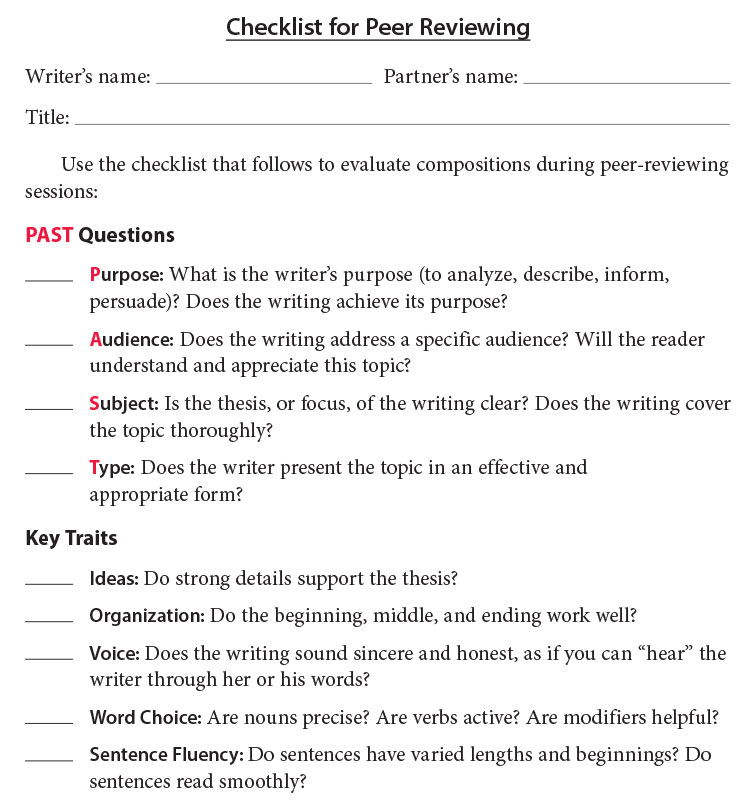
Revising with a Peer Response
Share your writing.
Have a trusted classmate read your definition essay and complete the form.
Revising in Action
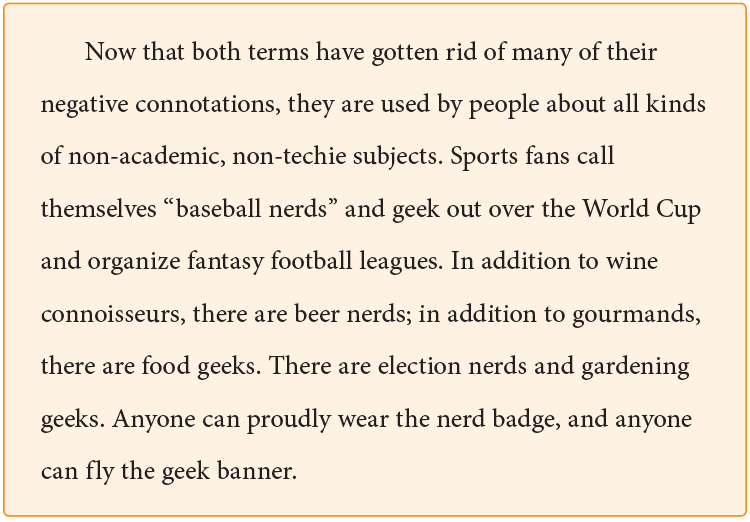
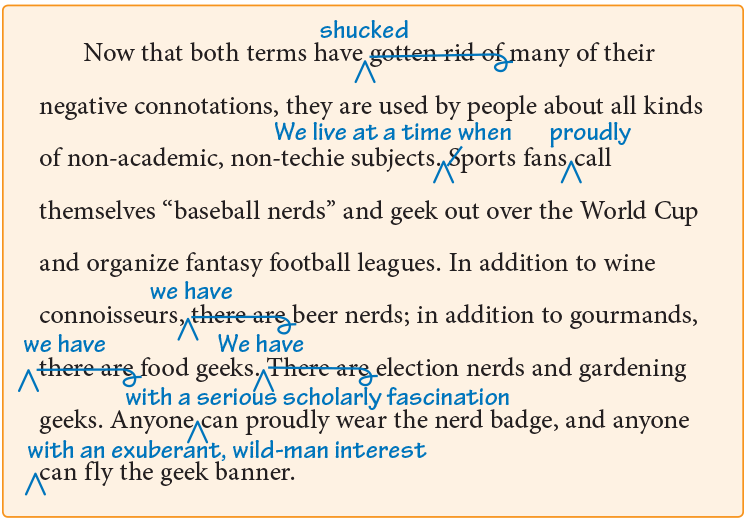
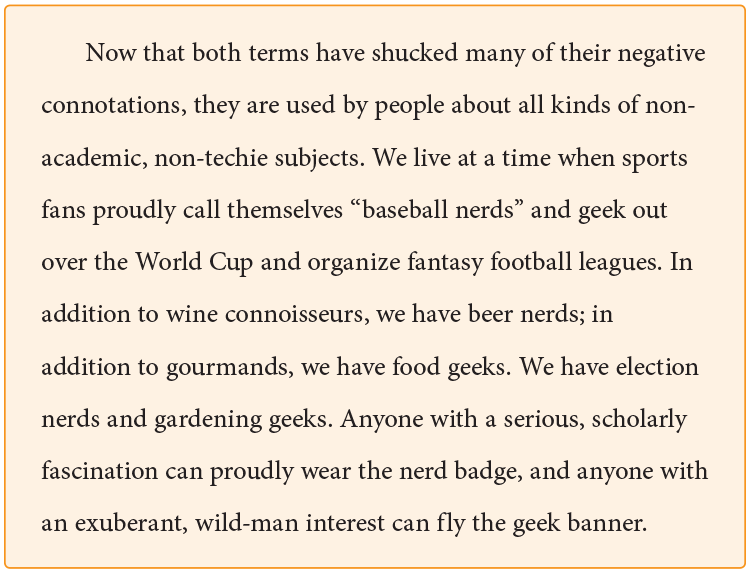
When you revise, you add, delete, rewrite, and rearrange your writing to make it clearer. Here are some revisions to "Get Your Nerd On."
-
Paragraph Before Revisions
-
We connects to readers, and strongly emotional words show interest in the topic.
-
Paragraph After Revisions
Revise with a checklist.
As you revise your definition essay, ask yourself the questions on this checklist. When you can answer a question yes, check it off. Continue revising until all questions are checked off.
- Does the essay focus on an interesting term or terms and provide an in-depth exploration of the meaning?
- Does the essay include a variety of effective details: denotation, connotation, etymology, examples, quotations, logic, and so on?
- Are the details well organized to lead the reader through a fascinating discussion of the term(s)?
- Does the voice connect to the reader and show real interest in the topic?
- Are words precise, with strong emotional impact?
- Are nouns specific, verbs active, and modifiers vivid?
- Do sentences read smoothly and vary in lengths and beginnings?
- Does the reader come away with a new understanding of and appreciation for the term(s)?