Revising Literary Analyses
After you have completed a first draft of your analysis, set it aside awhile. Once you get some distance from it, you can more objectively make improvements. Start by focusing on the large-scale issues: the ideas, organization, and voice in your writing. The following activities will help you.
Revising to Use Literary Present Tense
Sometimes you might struggle with the tense of verbs in a literary analysis. Do you say, "Richard Adams lived in Whitchurch, England" or "Richard Adams lives in Whitchurch, England," (when he is deceased)? Do you say "Richard Adams combined anthropomorphic fiction with naturalism" or "Richard Adams combines anthropomorphic fiction with naturalism"? And if you are in present tense for your main text, how do you handle quotations in past tense?
When you write a literature review, you should use literary present tense. This style of writing treats the piece of literature as something new and fresh whenever it is read rather than being something stuck in the past. Follow these rules to write effectively in the literary present tense:
When speaking about the work and the events in it, use the present tense.
When referring to historical events in the author's life or in the world at the time, use the past tense.
Keep the tense of quotations even if they do not match the surrounding text.
Keep the tense consistent, changing only if the content requires it (for example, shifting from a discussion of history to one of the text).
Revise for the literary present tense.
Review your first draft, checking the tense of each verb that you find. Do you remain in the literary present tense when discussing the work and the events and characters in it? Do you use past tense to talk about historical events surrounding the novel? Do you preserve the tense of quotations? Make changes to make tense consistent.
Revising to Improve Transitions
Transition words and phrases help to show the connections between ideas and create an effective flow of thought in your writing. If your first draft sounds choppy or confused, transitions can smooth out ideas. You also may need to move sentences into a better order. You can use different kinds of transitions to show different kinds of connections:
Time-Order Transitions
about
after
as soon as
at
before
during
finally
first
in the end
later
meanwhile
next
second
soon
then
to begin
today
tomorrow
until
yesterday
Location Transitions
above
across
against
along
among
around
behind
below
beneath
beside
between
by
down
in back of
in front of
inside
into
near
next to
on top of
outside
over
throughout
to the right
under
Comparisons and Contrasts
although
but
even though
however
on the other hand
otherwise
still
yet
as
both
in the same way
like
likewise
one way
similarly
Transitions to Add Information
additionally
again
along with
also
and
another
as well
besides
finally
for example
for instance
in addition
moreover
next
other
indeed
Note that many of these words can introduce phrases or clauses. For example, before can introduce a phrase like before the battle of Watership Down or a clause like before the rabbits had even sighted their new home. These groups of words also function as transitions.
Revise for transitions.
Reread your draft, listening for places that sound choppy or confused. For each place, come up with a transition that could smooth the flow of ideas. If no transition could smooth the flow, consider moving the detail to a more logical spot or deleting it altogether.
Revising with a Peer Response
Share your writing.
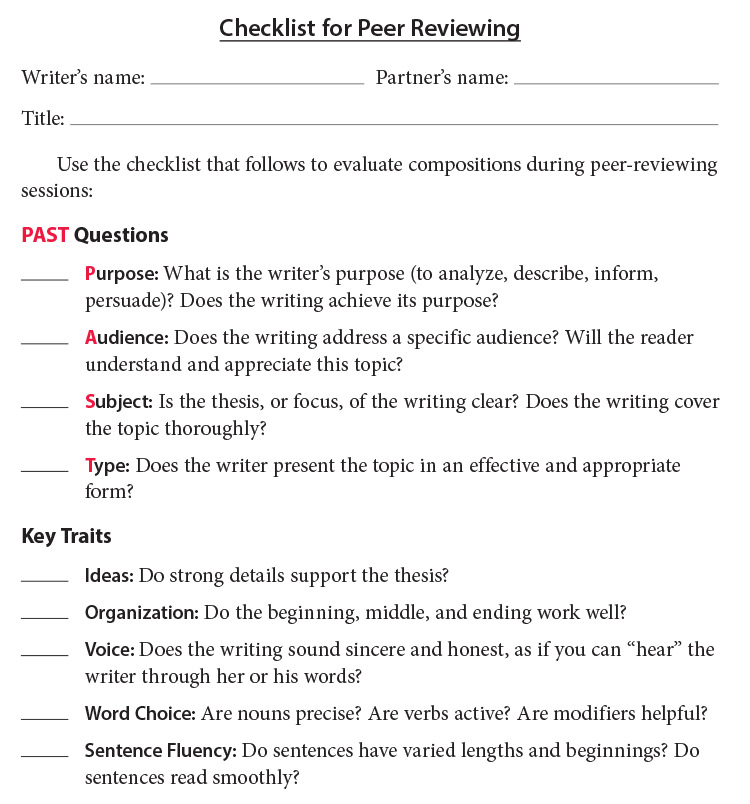
Have a trusted classmate read your review and complete the form.
Revising in Action
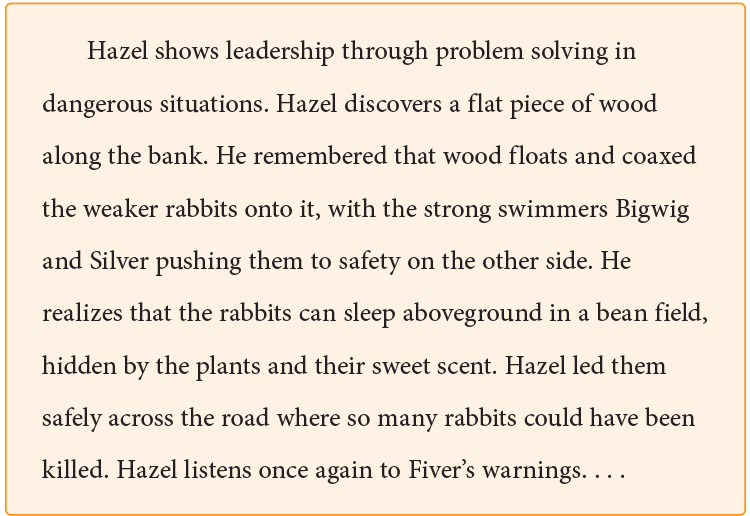
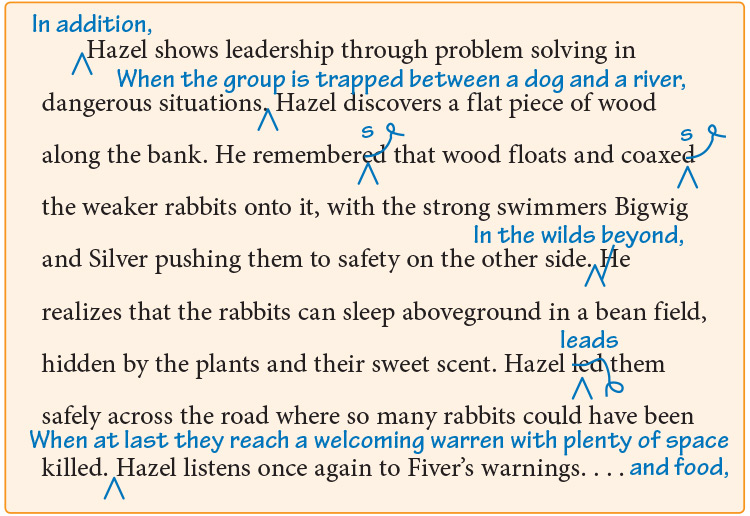
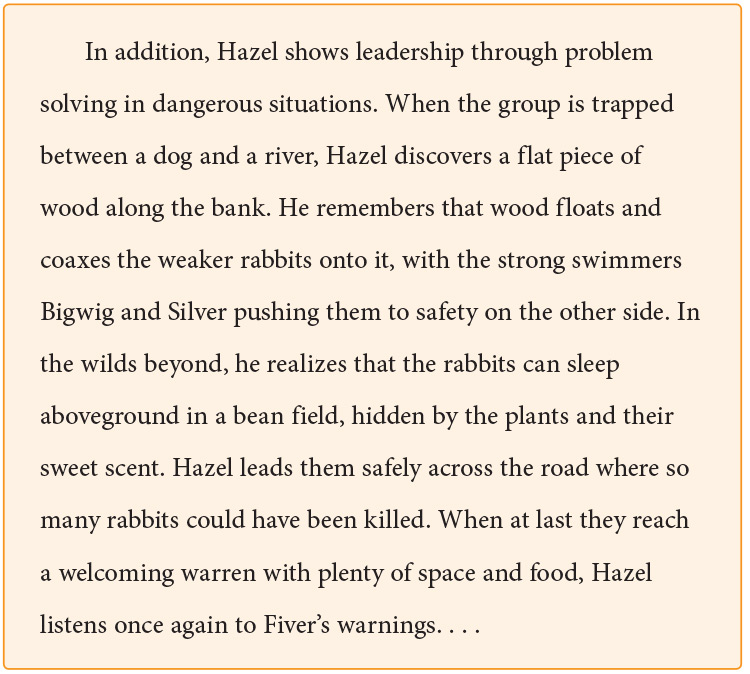
When you revise, you add, delete, rewrite, and rearrange your writing to make it clearer. Here are some revisions to the literary analysis of Watership Down.
-
Paragraph Before Revisions
-
Transitions smooth the flow and literary present tense is corrected.
-
Paragraph After Revisions
Revise with a checklist.
Read each line. When you can answer each question with a yes, check it off.
Developing Your Ideas
- Does the analysis have a strong lead that catches the reader's interest?
- Does the thesis statement clearly focus on one or more major elements of the literature and connect them to a major theme?
- Does the topic sentence of each body paragraph name a specific main point that supports the thesis?
- Does evidence from the literature provide solid support for the analysis?
- Do transition words and phrases connect ideas and create a smooth flow of thought?
- Does the voice sound knowledgeable and interested?
- Does the analysis consistently use literary present tense?
- Do the sentences read smoothly?