Revising Problem-Solution Essays
After you write a first draft, you'll be ready to start reviewing and revising. When you revise, you think about the "big picture," including the overall structure of your writing (beginning, middle, and ending) and the focus, main ideas, and supporting details you use. These activities will help you revise.
Revising to Choose Strong Support
In your problem-solution essay, strong reasons and supporting details will help you convince readers to care about the problem and agree with your solution. The best reasons and details are specific and tell something important about your subject.
Strong
A service project will make the park safer for play.
Weak
Cleaning will make the park better.
Choose strong supporting details.
Read the sentence pairs of supporting details. Put an “X” next to the sentence that is both specific and important.
- ___ Canceling gym class will be bad for kids.
___ Canceling gym class will make it harder for kids to stay in shape. X Canceling gym class will make it harder for kids to stay in shape. - ___ Kids will lose a safe place to play if the rec center closes.
X Kids will lose a safe place to play if the rec center closes.
___ Kids will lose out if the rec center closes. - ___ Reading books introduces you to new people and ideas.
X Reading books introduces you to new people and ideas.
___ You should learn about new people and ideas. - ___ Swimming lessons make your life better and help you a lot.
___ Swimming lessons help you stay afloat if you fall into water. X Swimming lessons help you stay afloat if you fall into water. - ___ The playground equipment is no good.
___ The playground equipment is rusty and unsteady. X The playground equipment is rusty and unsteady. - ___ Learning a second language teaches you about another culture.
X Learning a second language teaches you about another culture.
___ Learning a second language helps you learn about another language.
Revising to Fix Exaggerations
An exaggeration is a statement that stretches the truth. Exaggerations make writing sound less convincing. If a reader spots too many exaggerations in your essay, he or she might not believe what you are saying.
Cleaning up Rosemont Park will make it the nicest park in the entire world. All we need to do is clean up the giant mountain of trash. It’s so high you need climbing gear to reach the top.
You can fix an exaggeration by telling the truth. Be specific about problems and solutions. Don’t stretch the truth to make problems seem worse or solutions seem better.
Revise exaggerations.
Read the paragraph, noticing which sentences include exaggerations. Then rewrite the paragraph, changing the exaggerations to make them sound more believable.
Our school needs new gym equipment. We have the worst equipment in the history of the state. Our basketball goals have bent rims and no nets. We have like 1,000 worn down and deflated kick balls. Our jump ropes are fraying at the edges. Finally, I’m certain a hungry monster took a bite out of every Nerf ball.
Our school needs new gym equipment. We have the worst equipment in the history of the state. Our basketball goals have bent rims and no nets. We have like 1,000 worn down and deflated kick balls. Our jump ropes are fraying at the edges. Finally, I’m certain a hungry monster took a bite out of every Nerf ball.
Revising with a Peer Response
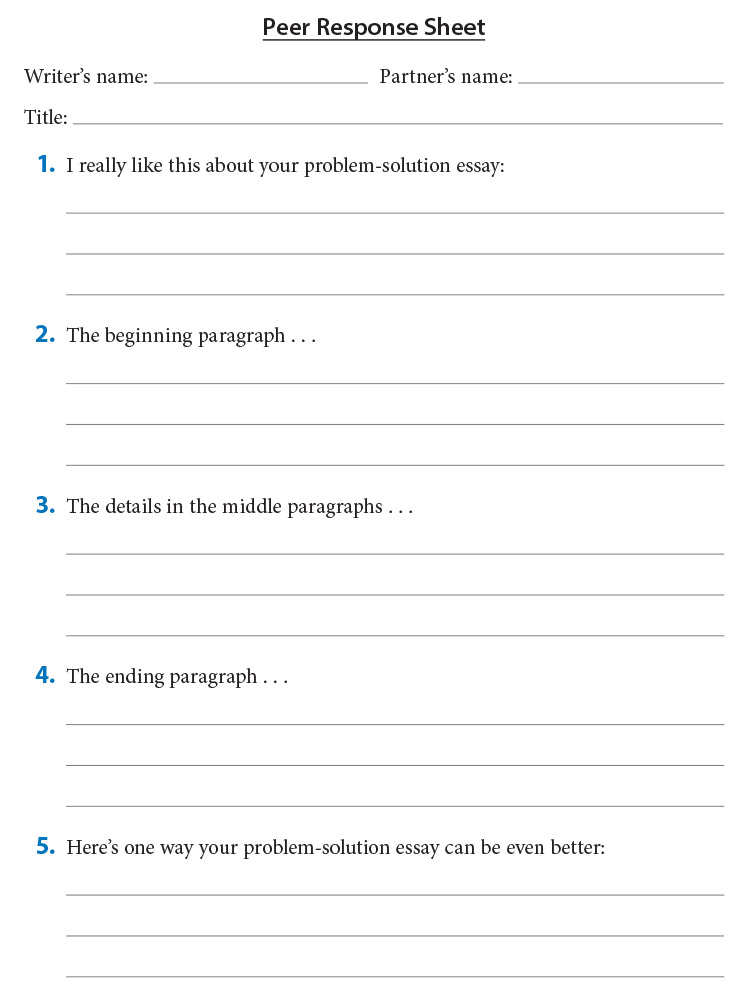
Share your writing.
Have a trusted classmate read your essay and complete the form.
Revising in Action
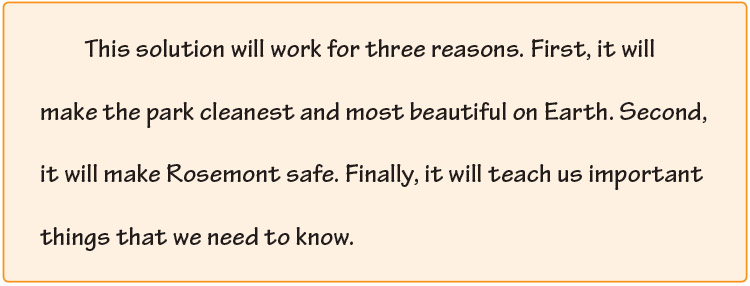
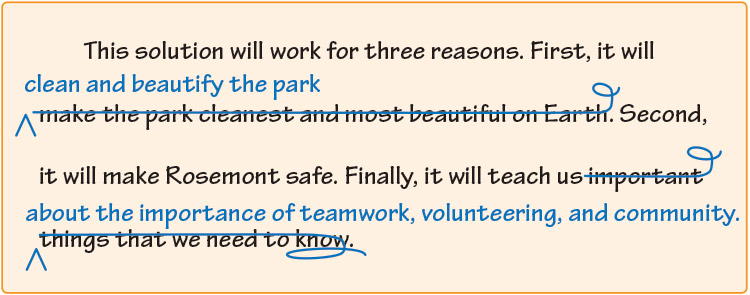
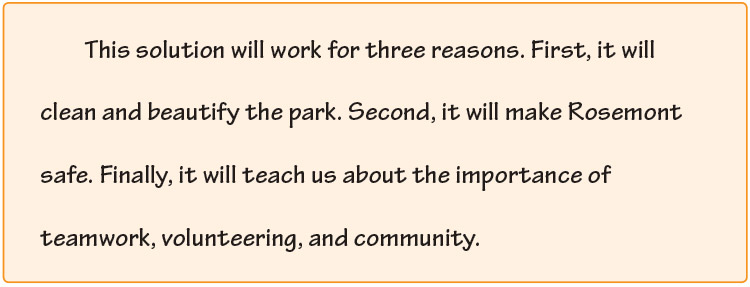
When you revise, you add, delete, rewrite, and rearrange your writing to make it clearer. Here are some revisions to “Restoring Rosemont Park.”
-
Paragraph Before Revisions
-
An exaggeration was fixed and a specific reason was added.
-
Paragraph After Revisions
Revise with a checklist.
Read each line. When you can answer each question with a yes, check it off.
Developing Your Ideas
- Does the essay address a current problem?
- Does it offer a solution to the problem?
- Is the opinion statement clear, using the word “should”?
- Do I feel strongly about my opinion?
- Do strong reasons and supporting details support the opinion?
Structuring Your Ideas
- Does the beginning paragraph start with an interesting lead?
- Does the beginning paragraph end with a clear opinion statement?
- Do the middle paragraphs explain the seriousness of the problem, offer a solution, and show why the solution will work without exaggerating the truth?
- Does the ending paragraph end by calling readers to action?
- Do transitions connect ideas?