Warm-Up for Problem-Solution Writing
When you search for a job, you'll see that employers seek "self-starters" who are "goal-oriented" and "collaborative team members," people who thrive in a "dynamic workplace environment" and take on "diverse challenges." Employers seek problem solvers.
That's a secret to success not just on the job but in life itself: Be the solution person instead of the problem person. The world is filled with problems and with people who love to focus on them. Become one of those rare people who loves to devise solutions—fixing problems and improving life for everyone.
In this unit, you will write an essay that closely analyzes a problem in your community, proposes a specific solution, and argues to convince the reader that it will work. As you develop your essay, you will use the problem-solving process.
What Is the Problem-Solving Process?
Listen to "What Is the Problem-Solving Process?"
Hide audio

The problem-solving process is a series of steps that carries a person from knowing little about a problem to creating a satisfying solution. This process switches back and forth between critical and creative thinking, following steps like these:
- Analyze the problem, exploring causes and effects (critical thinking).
- Brainstorm solutions—ways to remove or reduce causes and effects (creative thinking).
- Evaluate possible solutions and choose the best one (critical thinking).
- Create a plan for implementing the solution (creative thinking).
- Apply the plan, evaluating each part (critical thinking).
- Revise, refine, and perfect the solution (creative thinking).
You'll use the problem-solving process right along with the writing process as you create your essay. In fact, they are related. The writing process is one version of the problem-solving process—the steps that take you from knowing little about your topic to having an effective final essay. The lessons in this unit will guide you through both processes. You can get started by thinking about the problems all around you.
Thinking About Problems
"Problem" is a big word. It can refer to something as simple as a hang-nail and something as complex as the national debt. One way to start thinking about problems, big and small, is to focus on "pain points." A pain point is simply something that causes you discomfort. It could be a squeaky desk in second hour. It could be the fact that your best friend is moving to Tucson. Both are problems that need effective solutions.
You can brainstorm pain points in your life by creating a cluster. In the center of a piece of paper, write the words "Pain Points" and circle them. Around that circle, write things that cause you discomfort, and circle those things as well. Let your thoughts spin outward, exploring more and more specific examples of these pain points. Here is one student's cluster.
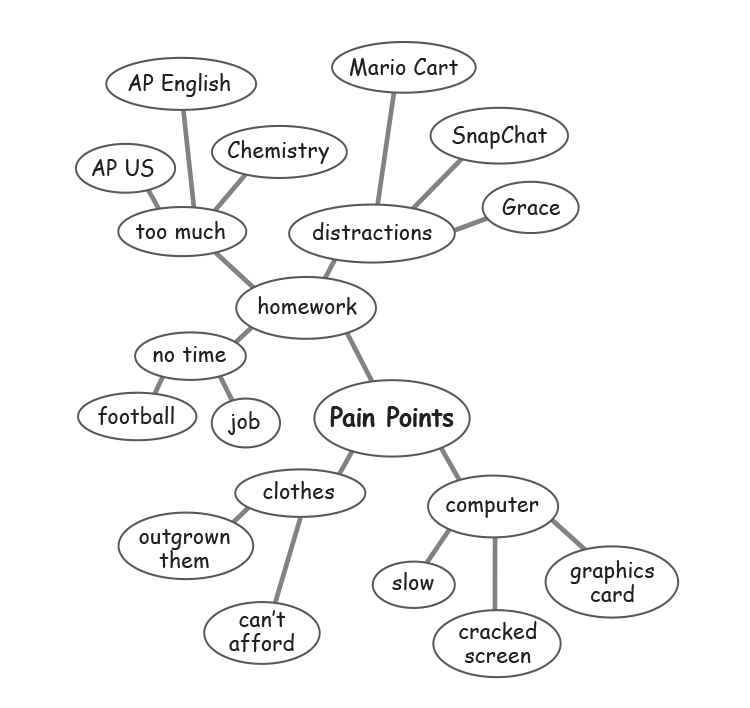
Think about pain points.
Write "Pain Points" in the center of a piece of paper and circle the words. Around the circle, write things that cause you discomfort. Connect specific examples to your cluster.
Brainstorming Solutions
After you have explored the pain points in your life, you might feel a bit overwhelmed. That's a whole cluster of problems! But you can solve some of those problems to reduce your pain points.
You can start by reviewing your cluster and picking out a problem that you would like to solve. Then you can list causes and effects of the problem—why the issue happens and why it is such a nuisance. After you have explored causes and effects, you can brainstorm ways to eliminate some or all of them. That's a solution.
The student who created the cluster above decided to focus on the problem of distractions when doing homework. A T-chart let the student list causes and effects of the problem in the left-hand column and brainstorm solutions in the right-hand column.
Problem: Homework Distractions
|
Causes/Effects |
Solutions |
|
Homework is never as interesting as video games. |
I could spend an hour on homework, take a 15 minute video-game break, spend another hour on homework, and so on. |
|
Grace wants a lot of my time. |
We could have study dates at the coffee house. |
|
SnapChat keeps interrupting homework. |
I should just put my phone away. I can check it during video-game breaks. |
|
Jaxon always wants to talk to me when I'm working on homework. |
I can work in my room with the door closed. |
Brainstorm solutions.
Pick a problem you want to solve and write it at the top of a T-chart. In the left-hand column, list causes and effects of the problem. In the right-hand column, write ways to lessen or eliminate the causes/effects.
Teaching Tip
This activity gives students a beginning sense of problem solving with everyday issues. They can apply this simple strategy to make their lives better in small terms, but these same skills will help them take on much bigger, more complex problems as well.