Editing Character Analyses
After revising your character analysis, you should next carefully edit it for correctness. Editing involves reviewing your punctuation, capitalization, spelling, and grammar. The following activities will help you work through important editing issues.
Editing Common Comma Errors
In the last lesson, you learned how to combine sentences to improve the flow of your writing. In this lesson, you'll review how to avoid three common comma errors that can occur when you combine sentences.
- Missing Comma in a Compound Sentence: When you combine two sentences (independent clauses) using a coordinating conjunction (and, but, or, nor, for, so, yet), always place a comma before the conjunction.
Manuel gave swimming lessons to Sam, and Lupita coaxed him into the wave pool.
Note: Without the comma, this compound sentence could be misread as "Manuel gave swimming lessons to Sam and Lupita . . .
- Missing Comma in a Series: Use commas to separate three or more words, phrases, or clauses, in a series.
I want to thank my parents, Spock, and Serena Williams.
Note: Without the final comma, this sentence could be misread as "I want to thank my parents, Spock and Serena Williams (the parents are Spock and Serena Williams?).
- Missing Comma After Long Introductory Phrases or Clauses: Place a comma after a long introductory phrases or clauses before the main part of sentence.
In the middle of the night, the neighborhood was usually very quiet.
When I heard a thump and shout, the pounding of my heart filled the room.
Note: Without the comma, the opening clause gets confused with the subject: "a thump and shout the pounding of my heart . . ."
Add missing commas.
Add the missing commas where needed in the following sentences.
-
Amazon ants are fierce, but fire ants are even fiercer.
-
An owl cannot move its eyes, so it must move its whole head to look in different directions.
-
To compete in the Olympics, Maria must train for years.
-
If you are interested in trying snowboarding, you should rent equipment before buying it.
-
Imagine life without antibiotics to fight infections, vaccinations to prevent diseases, or scanners to diagnose our illnesses.
-
The curtain parted to reveal Childish Gambino, and the crowd clapped and screamed loudly.
-
Yellowstone, Glacier, and Yosemite National Parks protect complex ecosystems that might otherwise be lost forever.
-
Blue whales are the largest living creatures, and Galapagos tortoises have the longest life span.
-
Because mountain climbers often endure many weather changes, they wear multiple layers of clothing.
-
Mammals have red blood, and insects have yellow blood.
Editing Titles
When you write about literature, you should include the titles of the specific works you are discussing. Two editing issues you need to consider with titles are (1) what words to capitalize and (2) whether to italicize the title or surround it with quotations marks.
In general, you'll want to follow these rules:
- Italicize (or underline) titles of larger works (books, movies, TV shows—whole works), and use quotation marks around smaller works (articles, poems, short stories, speeches—parts of whole works).
- Always capitalize the first and last words in titles.
- Also capitalize important words in between, including short verbs (is, was, and so on) and personal pronouns and possessives (me, hers, it, you, my, our, and so on).
- Don't capitalize articles (a, an, and the), coordinating conjunctions (and, but, or, nor, for, so, and yet), and very short prepositions (with, in, to, into, from, of, and so on) in this middle of titles.
All the Wind in the World (book)
"The Road Not Taken" (poem)
Edit titles.
Capitalize the appropriate words in the following titles. Then determine if the title is a larger work or smaller work. Italicize (or underline) the larger works, and insert quotation marks around smaller works.
-
Harry potter and the sorcerer's stoneHarry Potter and the Sorcerer's Stone (Book)
-
mending wall"Mending Wall" (Poem)
-
I have a dream"I Have a Dream" (Speech)
-
Raiders of the lost arkRaiders of the Lost Ark (Movie)
-
to kill a mockingbirdTo Kill a Mockingbird (Book)
Editing in Action
When you edit, you check sentences, punctuation, capitalization, spelling, usage, and grammar. You make corrections to ensure that your work is error free.
-
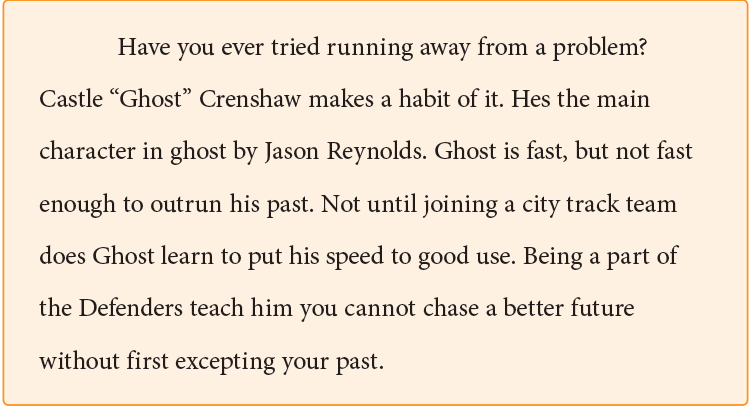
Paragraph Before Edits
-
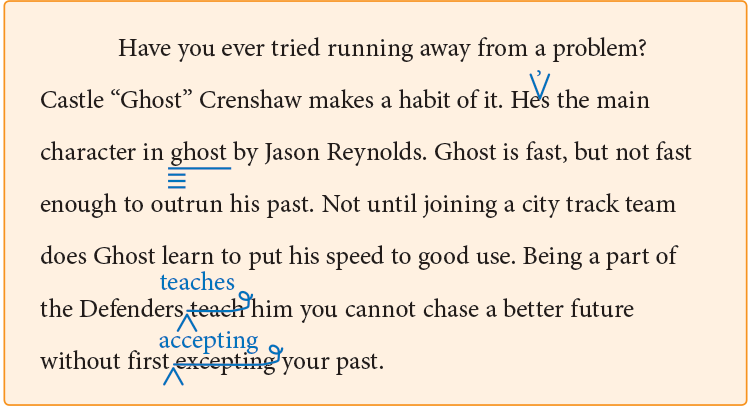
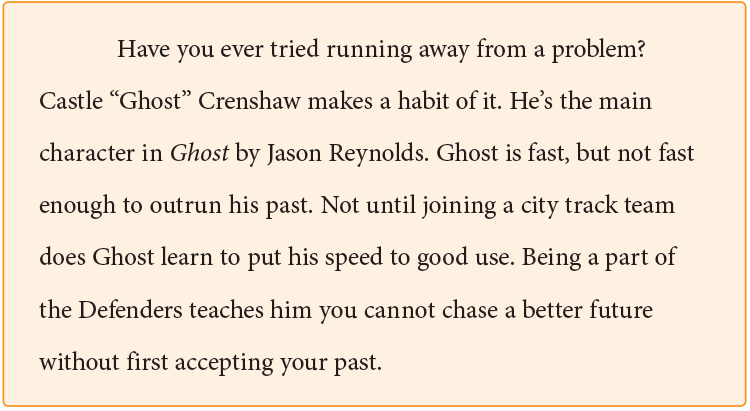
Agreement and usage errors are fixed as well as missing capital letters and commas.
-
Paragraph After Edits
Edit with a checklist.
Read each line. When you can answer each question with a yes, check it off. Continue editing until each line is checked.
Sentences
- Are sentences correct, without run-ons, comma splices, or fragments?
Punctuation
- Do commas appear before connecting words (and, but, or, nor, for, so, yet) in compound sentences?
- Do commas follow introductory clauses and longer introductory phrases (four words or more)?
- Do double quotation marks surround exact words taken from the literature?
- Are the titles of book-length literature in italics and titles of short stories in quotation marks?
Mechanics
- Does each sentence start with a capital letter?
- In titles, are the first and last words capitalized as well as all words in between except coordinating conjunctions (and, but, or), articles (a, an, the), and short prepositions (in, of, at, with, on)?
- Have I checked spellings of the names of characters and locations in the literature?
- Have I checked spelling using a dictionary or the spell checker on my computer?
Grammar
- Do subjects and verbs agree? (Nina sings, not Nina sing.)
- Do pronouns and antecedents agree? (The boys clapped their hands, not The boys clapped his hands)
Usage
- Are commonly confused words used correctly (your/you’re, their/they’re, its/it’s)?
Publishing Character Analyses
Publishing is simply the act of making your work public. That's why publishing takes so many different forms. First, you need to make a clean final copy of your work. Then you should find ways to share your writing with classmates, your teacher, your family, and your friends.
Publishing a Final Copy
Create a final copy of your analysis.
Include your revising and editing changes and read over your work a final time. (If you are working on a computer, spell-check your work.)
Reflecting on Your Writing
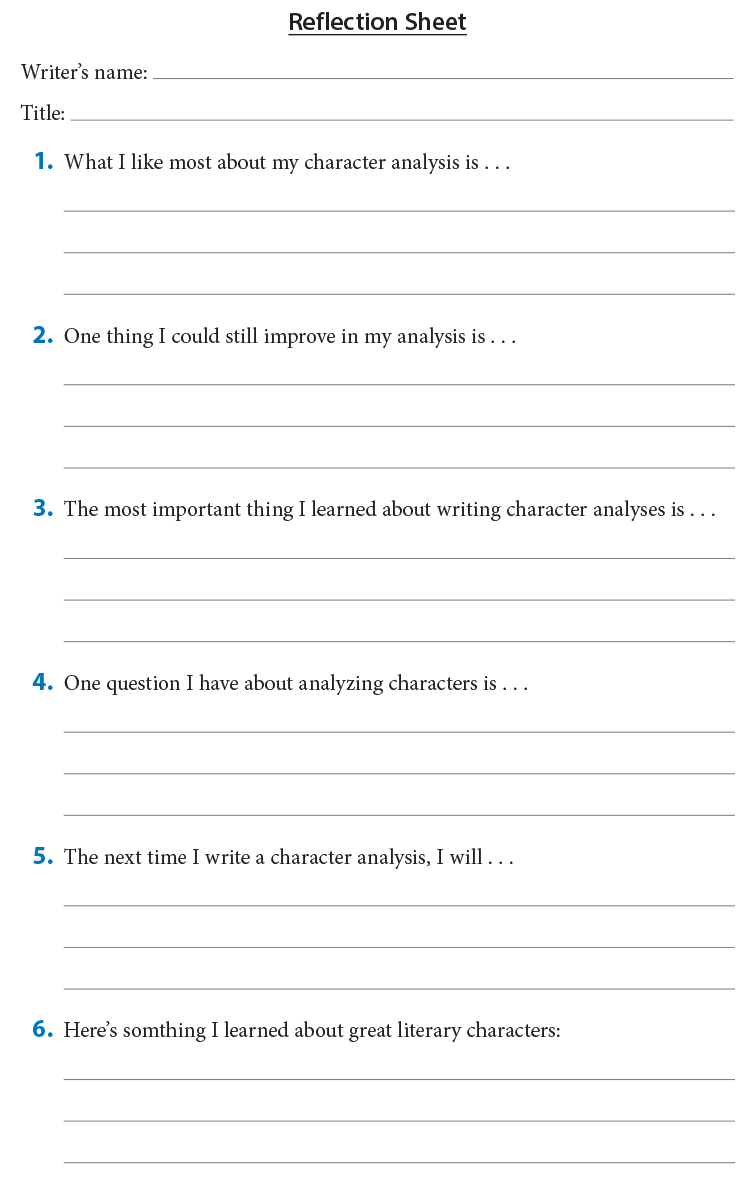
Reflect on your writing.
Complete the following sheet to reflect on analyzing characters from literature.