Prewriting for Literary Analysis
Sometimes, the hardest part of writing is getting started. The prewriting ideas in this lesson will get you moving. These prewriting lessons will help you draw ideas and details from your reading and focus and plan your analysis.
Prewriting to Select a Work
Your teacher may assign a certain work of literature for you to analyze, or you may get to choose your own. If you need to choose between multiple works, create a chart to gather topic ideas. Then select the topic for your analysis.
|
Story and author |
What is the story about? |
What is the main character like? |
|---|---|---|
|
"Thank You, Ma'm" by Langston Hughes |
A boy tries to rob an old lady, but she drags him home. |
Roger is a tough kid until he gets caught. |
|
"Helen on Eighty-Sixth Street" by Wendi Kaufman |
A girl tries to understand why her dad went away. |
Vita is very smart. |
|
Roll of Thunder, Hear My Cry by Mildred D. Taylor |
A young girl learns important lessons about discrimination. |
Cassie is bold and daring. |
Fill in a topic-ideas chart.
Fill in the chart with topic ideas for your literary analysis. Review your answers, and choose one work to analyze.
Prewriting to Focus on Literary Elements
All fiction has a number of common elements: characters, plot, setting, and theme. You can ask questions about each element to gather details about the work you chose. You may need to reread portions of the work in order to fully answer qustions.
Answer questions about literary elements.
Answer the following questions about the literary elements in your work. Reread as needed.
Characters
- How does the main character change from the beginning to the end of the story?
- What is the character's best trait? Worst trait?
Plot
- What conflict(s) occur in the story?
- What is the most important event in the story, and how is it resolved?
Setting
- How does setting impact the main character?
- How would the story be different if it were set at a different time and place?
Theme
- What life lessons does the main character learn?
- What moral did the story teach you?
Choose a focus.
Review your answers to the previous activity. Choose one element as the main focus of your analysis and write it below. (Your analysis will probably also refer to other elements.)
Prewriting to Explore Your Focus
Now that you have selected a focus for your review, you can explore the focus by creating a cluster. Here is a cluster about the character of Cassie in Roll of Thunder, Hear My Cry.
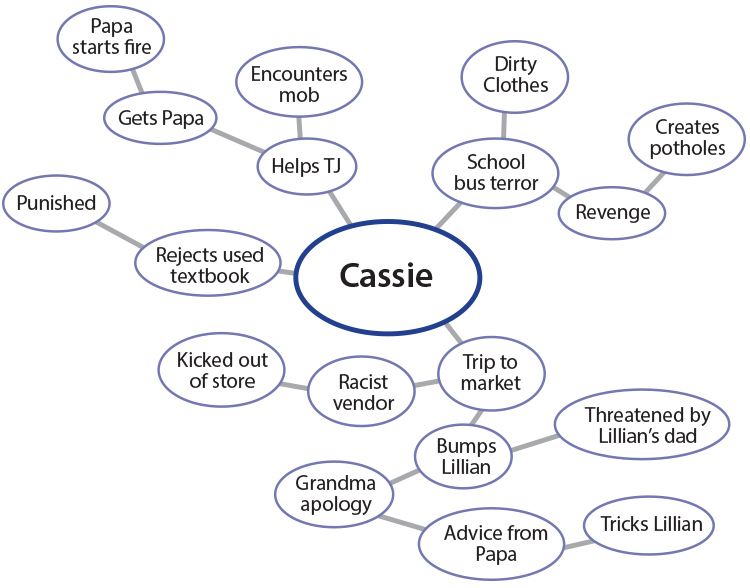
Explore your focus.
Write the focus of your literary analysis in the center of a piece of paper and circle it. Around it, write details from the literature and connect them to the focus. Gather as many connections as you can.
Teaching Tip
Clusters allow students to create a nonlinear, networked set of ideas. Instead of organizing their thoughts in a time line or outline, they can create an interconnected web of associations. Thinking in this diverse way helps students discover themes hidden within interrelated elements of literature.
Prewriting to Create a Thesis Statement
After gathering evidence about your focus(s), you should write a working thesis statement to focus your thinking. The thesis statement should name the focus of your essay and provide an important insight or feeling about it.
Write a thesis statement.
Write down the focus of your analysis and an interesting thought or feeling about it. Then combine both into a single sentence that expresses your thesis.
Focus(es) |
+ |
Thought or Feeling |
= |
Thesis Statement |
|
Cassie |
learns why her family's land is so important in the struggle against injustice |
Cassie’s experiences with injustice teach her why a tract of land in rural Mississippi is so important and why her family protects it so fiercely. |
Prewriting to Find Direct Evidence
You should support your thesis by gathering details from the reading. Jot down important actions and consequences, lessons learned, and quotations that reveal something about your thesis. Write each quotation word for word within quotation marks and record the page number where it appeared.
Fill in an evidence chart.
Use an evidence chart to jot down key plot points, lessons learned, and quotations that support your thesis.
Story title:
Roll of Thunder, Hear My Cry
Thesis statement:
Cassie’s experiences with injustice teach her why a tract of land in rural Mississippi is so important and why her family protects it so fiercely.
|
Key plot points |
Lessons learned |
Quotations |
|---|---|---|
|
School bus runs kids off the road. Cassie faces discrimination at the market. Cassie bumps into Lillian. Racist grocery discriminates; Logan family responds. Mob surrounds TJ; Cassie's dad makes huge sacrifice to saves him. |
Young people can be targets of racism. Choose battles wisely. Respond to injustice thoughtfully. Show courage and resolve in face of adversity. Uphold family values and code of conduct. |
“You ain’t never had to live on nobody’s place but your own and long as I live and the family survives, you’ll never have to. That’s important. You may not understand that now, but one day you will” (7). “There’ll be a whole lot of things you ain’t gonna wanna do but you’ll have to do in this life just so you can survive” (175). “You have to demand respect in this world, ain’t nobody just gonna hand it to you” (176).   |