Revising Argument Essays
During a verbal argument, you have to respond in the moment, so you often have regrets afterward: "I wish I had said ________. I wish I hadn't said ________. " In an argument essay, you don't need regrets because you can add whatever you left out and remove whatever you shouldn't have said. That's revising. You can also eliminate any faulty logic and make sure your voice is persuasive. The following activities will help.
Revising to Avoid Logical Fallacies
From the first Greek philosophers to today, thinkers have been on the lookout for specific flaws in reasoning—logical fallacies. These errors crop up constantly in advertising, political debates, and lunchroom discussions. You should learn to recognize the following forms of fuzzy logic in the thinking of others and eliminate them from your own thinking.
Logical Fallacies
Ad Hominem Attack
"Ad hominem" is Latin for "to the person." An ad hominem attack goes after the person making the argument instead of the argument itself. Keep personalities out of the issue and instead focus on the controversial topic.
Fallacy: It's not surprising Jake from Jake's Roadhouse opposes food trucks since Jake is a selfish crook.
Better: It's not surprising restaurant owners oppose food trucks, but they should not be allowed to prevent fair competition.
Appeal to Ignorance
An appeal to ignorance cites a lack of evidence as if it were evidence. Support your argument with actual facts, statistics, examples, and so on.
Fallacy: No one has any idea whether food trucks would cause a problem in Waterford, so we can't outlaw them.
Better: Upper Forks, a city about the size of Waterford, passed a balanced food-truck ordinance, and five years later, their brick-and-mortar restaurants are thriving due to the new foodie culture.
Bandwagon
Long ago, people promoting a specific cause would put a band on a wagon and march through town with it, handing out pamphlets urging people to join the cause. The modern bandwagon fallacy is telling people they should do or believe something because everyone else is. Remember, a mob is often wrong. Instead, use careful logic and truthful examples to show why your position is strong.
Fallacy: All of our neighbor cities allow food trucks, so we should also.
Better: We can study the food truck ordinances and operations in our neighbor cities to learn what works and what doesn't before we create our own law.
Broad Generalization
A broad generalization occurs when one limited case is taken to represent all cases everywhere. Instead, present a complete picture of the situation.
Fallacy: Every student at my lunch table would rather eat from a food truck than have another cafeteria meal, so all of Waterford is crying out for this change.
Better: A recent survey by the Waterford Examiner showed that 73 percent of citizens polled indicated a desire to have food trucks available within the city.
Circular Reasoning
Circular reasoning starts and ends in the same place. The givens of the argument are the same as the conclusions. Instead, your argument should start with givens that even opponents would agree with and should use logic and evidence to convince them of your conclusion.
Fallacy: The Nation Food Truck Association, the leading advocate for unrestricted mobile food service vending, recommends that food trucks have no restrictions in terms of operation.
Better: A recent study by the U.S. Food and Drug Administration outlined five key components for successful food-truck regulation.
Genetic Fallacy
The genetic fallacy argues that the origin of something dictates its current reality. Just because Thursday began as "Thor's Day" doesn't mean lightning storms are more common then. Deal with the current reality of the issue.
Fallacy: We all know what food-trucks are: claptrap hotdog carts spreading indigestion and obesity one student at a time.
Better: Though historically food trucks have sold only junk food at high prices, today's food trucks often offer diverse, healthy fare prepared by chefs—at competitive prices.
Half-Truth
A half-truth knowingly presents only one side of an issue with two or more sides. Be sure to provide a complete picture. If you ignore information that does not support your view, you weaken your position by opening yourself up to attack.
Fallacy: Consumers win when they have more dining options, so we should allow food trucks into the city.
Better: Consumers win when they have more dining options, but providers of dining options must have a fair marketplace in which to compete for consumers. That's why careful regulation of food trucks is key.
Jumping to Conclusions
Avoid making conclusions that are not supported by logic and strong evidence. Help readers follow each step of your argument along the way.
Fallacy: Gas prices are rising, so food trucks won't create any competition for restaurants.
Better: Rising gas prices, inclement weather, vehicle maintenance, and the struggle to stock and run a fully-functioning kitchen in a tight space make food-truck operation a different challenge from restaurant operation.
Oversimplification
Oversimplification renders a complex situation as if it were simple. Embrace complexity as you make your argument.
Fallacy: A vote against food trucks is a vote against free enterprise. It's a vote against America.
Better: A vote to ban food trucks outright would limit competition and thereby reduce food options and raise prices.
Slanted Language
Slanted language uses highly positive or highly negative terms in order to make disagreement impossible. Show your commitment to your position, but use fair language when representing it and opposition to it.
Fallacy: Greedy restaurant owners are trying to rig the marketplace so that they can get rich off us while still cooking the same horrible food.
Better: Restaurant owners understandably want to prevent unfair competition, but fair competition will only push them to improve their offerings and prices.
Straw Man
Medieval knights used to practice by slashing at a scarecrow that represented their foes. In an argument, a straw man is an absurd position that opponents don't actually hold, set up only so that the writer can easily strike it down. Instead, fairly represent the opposing position before defeating it.
Fallacy: People who want to ban food trucks want to keep everybody eating fast food and paying high prices.
Better: People who want to ban food trucks fear unfair competition, so they should help craft legislation that ensures a level playing field.
Check for logical fallacies.
Review your argument essay, watching for any of these logical fallacies. If you find one, place a question mark in the margin beside it. Then return to rework or cut the faulty logic.
Teaching Tip
As an extension activity, have students search for these logical fallacies in advertising and political tweets and speeches. Have them write down any examples they find and rework the material to remove the fallacy. Consider giving a point of extra credit for each three examples they find and fix.
Revising to Improve Voice
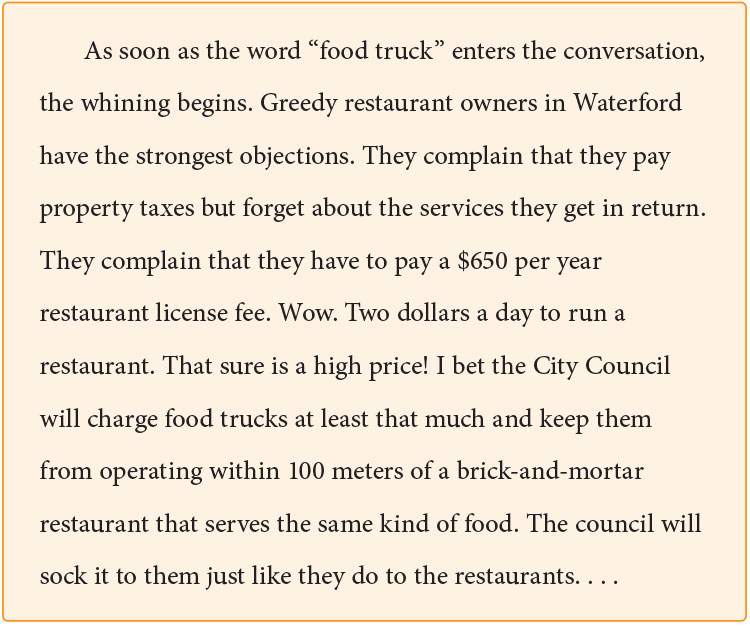
Among the logical fallacies in the last activity, you learned to avoid slanted language, which unfairly presents the issue. That fallacy weakens your position because it shows readers that you are being unreasonable.
To create an effective argument, you should instead use three kinds of reasonable appeals:
- Appeal to logos means using logic to argue for your position. Readers are persuaded by a fair, clear, logical argument.
- Appeal to ethos means using ethical language to represent each point of view. Readers are persuaded by a writer who argues reasonably for a specific conclusion.
- Appeal to pathos means showing the right level of emotion. You should be committed to your position (neither rabid nor disinterested) while at the same time showing concern for the position of opponents (neither hypercritical nor dismissive).
-
Paragraph with Ineffective Persuasive Voice
-
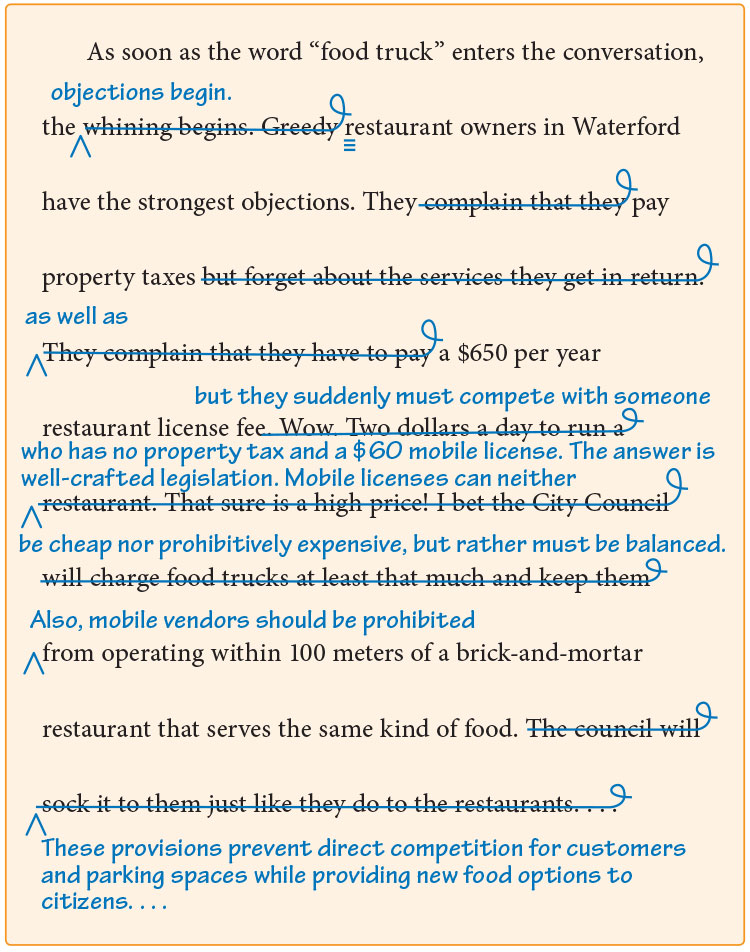
Appeals to Logos, Ethos, and Pathos
-
Paragraph with Effective Persuasive Voice
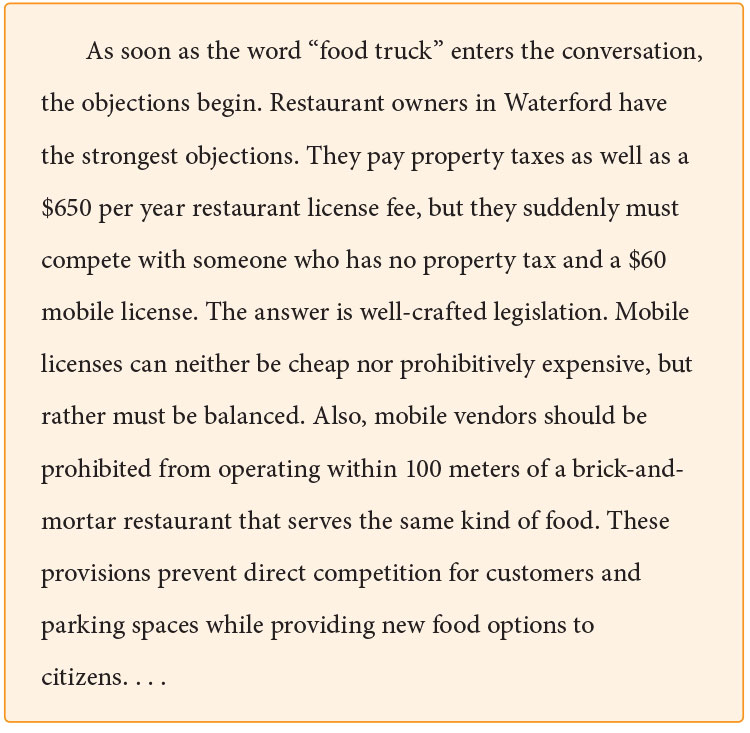
Improve persuasive voice.
Rewrite each problem passage below to make the voice more persuasive. Then review your argument essay, making sure that you use logic, treat the issue ethically, and show commitment to your position and concern for those who oppose you.
- Next the mothers start whining about all the junk food their kids will eat from food trucks instead of the cafeteria.
- The cops should just arrest junk food truck drivers if they come close to a school.
- People complain about all the trash that'll be thrown into the gutters.
- Tell the food truck drivers they have to clean up the mess or get fined!
- Did everybody forget about trash cans just because food trucks showed up?!
Revising with a Peer Response
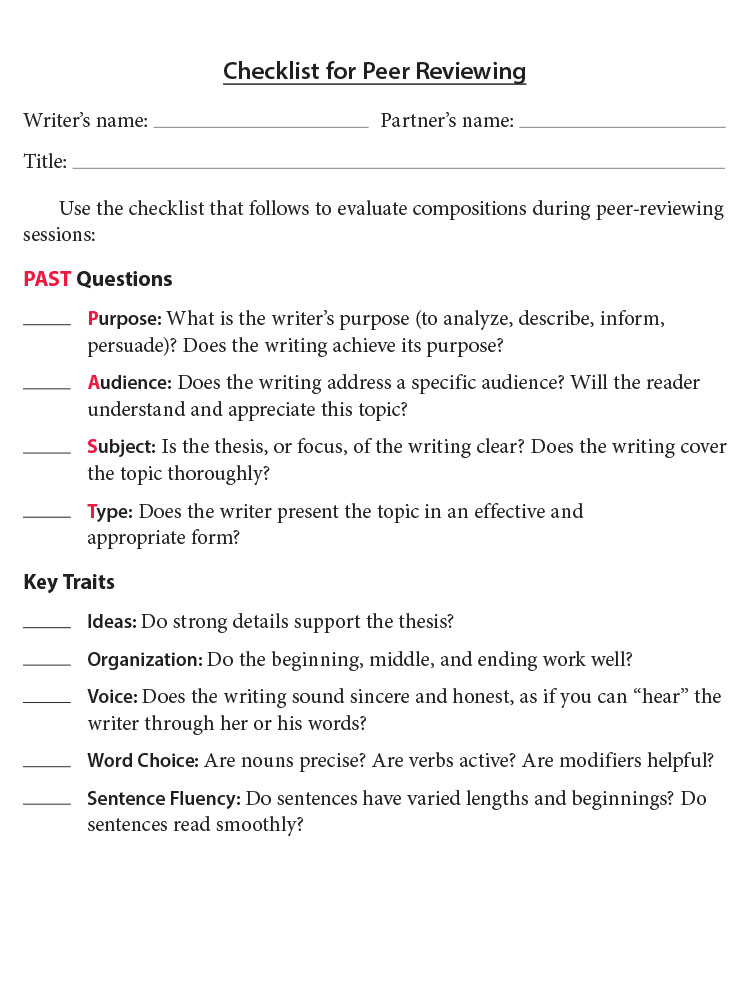
Share your writing.
Have a trusted classmate read your personal essay and complete the form.
Revising in Action
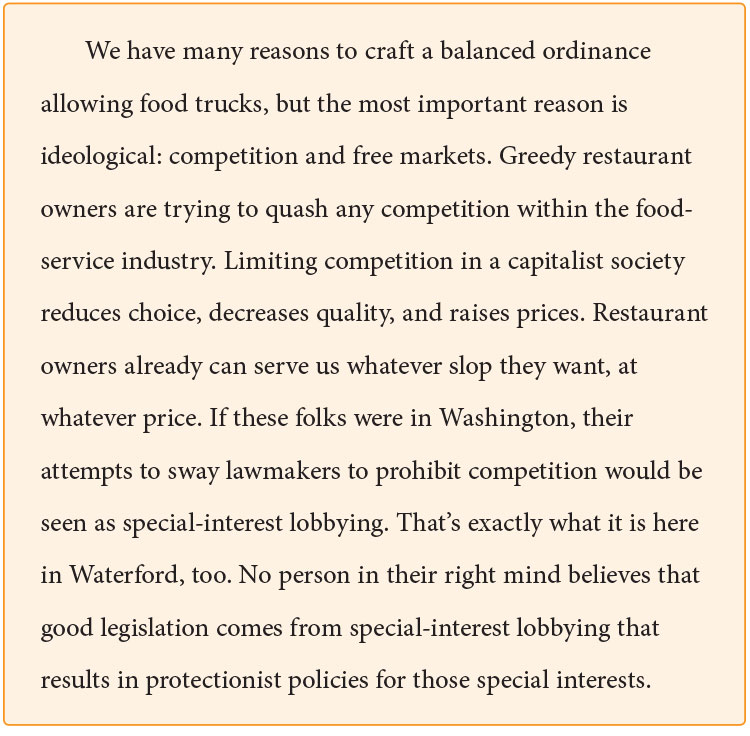
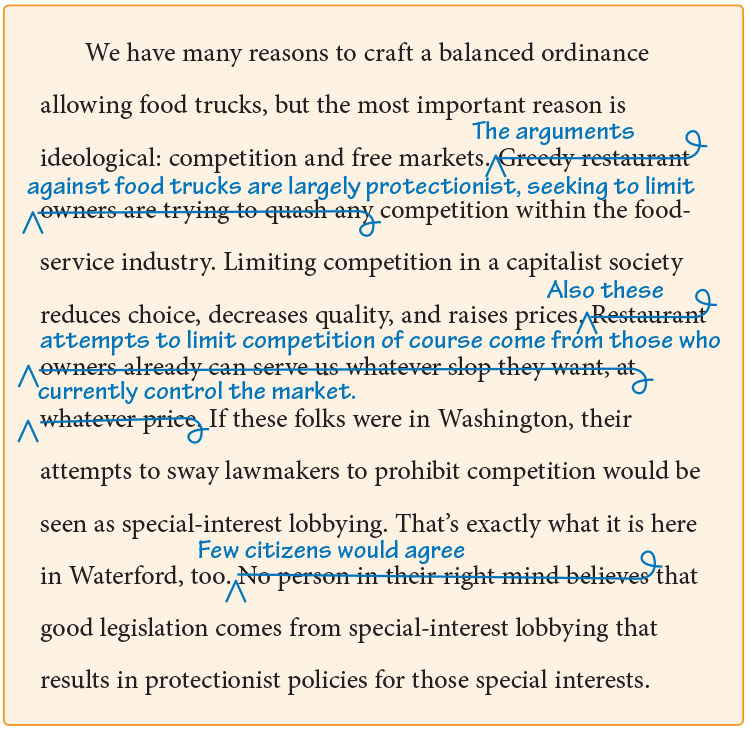
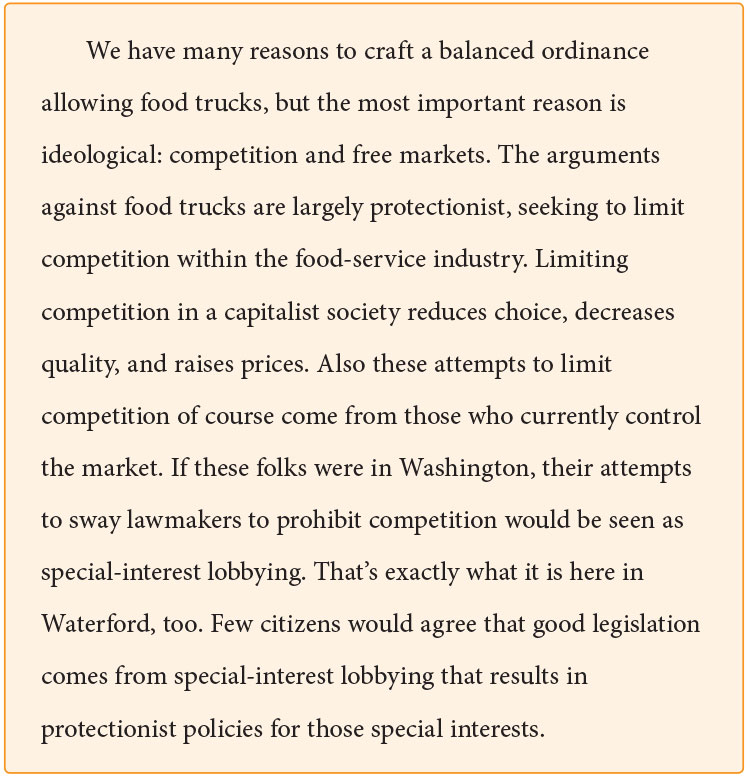
When you revise, you add, delete, rewrite, and rearrange your writing to make it clearer. Here are some revisions to "Moveable Feast."
-
Paragraph Before Revisions
-
Revisions remove slanted language, introduce logic, and improve voice.
-
Paragraph After Revisions
Revise with a checklist.
As you revise your argument essay, ask yourself the questions on this checklist. When you can answer a question yes, check it off. Continue revising until all questions are checked off.
- Does the beginning capture the reader's attention and present a clear position statement?
- Do middle paragraphs present strong reasons that support the position and develop these reasons using facts, statistics, examples, and other details?
- Does the essay answer objections early (resistant audience) or later (receptive audience)?
- Does the ending summarize the argument and encourage the reader to agree or take action?
- Does the argument use strong logic and avoid logical fallacies?
- Is the voice persuasive, showing the writer's investment in the position while ethically treating the issue?
- Do sentences read smoothly and vary in lengths and beginnings?