Prewriting for Literary Analyses
Did you ever sit down and stare at a blank screen and think, "I have no idea what to write about"? Prewriting helps you know what to write about. During prewriting, you gather ideas, think, plan, outline, scribble, and do whatever else you need to do so that you do know what to write about. These activities will help you fill that blank screen.
Prewriting to Select a Work
You may already know what story or novel you want to write about. If not, answering a set of questions can give you some options:
1. What literary work have you read most recently?
Animal Dreams
2. What literary work was the most challenging to read?
The Odyssey
3. What fiction work do you love that is not a novel or story?
Romeo and Juliet
4. What literary work is the most perplexing to you?
A Farewell to Arms
5. Who is your favorite author, and what is that person's best work?
Richard Adams, Watership Down
6. What literary work has the best characters?
The Count of Monte Cristo
Select a work to analyze.
Answer the following questions to think about possible works that you could analyze in an essay. Afterward, review your answers and pick the work you would most like to analyze.
1. What literary work have you read most recently?
2. What literary work was the most challenging to read?
3. What fiction work do you love that is not a novel or story?
4. What literary work is the most perplexing to you?
5. Who is your favorite author, and what is that person's best work?
6. What literary work has the best characters?
Prewriting to Gather Literary Elements
All fiction literature has a number of common elements: character, plot, setting, and conflict. They also include literary devices such as symbolism, action, dialogue, and description. Now that you have selected a literary work to analyze, you can gather elements related to it.
Elements of Watership Down
|
Character |
Plot |
Setting |
Conflict |
Literary Devices |
|---|---|---|---|---|
|
Hazel Fiver Bigwig Dandelion Blackberry |
Escaping the doomed warren Crossing the river Escaping Cowslip's warren Reaching Watership Down Raiding the farm Infiltrating Efrafa Battle of Watership Down |
Old warren Woods, River, Bean Field Road, Cowslip's Warren Watership Down Farm Efrafa |
Hazel vs. the Chief Rabbit Fiver vs. the warren Bigwig vs. Captain Holly Bigwig vs. the silver wire Hazel's warren vs. Cowslip's warren Hazel vs. the farmer Hazel's warren vs. Efrafa |
Stories of El-ahrairah Descriptions of nature Rabbit-eye description of human world Symbolism of Black Rabbit of Inlé Rabbits as refugees Efrafa as totalitarian state |
Gather literary elements.
Review the literary work you have chosen to analyze, and gather elements from it by filling out a chart like the one above. Then think about which elements you would most like to focus on in your analysis.
Prewriting to Explore Your Focus
Now that you have selected one or more elements to focus on in your review, you can connect your selected focus to other ideas. A cluster can help you visualize these connections. Here is a cluster about the character of Hazel in Watership Down.
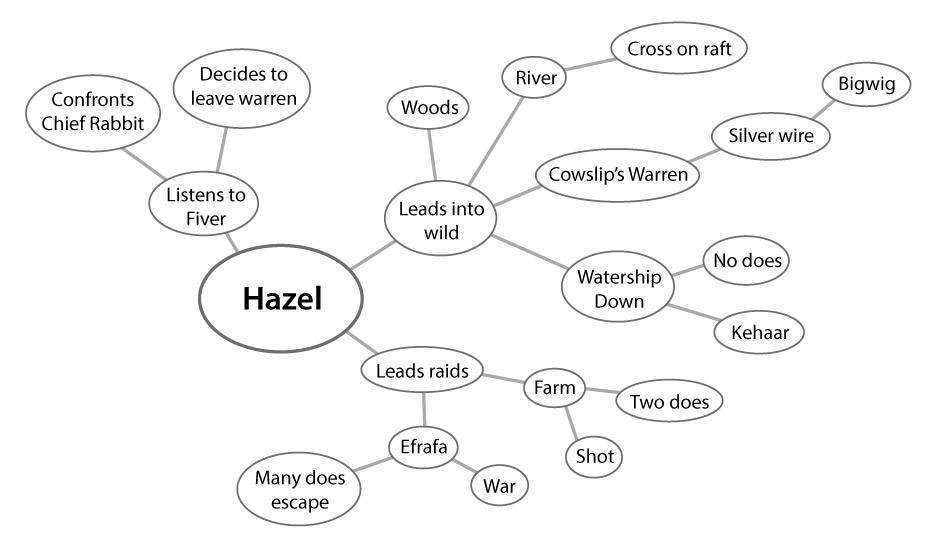
Explore your focus.
Write the focus of your literary analysis in the center of a piece of paper and circle it. Around it, write details from the literature and connect them to the focus. Gather as many connections as you can.
Teaching Tip
Clusters allow students to create a nonlinear, networked set of ideas. Instead of organizing their thoughts in a time line or outline, they can create an interconnected web of associations. Thinking in this diverse way helps students discover themes hidden within interrelated elements of literature.
Prewriting to Create a Thesis Statement
After gathering evidence about your focus(s), you should write a working thesis statement to focus your thinking. The thesis statement should name the focus of your essay and then provide an important insight or feeling about it.
Write a thesis statement.
Write down the focus of your analysis and an interesting thought or feeling about it. Then combine both into a single sentence that expresses your thesis.
Focus(es) |
+ |
Thought or Feeling |
= |
Thesis Statement |
|
Hazel |
shows how someone can become a great leader |
Hazel shows how an individual with the right vision, grit, and courage can save a whole group and become a great leader. |